Vivre à l’étranger ne suspend ni les obligations familiales ni les effets du droit marocain. Pour un Marocain résidant à l’étranger, un mariage célébré hors du Royaume, un divorce prononcé à l’étranger, une succession ouverte au Maroc ou un litige sur la garde d’un enfant restent soumis au Code de la famille, qui s’applique aux Marocains même lorsqu’ils possèdent une autre nationalité, ainsi qu’aux relations impliquant au moins une personne marocaine. Dans ce contexte, l’assistance d’un avocat famille MRE Maroc n’est pas un simple confort : c’est un véritable levier de sécurité juridique pour agir à distance, éviter les blocages administrative and preserve its rights patrimonial, parental and inheritance.
Le Code de la famille a d’ailleurs été diffusé en tenant compte des besoins spécifiques de la communauté marocaine résidant à l’étranger. Il prévoit expressément des mécanismes adaptés : enregistrement du mariage conclu à l’étranger auprès des services consulaires, représentation par procuration dans certaines hypothèses, et exécution au Maroc de jugements étrangers après exequatur. En pratique, la difficulté ne réside pas seulement dans la connaissance de la règle, mais dans son articulation correcte avec l’état civil marocain, le consulat, les juridictions de la famille, les adoul, le parquet et parfois d’autres héritiers ou le conjoint. C’est précisément là qu’un avocat famille MRE Maroc devient la solution opérationnelle : il pilote la procédure, constitue un dossier conforme, anticipe les objections et empêche qu’une situation familiale simple à l’étranger se transforme en contentieux complexe au Maroc.
The transcription of a foreign divorce in Morocco
Why is the transcription-is it indispensable ?
The Family Code strictly regulates the effects of the dissolution of marriage and organizes the updating of civil status records, notably by transmitting extracts to civil registrars or, when one of the spouses was not born in Morocco, to the King's Prosecutor at the Court of First Instance in Rabat. A foreign divorce that is not properly recorded in the Moroccan registers exposes the individual to serious legal inconsistencies: outdated civil status, difficulties in remarriage, disputes over the status of spouse or ex-spouse, and blockages in property or inheritance matters.
En d’autres termes, la transcription du divorce étranger au Maroc n’est pas une formalité secondaire. Elle aligne la réalité familiale vécue à l’étranger avec les registres marocains, prévient les conflits futurs et empêche qu’un ancien lien matrimonial continue à produire des effets administratifs ou sociaux au Maroc.
The administrative procedure and the role of the consulate
The text stipulates that, for marriages contracted abroad under local law, a copy of the marriage certificate must be filed with the Moroccan consular services within three months, and then forwarded to the civil registrar and the competent family court. This approach highlights the consulate's central role as the point of entry for documentation related to the family life of Moroccans residing abroad (MREs), even though legal regularization in Morocco may subsequently become necessary depending on the nature of the foreign document or judgment.
In a foreign divorce case, a thorough approach involves preparing a comprehensive package: the foreign judgment, proof of its finality, identity documents, marriage certificate, birth certificates, a usable translation if necessary, and a strategy for regularization in Morocco. It is at this stage that the lawyer's role becomes crucial: they verify whether a simple administrative update is sufficient or if an exequatur procedure for the foreign judgment must first be initiated to make the decision enforceable and binding in the Kingdom.
Delays and pitfalls to avoid
Le premier piège consiste à croire qu’un divorce étranger produit automatiquement tous ses effets au Maroc. Le Code précise au contraire que les jugements de divorce rendus par des juridictions étrangères ne sont exécutoires qu’après satisfaction des procédures d’exequatur, conformément aux règles de procédure civile. Le second écueil réside dans la présentation d’un dossier incomplet ou incohérent : noms, dates, adresses ou références d’actes qui divergent entre les documents étrangers et les pièces marocaines.
Another common risk concerns Moroccans residing abroad (MREs) born outside Morocco, for whom the transmission process does not always follow the logic of their place of birth but rather that of Rabat and the competent King's Prosecutor. Finally, the later the file is filed, the more difficult it becomes to reconstruct, especially if a remarriage, birth, death, or inheritance has occurred in the interim.
The role of exequatur in family court judgments
Legal definition
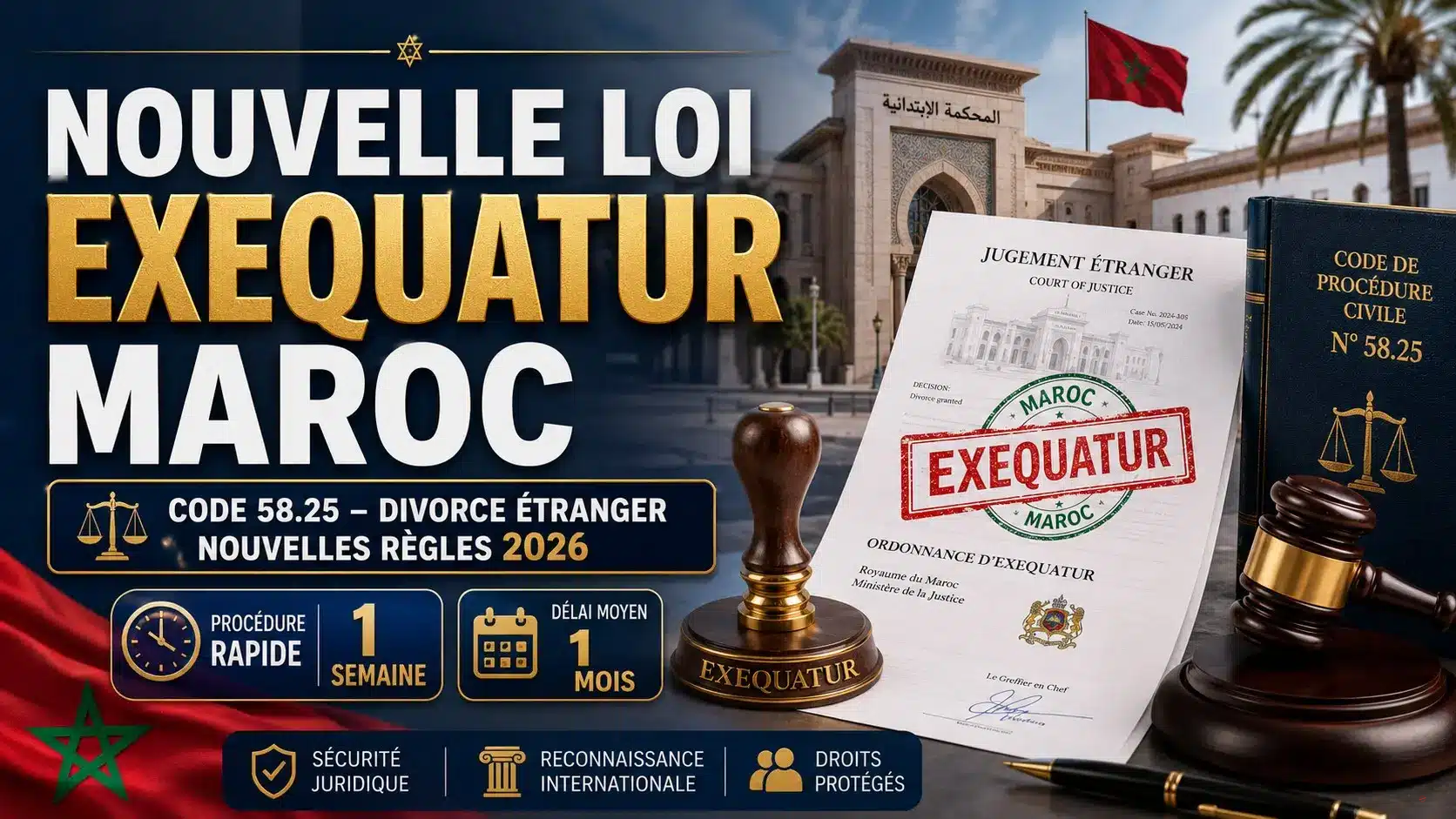
Exequatur is the procedure that allows a judgment rendered abroad to be recognized in Morocco as enforceable. Family Code expressly states that foreign judgments relating to divorce and acts concluded abroad before competent public officers or officials are enforceable in Morocco only after completion of the exequatur procedures provided for in Articles 430, 431 and 432 of the Code of Civil Procedure.
En termes simples, l’exequatur transforme une décision étrangère valable dans son pays d’origine en décision exploitable devant les autorités marocaines. Sans cette étape, le jugement reste juridiquement impuissant au Maroc, notamment pour la mise à jour de l’état civil, l’exécution patrimoniale ou l’opposabilité à des tiers.
Substantive and procedural conditions
Le Code impose que le jugement étranger provienne d’une juridiction compétente et repose sur des motifs compatibles avec ceux prévus par le Code de la famille pour la dissolution du mariage. Cette exigence implique un contrôle de compatibilité avec l’ordre juridique marocain : procédure respectée, droits de la défense garantis, motif de dissolution conforme, absence de contrariété aux principes essentiels du Moroccan law.
A well-prepared case therefore requires the submission of clear documents demonstrating the jurisdiction of the foreign court, the notification or appearance of the parties, the enforceability of the decision, and its consistency with the dissolution mechanisms permitted by the Moroccan Code. An experienced lawyer knows how to identify potential weaknesses in a foreign decision and construct the arguments that reassure the Moroccan judge of the validity of the judgment.
Proceedings before the court of first instance
The enforcement application is brought before the court. Moroccan competent to obtain a decision making the foreign judgment enforceable in Morocco. The Code explicitly refers to the formalities of the Code of Civil Procedure and confirms that this step is mandatory to make foreign divorce judgments and family law documents effective.
Therefore, enforcement should never be treated as a mere procedural formality: it is a technical legal matter where the quality of the application, the consistency of the annexes, and the mastery of the Family Law Moroccans often distinguish between a smooth procedure and months of delay.
Managing a family dispute in Morocco by proxy
Special power of attorney: validity and drafting
The Family Code authorizes, in matters of marriage, a power of attorney granted with the authorization of the family judge, provided that:
- the principal being prevented from appearing in person,
- the mandate, whether authentic or a private agreement with a legalized signature,
- the agent must be of legal age and capable.
- The power of attorney indicates the identity of the other party, the amount of the sadaq, and the desired conditions.
The text specifies that the power of attorney must be approved by the judge after verification of its compliance. Each family dispute has its own specific requirements; therefore, the special power of attorney is not a generic document. It must be legally calibrated, precise in its purpose, and drafted in such a way as to cover exactly the actions to be performed, otherwise it becomes a source of nullity or obstruction.
Documents most often required
- Copy of the principal's identity document,
- Full contact details of the agent,
- Detailed purpose of the mandate,
- Legalized signature
- References to the relevant documents (marriage, divorce, civil status or inheritance),
- Supporting documents to enable the agent and the lawyer to act effectively.
Is long-distance divorce possible for Moroccans living abroad (MRE) in Morocco?
Yes, the Long-distance divorce is legally While conceivable, it never means the complete absence of proceedings. The Code stipulates that all divorce petitions must be filed with the court, accompanied by the spouses' identities, information about the children, and supporting documents relating to their financial situation. The judge then arranges a conciliation hearing.
If conciliation fails, the court sets the amount to be deposited for the rights owed to the wife and children (remainder of the sadaq, widow's pension, consolation gift, housing, Alimony). The long-distance divorce It therefore becomes possible when the case is rigorously prepared, the representation is properly organized, and financial and parental rights are anticipated, and not improvised.
Representation by a lawyer
The real challenge for a Moroccan living abroad (MRE) is not simply to be represented, but to be protected. The Family Code provides mechanisms for mediation, evidence gathering, deposit of funds, child custody and housing, and the transmission of information to the civil registry, all of which require constant procedural monitoring. Legal representation centralizes these steps, reduces travel, ensures the security of notifications, and defends the client's interests before the Moroccan family court.
For sensitive cases, the lawyer also acts as a strategic filter: he assesses whether to initiate a divorce under judicial supervision, a divorce for harm, absence or lack of maintenance, or a separate procedure relating to custody, alimony or the enforcement of a foreign judgment.
Inheritance in Morocco: Specifics for Moroccans Living Abroad
Establishing the deed of inheritance remotely
Book VI of the Family Code details the devolution, liquidation, and division of the estate. After the court examines the inventory, the estate is liquidated under its supervision; the liquidator carries out management tasks, represents the estate in court, and collects debts.
For a Moroccan living abroad, a serious inheritance case goes far beyond simply requesting a routine document (iraka). It requires considering the inventory, debts, receivables, representation of the estate, real estate, bank accounts, and any absent or disagreeing heirs. Legal assistance then becomes essential to transform a stalled inheritance process into a structured procedure that can be managed from abroad.
Real estate and bank accounts after death
The Code stipulates that the liquidator may engage experts to assess the assets and may only pay outstanding debts after authorization from the guardianship judge and approval from the heirs. Disputed debts are settled only after a final judgment. The division of assets is not contingent upon the recovery of all debts, but it may be suspended to the extent of the outstanding debt until the litigation is resolved.
These rules have a major practical consequence for Moroccans residing abroad (MREs): selling property, unfreezing an account, or distributing an inheritance without a comprehensive overview exposes them to serious disputes. A coordinated legal strategy makes it possible to distinguish between urgent matters, undisputed debts, contested claims, and necessary protective measures.
Disputes between heirs from abroad
Inheritances involving Moroccans residing abroad (MREs) often become contentious when some heirs already occupy the property, hold the documents, manage the rents, or claim to have financed renovations themselves. The Code stipulates that estate settlement is conducted under judicial supervision and may involve management, inventory, and expert appraisal. Legal RepresentationAn heir residing abroad is therefore not condemned to suffer: he can act through a power of attorney and lawyer to assert his rights, obtain the accounts, challenge a de facto appropriation and demand an equitable share.
At this stage, the lawyer's role is not solely contentious; it is also preventative. Well-conducted legal mediation between heirs can prevent the family estate from becoming paralyzed and years of litigation from ensnaring it.
Conclusion
For Moroccans residing abroad, the real danger is not only family conflict, but the poor coordination between foreign law, Moroccan formalities, civil status, family court, and documentary evidence. The Family Code offers concrete tools: registration of documents established abroad, divorce proceedings under judicial supervisionexequatur of foreign judgments, special powers of attorney, estate settlement under court supervision. But these tools require rigorous implementation.
C’est pourquoi l’accompagnement par un avocat famille MRE Maroc permet de sécuriser vos droits sans retour immédiat au pays, de réduire les risques de blocage et de traiter à distance des dossiers sensibles comme le divorce à distance, la transcription d’un divorce étranger ou une succession familiale complexe. Prenez rendez‑vous pour une Legal consultation online or request a quote to quickly initiate your regularization, divorce, or exequatur procedure in Morocco
FAQ MRE
How can I get a divorce in Morocco without leaving my country of residence?
Divorce proceedings are initiated by the competent court, with a petition containing the spouses' identities, information about the children, and details of the financial situation, followed by an attempt at reconciliation. If reconciliation fails, the court determines the rights and entitlements due to the wife and children, which the husband must deposit before the divorce decree is finalized by the adoul (notary). A Moroccan living abroad (MRE) can manage their case remotely through a mandate and legal assistance, provided they properly prepare the documents, the procedural strategy, and address financial and parental issues.
What is the average cost of an exequatur procedure?
The text does not provide any specific fees or official rates. The actual cost depends on the complexity of the case, the number of documents to be processed, the translations required, the nature of the foreign judgment, and the potential level of opposition from the other party.
Is my foreign marriage certificate automatically recognized in Morocco?
The Code stipulates that Moroccans residing abroad may marry according to local formalities, provided they comply with substantive Moroccan requirements (consent, legal capacity, absence of impediments, and two Muslim witnesses). A copy of the marriage certificate must be filed with the consular services within three months of the ceremony and then forwarded to the competent Moroccan authorities. Therefore, practical recognition requires adherence to the registration process and compliance with the requirements of the Family Code.
How to hire a family lawyer for Moroccans residing abroad (MRE)?
The Moroccan family law Representation and special powers of attorney are accepted when the legal requirements are met: precision, form, and authentication or legalization as appropriate. In practice, the Moroccan residing abroad (MRE) must prepare a clear mandate, along with their identification documents and all relevant case files, so that the lawyer can act effectively before the family court, the civil registry, the notaries (adoul), or the relevant government agencies. The more precise the mandate and the more complete the file, the faster, more secure, and more efficient the remote process becomes.