Depuis l’entrée en vigueur du Code de la famille en 2004, le droit marocain a connu une profonde mutation : équilibre, équité, responsabilité partagée des époux et protection de l’enfant sont désormais les piliers du régime matrimonial. Dans ce cadre, le divorce amiable s’est imposé comme la voie la plus pragmatique pour mettre fin à une union lorsque les deux parties sont d’accord, tout en respectant la Moudawana et sous contrôle judiciaire.
The principle of divorce by mutual consent
Prévu à l’article 114 du Family Code, le divorce par consentement mutuel autorise les époux à s’accorder sur la rupture, avec ou sans conditions, à condition que celles‑ci ne contredisent pas le Code ni ne portent préjudice aux intérêts des enfants. Cette procédure, aujourd’hui privilégiée, limite les affrontements, préserve la dignité familiale et, dans de nombreux cas, se révèle plus fluide que les procédures contentieuses fondées sur le Chiqaq ou d’autres causes de divorce judiciaire.
In this article, I detail in a precise and accessible way the advantages of amicable divorce, the conditions to be met, the drafting of the agreement, the procedure before the court, the deadlines, the costs, the question of the divorce certificate and the post-judgment formalities, based exclusively on the Moudawana.
The advantages
The main advantage of an amicable divorce lies in its cooperative approach: the spouses do not ask the judge to resolve a dispute, but rather to acknowledge an agreement that complies with the law and is in the best interests of the child. In Chiqaq cases, the court must investigate the causes of the conflict, attempt to reconcile the parties, and, if this fails, rule on responsibilities and rights, a process that can take up to six months.
In practice, an amicable agreement offers a faster, more predictable, and less emotionally draining process than a contested divorce. It also protects family privacy, as spouses avoid airing personal grievances, verbal abuse, or recurring arguments before a judge.
Pour les enfants, le bénéfice psychologique est considérable : tant que les parents conservent un minimum de dialogue, le Code, qui place l’intérêt de l’enfant au cœur de la décision, facilite la garde, le logement, la Alimony et l’organisation du droit de visite.
Comparative table
Criteria | Divorce amiable | Divorce for Truth |
Basis of the procedure | Agreement of the spouses | Ongoing conflict |
Level of conflict | Low to moderate | Often high |
Role of the judge | Monitoring the agreement, attempting reconciliation | Conciliation, investigation, possible arbitration, judgment |
Time limit | Often shorter | Up to 6 months |
Impact familial | Less aggressive | More psychologically taxing |
Eligibility requirements
La base juridique du divorce par consentement mutuel est claire : les deux époux peuvent décider conjointement de mettre fin à leur union, avec ou sans conditions licites. Aucun consentement extorqué, vague ou contradictoire ne doit exister.
The agreement must cover not only the principle of divorce, but also its essential effects (children, assets). The more comprehensive the agreement, the smoother the legal proceedings will be, as the judge must verify that the provisions do not infringe upon the interests of the children or the mandatory requirements of the Family Code (Moudawana).
Question fréquente : peut‑on divorcer sans juge au Maroc ?
Answer No. The Code imposes mandatory judicial review: the application is presented to the court, the written agreement is submitted, the judge first attempts conciliation, then authorizes the divorce if conciliation fails.
The divorce agreement
The amicable agreement must be formalized in a written document attached to the petition. This document, often referred to as the "document establishing said agreement," constitutes the divorce agreement. It must:
- Clearly identify the spouses and the marriage details.
- To express the shared desire to end the relationship.
- To settle the consequences for the children, finances and, where applicable, assets acquired during the marriage.
Guarding and visiting
The Code places the child's best interests at its core. Custody is, by default, awarded to the mother, then to the father, then to the maternal grandmother, unless the court decides otherwise. The agreement must specify:
- The person in charge of custody.
- The child's place of residence.
- The organization of visitation rights (times, places, handing over and return procedures).
- Provisions for holidays, celebrations and exceptional situations.
In the absence of specific details, the judge intervenes to set the terms in order to prevent any abuse.
Nafaka and housing
Child support (Nafaka) must cover food, clothing, medical care, education, and other essential needs, based on the payer's income, the recipient's circumstances, and the cost of living. Providing housing for the child is a separate obligation. Therefore, the agreement must specify:
- The amount of Nafaka for each child.
- Tuition and health fees.
- The accommodation or the amount of rent.
- Payment terms (frequency, guarantees).
Regarding the wife, the Code stipulates the remaining Sadaq, the Idda, the consolation gift (Mout'a), and, if applicable, the Idda allowance. Even in an amicable divorce, these points must be addressed rigorously.
Division of assets
Each spouse has their own separate property, but jointly acquired assets may be divided according to a prior agreement or, failing that, according to the provisions of the Civil Code. The agreement must specify:
- The property belonging to each spouse.
- Common property.
- The agreed distribution method.
- Any lawful waiver of certain claims.
Poor drafting can lead to further disputes; therefore, it is recommended to seek the assistance of a legal professional.
Legal proceedings
- Preparation : written agreement between the spouses.
- Deposit : application to the Family Court with the agreement document.
- Conciliation : the judge tries to reconcile the parties (obligation of the Moudawana).
- Authorisation : if conciliation fails, the judge authorizes the divorce proceedings.
- Divorce certificate : two adouls draw up the document under judicial supervision (date, authorization number, identity of the spouses, marriage references, nature of the divorce).
- Civil status formalities : transmission of the extract to the civil registry service for updating of birth certificates.
Duration and costs
Le Code ne fixe pas de délai précis, mais la procédure amiable est généralement plus courte que le Chiqaq, qui peut s’étendre jusqu’à six mois. La rapidité dépend de :
- The court's responsibility.
- The completeness of the file.
- The presence of children.
- The clarity of the agreement.
Costs The Code does not provide for a single price. The following are added:
- Application and processing fees.
- Fees for drawing up the deed by the adouls.
- Lawyer's fees (optional but highly recommended).
- Financial rights due to the wife and children (Sadaq, Idda, Mout'a, Nafaka, etc.).
Turning a conflict into an agreement
A contentious divorce can sometimes lead to an amicable agreement. The law encourages mediation and settlement, even during legal proceedings. When the dispute is limited to the practical details (custody, visitation, Nafaka, division of assets), negotiation guided by a lawyer can save time, reduce tension, and avoid an emotionally draining court case.
The divorce decree
L’acte, dressé par deux adouls après autorisation du tribunal, n’est pas un simple document privé ; il comporte des mentions obligatoires. Il doit être remis à l’épouse dans les quinze jours suivant sa rédaction, tandis que l’ex‑époux peut en obtenir une copie. Le tribunal transmet également un extrait à l’officier d’état civil afin de mettre à jour les mentions sur les actes de naissance. Cette étape garantit la sécurité juridique et facilite la mise à jour des pièces d’identité, passeports, etc.
Conclusion
Le divorce amiable constitue, en Moroccan law, la voie la plus équilibrée lorsqu’un couple souhaite se séparer sans déclencher une guerre judiciaire. Il combine rapidité, sécurité juridique et protection de l’enfant, tout en maintenant le contrôle indispensable du tribunal pour garantir la conformité à la Moudawana.
La clé du succès réside dans la qualité de la préparation : un accord clair, complet et juridiquement rédigé évite retards, rejets et litiges post‑divorce. Avant de déposer votre dossier, faites relire ou rédiger votre convention par un expert en Family Law afin de sécuriser chaque clause (garde, Nafaka, logement, biens, acte de divorce).
FAQ
The woman loses- What are her rights in the event of an amicable divorce? ?
No. The Code does not eliminate any rights of the wife. On the contrary, the agreement must remain in accordance with the provisions relating to Sadaq, Idda, Mut'a and the rights of children, under the supervision of the judge.
A lawyer is- Is it mandatory? ?
La loi n’exige pas la présence from a lawyer, mais son accompagnement est fortement recommandé pour rédiger une convention solide et acceptable par le juge.
Can-on divorce to the'amicable if l'one of the spouses lives to the'stranger ?
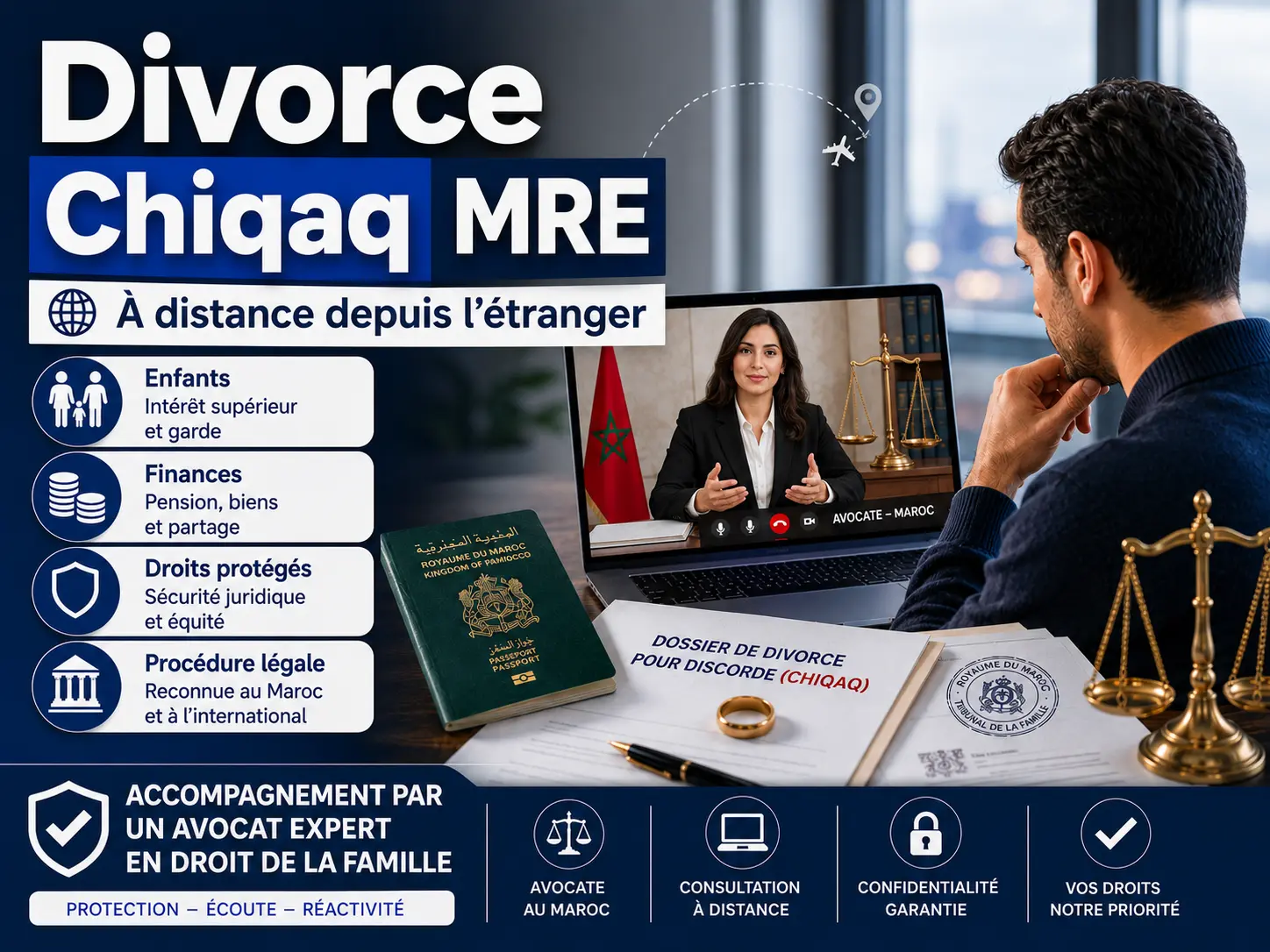
Yes, the Code applies to Moroccans, whether they reside in Morocco or abroad, subject to compliance with the judicial and documentary formalities provided for by the Moudawana.