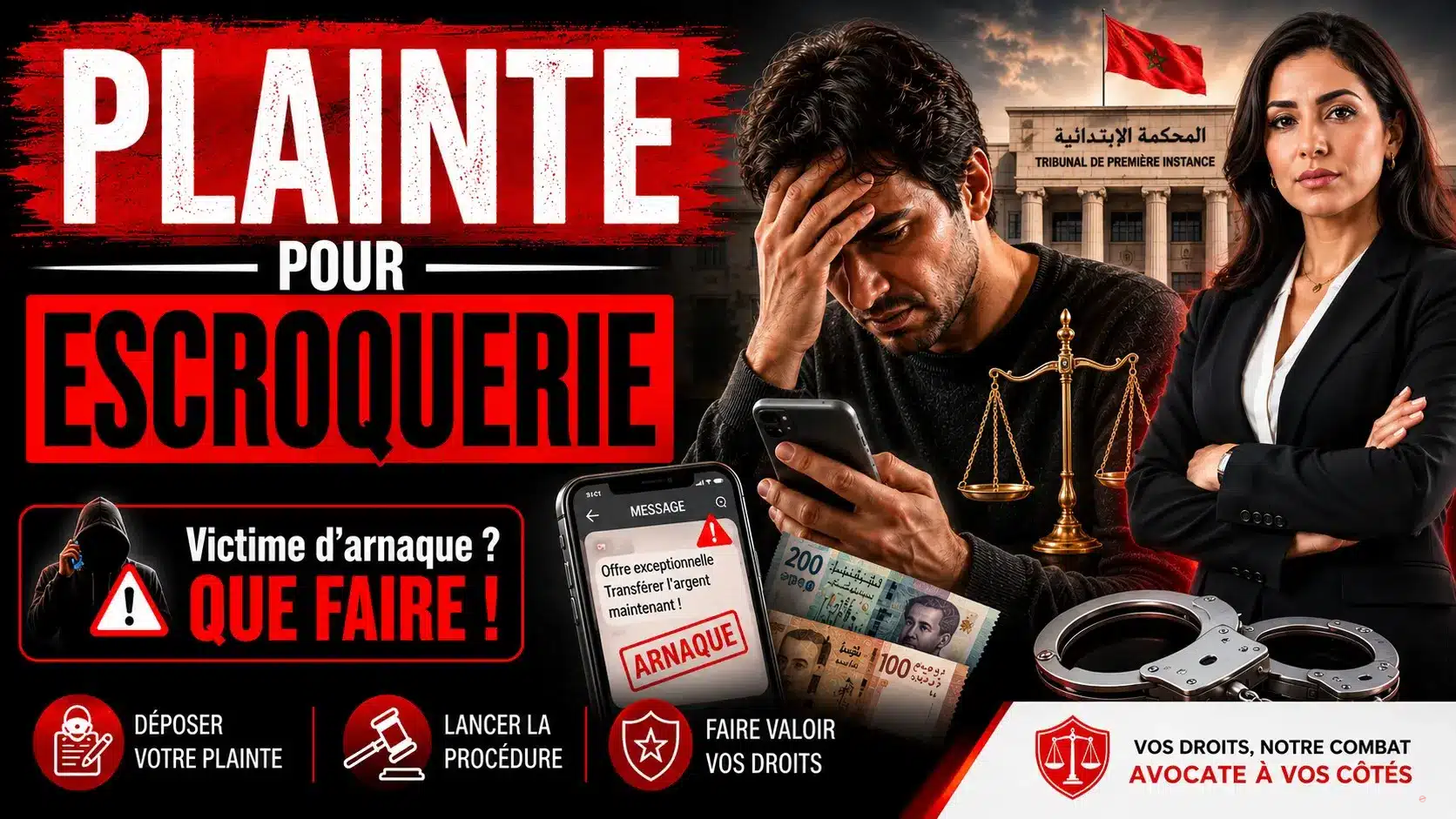
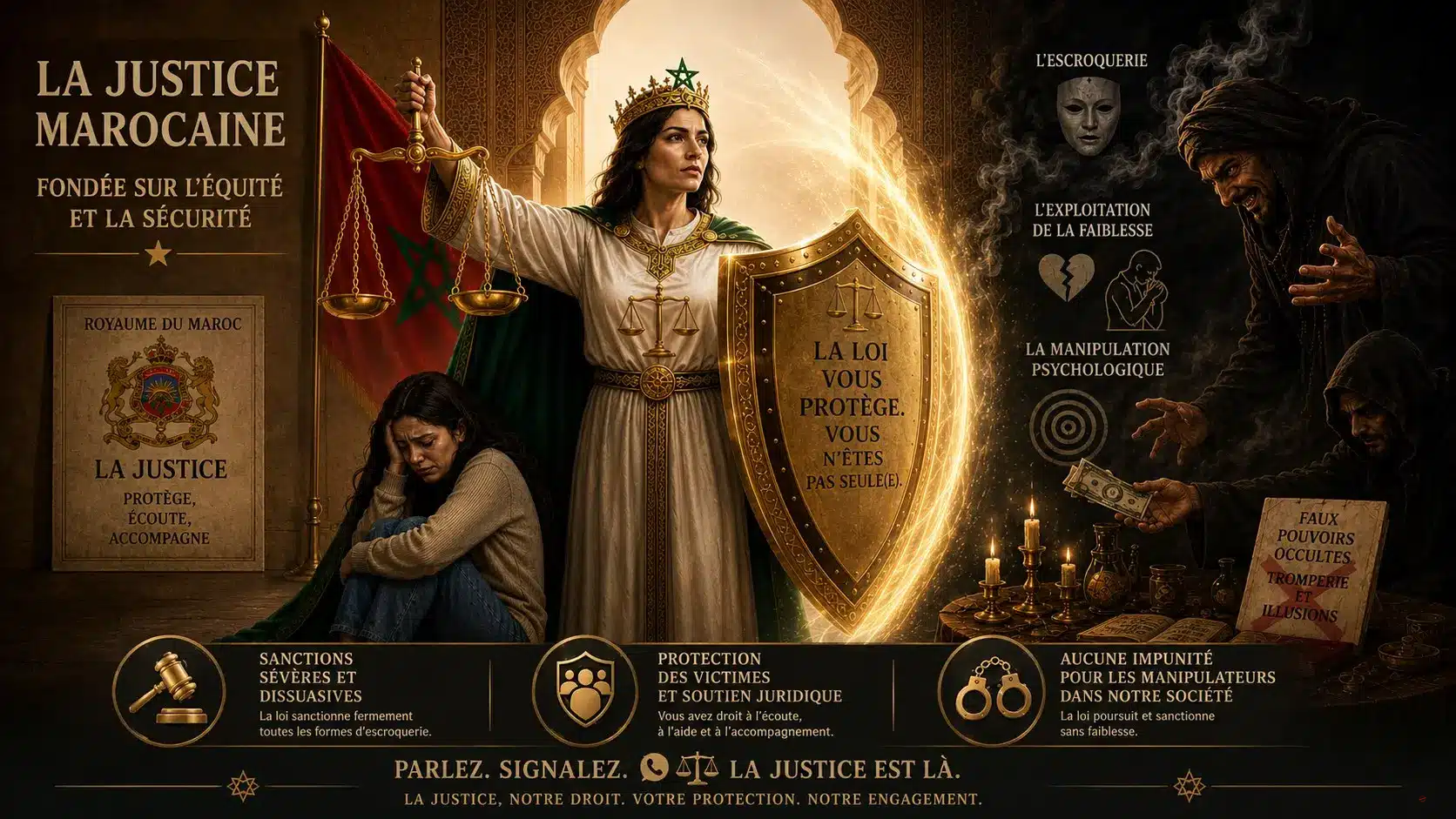
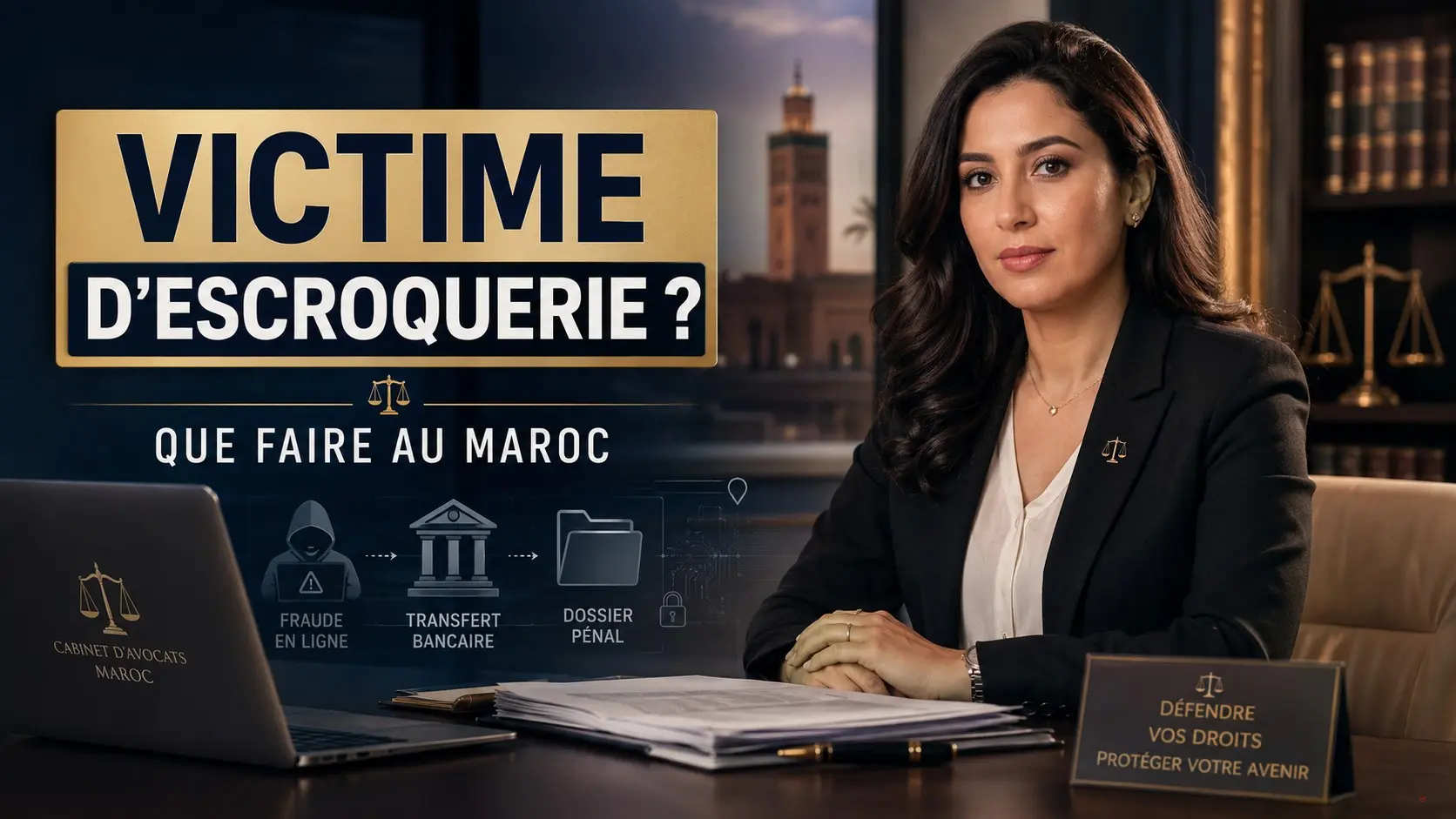
Falling victim to a witchcraft scam is neither a weakness nor a shameful failing. In everyday practice, this type of crime relies on sophisticated mechanisms of psychological manipulation, false promises, and intense financial pressure. These acts specifically target people made vulnerable by life circumstances: fear of the future, unexplained illness, family difficulties, emotional conflicts, or the desperate hope of resolving a seemingly hopeless situation.
Au Maroc, le droit pénal ne se limite pas à protéger les citoyens contre les fraudes commerciales classiques ou les escroqueries bancaires. Il déploie un arsenal juridique robuste pour poursuivre et condamner les auteurs qui exploitent les croyances, la détresse émotionnelle ou la vulnérabilité d’autrui dans le seul but de soutirer de l’argent ou des biens.
“In my office, I see victims every week who don’t dare tell their own families about what they’ve endured. Shame is the con artist’s best ally. My first role as a lawyer is to absolve the victim of guilt, to restore their dignity, before building an implacable criminal case to bring them justice.”
— Maître Amal Anouide, Avocate pénaliste (+13 ans d’expérience)
What constitutes witchcraft fraud under Moroccan law?
La confusion est fréquente : la justice ne juge pas la croyance en elle-même, mais l’acte de manipulation à des fins d’enrichissement. En Moroccan law, l’important n’est pas de savoir si une personne se présente sous l’étiquette de « guérisseur », « fqih », « raqi », « cheikh spirituel », ou encore comme un simple vendeur d’herbes et de produits traditionnels.
The real legal question is this: Did this person use deceitful methods and staged events to induce the victim to hand over money, jewelry, or valuables?
Article 540 of the Penal Code: The legal shield for victims
This classification as fraud is based on Article 540 of the Moroccan Penal Code. This text punishes fraud with one to five years of imprisonment and a fine when the perpetrator employs fraudulent maneuvers, claims false credentials, or uses deceptive means to induce a person to hand over property.
In cases of quackery, the swindler constructs an elaborate scenario (the "staging" in the legal sense):
- Spiritual intimidation (threats of misfortune if the ritual is not paid for).
- Pseudo-religious or occult discourse to establish one's authority.
- Use of persuasive accessories: talismans, Quranic water, incense, amulets.
- Repeated and evolving requests for payments (claiming that the "blockage" is stronger than expected).
Key points to remember: Moroccan law does not penalize mere private or religious belief. It penalizes the fraudulent exploitation of that belief to impoverish the victim.
Moroccan jurisprudence: A strong signal against quackery
Pour dissiper les doutes sur l’application de la loi, la Moroccan Justice a posé des jalons stricts. L’arrêt de la Cour de cassation n° 878/12 rendu le 31/05/2023 (dossier correctionnel n° 19742/6/12/2022) constitue un précédent majeur et une victoire pour la sécurité juridique des victimes.
The context of the ruling
In this emblematic case, the defendant, convicted in the first instance of fraud, attempted to exonerate himself by claiming he was merely a simple herbalist (plant seller). He maintained that selling a bottle of water for 100 dirhams was simply a commercial transaction, attempting to conceal the occult dimension beneath a purely commercial veneer.
The Court of Cassation's unwavering decision
The highest court rejected this argument. Based on the investigations conducted by the judicial police, the defendant's partial confession, and telephone recordings, the Court confirmed that:
- The reality of actions takes precedence over appearances: Claiming to cure occult ailments (evil eye, witchcraft) for a fee is indeed a false claim of healing.
- The exploitation of error is characterized by: Selling Quranic water or talismans with the promise of a supernatural result in exchange for money characterizes fraudulent maneuvers.
- The offense of fraud is established: The ultimate goal was illegitimate enrichment at the expense of the victims' assets.
How to prove witchcraft fraud? Expert advice
The main difficulty in these cases lies in the administration of evidence. Under the influence of fear or shame, victims often delete compromising messages or pay large sums of cash without demanding receipts.
Master Amal Anouide souligne : « Même si vous pensez avoir tout supprimé, l’empreinte numérique et la chronologie des événements laissent toujours des traces exploitables par un avocat pénaliste averti. »
1. The Material Element
The "staging" must be demonstrated. Gather:
- Digital traces: WhatsApp screenshots, SMS messages, recorded voice notes.
- Financial traces: Transfer receipts (Wafacash, Western Union, bank transfers).
- Evidence: Talismans, powders, bottles of water, padlocks handed over by the con artist.
- Testimonials: Relatives or other identified victims.
2. The Intentional Element
It must be proven that the author acted in bad faith:
- Exponential increase in funding requests.
- Constantly changing excuses to justify the lack of results.
- Direct or indirect threats (“if you don’t pay, fate will turn against you”).
- Serial modus operandi (multiple victims targeted with the same method).
The 6 most common scam scenarios in Morocco
L’expertise du cabinet de Maître Anouide a permis de cartographier les modes opératoires les plus courants :
- The extraction of hidden treasures (Kanz): The con artist asks for money to buy overpriced incense (e.g., Bkhour Loubane Dakar) supposed to "appease the djinns" guarding the treasure.
- The exploitation of the myth of "Zohri the child": An aggravated and dangerous form of manipulation targeting children.
- The removal of a curse or the breaking of a blockage: A promise to unlock a marriage, infertility, or a professional career.
- The Return of the Loved One (Jalb Al Habib): Very common following painful breakups or divorces.
- The cure of serious illnesses: The con artist claims to cure physical illnesses (sometimes incurable) through spiritual means for which money is charged.
- Money multiplication (Magic wallet): Promise of dazzling hidden enrichment.
Moroccans residing abroad (MRE): How to file a complaint remotely?
The Moroccan diaspora is a prime target. Geographical distance, the perceived disconnect from realities on the ground, and the financial solvency of Moroccans living abroad attract scammers operating via social media.
Many Moroccans living abroad (MREs) give up their rights, believing that the cost of a trip to Morocco will be greater than the amount lost. That's a mistake. Legal, paperless solutions exist.
1. Electronic referral via the Public Prosecutor's Office
Moroccan authorities have modernized their services. A Moroccan living abroad (MRE) can file a report through the electronic platforms of the Public Prosecutor's Office (e-chikaya). It is crucial to include: a clear narrative account, proof of international money transfers, and the Moroccan phone numbers used by the perpetrator.
2. Attorney-at-law power of attorney (The recommended solution)
Pour éviter un aller-retour coûteux et assurer un suivi rigoureux, le MRE peut établir une procuration spéciale (légalisée au consulat du Maroc du pays de résidence) au nom de son lawyer in Morocco.
This approach allows Master Anouide to:
- Déposer plainte directement auprès du Procureur du Roi.
- Represent the victim during preliminary hearings if permitted by law.
- Follow up with the judicial police to ensure that the case is progressing.
- To file a civil suit in order to claim damages.
🚨 Emergency: 5 immediate actions to take if you've just discovered the scam
- Turn off the financial tap: Stop all money transfers instantly, regardless of any mystical threats made by the scammer.
- Save everything: Export your WhatsApp chats, take screenshots of social media profiles before the scammer blocks you.
- Trace the money: Gather your bank statements, Wafacash or Western Union receipts. Carefully note the names of the final beneficiaries (often accomplices).
- Do not threaten the scammer: Do not warn him that you are going to file a complaint, he would destroy the evidence or change his phone number.
- Consult an expert: Prenez rendez-vous (physique ou en visioconférence) avec un avocat pénaliste pour figer la stratégie juridique.
Frequently Asked Questions (FAQ): Your rights explained
I only know the scammer's first name or pseudonym (e.g., "Fqih Soussi"). Can I file a complaint?
Yes, absolutely. The criminal investigation department has advanced investigative tools at its disposal. A simple phone number (even a prepaid one), a receiving bank account, or even the location of a money withdrawal via money order is often enough to requisition the telecom operator or the transfer agency to formally identify the perpetrator or their accomplice.
I paid in cash for home visits, but I don't have a receipt. Is my file empty?
Non. En Criminal Law, la preuve est libre. Si vous n’avez pas de reçu papier, l’infraction peut être prouvée par des faisceaux d’indices : vos échanges vocaux préparant la rencontre, le témoignage de la personne qui vous a accompagné, ou encore la découverte du matériel frauduleux (objets occultes) chez l’auteur lors d’une perquisition.
The scammer claims that I gave him the money of my own free will ("gift" or "Sadaka"). What should I do?
This is the classic defense of charlatans. However, the very definition of fraud (Art. 540) implies that the victim hands over their money voluntarily, but only because they have been deceived. It is the consent vitiated by lies and manipulation that constitutes the crime.
Can I actually recover the money I lost?
Recovering your funds depends on how quickly you act. If the perpetrator is identified and apprehended, you can file a civil suit to demand full reimbursement and damages. In many cases, under legal pressure and the threat of imprisonment, fraudsters or their families offer to return the funds to obtain a partial withdrawal of charges from the victim (which does not, however, stop the prosecution, but may reduce the sentence).
Conclusion: Take back control of your life
Witchcraft scams are a true scourge that drains the wealth of Moroccan households and the diaspora by exploiting their most intimate resources: their pain, their fears, and their hopes. Remaining silent guarantees impunity for these organized networks and allows them to destroy more lives.
Le droit marocain, soutenu par une jurisprudence de la Cour de cassation toujours plus protectrice, vous offre les outils pour contre-attaquer. Avec l’accompagnement stratégique du cabinet de Maître Amal Anouide, vous transformez un traumatisme personnel en un dossier juridique solide. De l’évaluation des preuves numériques jusqu’à la plaidoirie devant le juge, une approche rigoureuse et confidentielle est la clé pour faire valoir vos droits et, surtout, retrouver votre tranquillité d’esprit.
Don't let fear dictate your actions any longer. Justice is on your side.
Request a confidential consultation with Me Anouide
Avertissement légal : Cet article est une publication à vocation informative et de sensibilisation au droit. Il ne saurait remplacer une Legal consultation personnalisée. Chaque affaire étant unique, elle nécessite l’examen minutieux des pièces de votre dossier par un avocat inscrit au Barreau.