The Family Law In Morocco, it is a complex field that requires the expertise of a lawyer qualified. Divorce, child custody and alimony cases are all situations where legal support is essential.
The procedures related to family law can be long and arduous. One specialist lawyer in this area can help you navigate these troubled waters and protect your rights.
With the expertise of a lawyer in Family Law In Morocco, you can ensure that your interests are represented and that your rights are preserved.
Key takeaways
Understanding the system Family law in Morocco requires a thorough analysis of the Moroccan Family Code and its evolution. The Moroccan family law is governed by a set of laws and regulations that have been amended over the years to reflect the social and cultural changes in the country.
The Moroccan Family Code is the Moroccan family code which governs family relations, including marriage, divorce, child custody and Inheritances. This code has undergone several revisions. since his adoption initial in 1957-1958, with significant modifications in 2004 to improve the rights of women and children.
The recent evolution of Moroccan family law is marked by reforms aimed at strengthening human rights and promoting gender equality. These changes reflect an adaptation to contemporary social realities. and a desire to harmonize the Moroccan law with international standards.
The Moroccan family law differs from French law in several aspects, particularly with regard to the rules of marriage, divorce and inheritance. The differences are partly due to historical and cultural foundations of the two legal systems. For example, the Moroccan law is influenced by Sharia law, while French law is based on secular principles.
En résumé, le système juridique familial au Maroc est caractérisé par la Moroccan Family Code and its ongoing evolution. The differences with French law emphasize the importance of understanding the cultural and legal specificities of each country.
In the context of Moroccan family law, the expertise of a specialist lawyer is essential. Divorce, child custody, and alimony proceedings require a thorough understanding of applicable laws and regulations.
And specialist lawyer in Family Law must possess legal skills sharp skills and significant experience in the field. He must be able to navigate the complexities of the Moroccan Family Code, known as Moroccan Family Code.
Lawyers specializing in family law offer a range of services, including:
The specific expertise of a family law attorney is crucial for achieving favorable outcomes in family matters. Their knowledge of laws and procedures allows them to effectively protect their clients' interests.
The procedures of divorce in Morocco are influenced by the Moroccan Family Code, which defines the rules and conditions for divorce.
The law Moroccan woman recognizes several types of divorce, each with its own conditions and implications.
This type of divorce is possible when both spouses agree to the dissolution of the marriage. It is considered the least contentious.
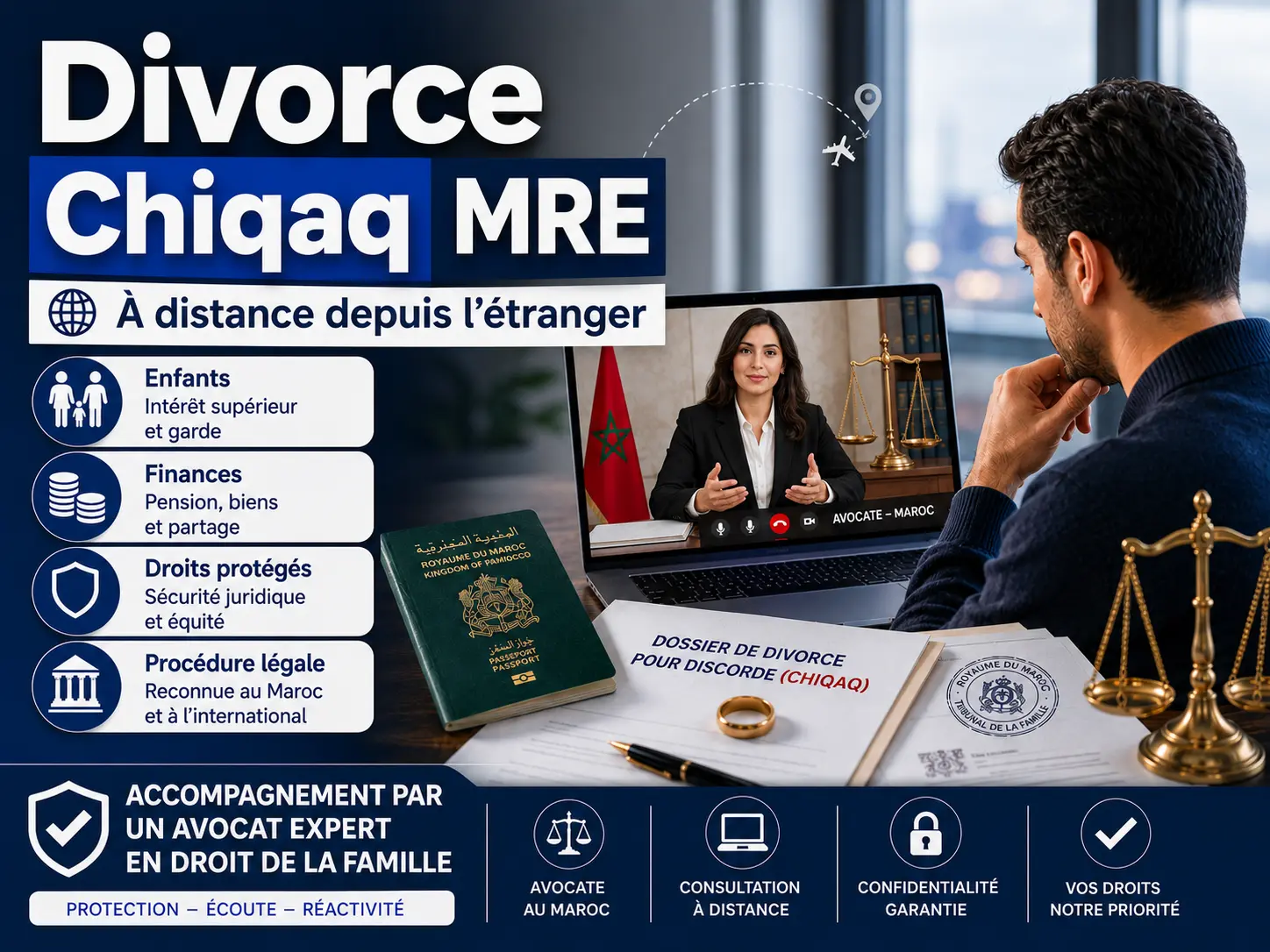
When spouses cannot agree on the reasons for or conditions of divorce, one of them may request a divorce on the grounds of discord.
A Khol' divorce is a procedure where the woman renounces to certain rights to obtain a divorce. This is an option for those who wish to end the marriage without their husband's consent.
The procedure divorce involves several stepsincluding conciliation, filing the divorce petition, and the court hearing.
The timeframes vary depending on the type of divorce and the complexity of the case. Here is a summary table:
Type of divorce | Average delay |
Divorce by mutual consent | 2-6 months |
Divorce for Discord (True) | 6-12 months |
Divorce Khol' | 3-9 months |
It is essential to consult a lawyer specialized to obtain accurate and up-to-date advice on divorce procedures in Morocco.
Child custody after a divorce is a crucial issue that requires careful attention. Parents must navigate a complex legal system to determine what is in the best interests of the child.
In Morocco, the legal criteria Child custody decisions are primarily based on...best interests of the childThe courts take into account various factors, including the child's age and sex, as well as the parents' ability to provide for the child's needs.
The non-custodial parent retains important rights, in particular the visitation rights and communication with the child. He is also required to contribute financially to the child's upkeep.
Custody decisions can be modified if circumstances change significantly. Parents must demonstrate that the modification is in the best interests of the child.
The international movement of children is governed by strict rules. Parents must obtain court authorization or the agreement of the other parent to move the child abroad.
Determining child support is a complex process requiring legal expertise. In Morocco, child support is governed by specific rules that take into account the needs of the child or former spouse and the financial means of the payer.
The calculation Child support payments are based on several criteria, including the paying parent's income, the needs of the child or former spouse, and the costs of schooling, healthcare, and other necessary expenses. A specialized lawyer can help assess these factors to determine a fair amount of support.
Once the child support amount has been set by the judge, it is essential to understand the enforcement proceduresThis can include measures such as wage garnishment or asset seizure. A lawyer can guide the creditor in these proceedings.
Procedure | Description | Benefits |
Wage garnishment | Direct deduction from the debtor's salary | Efficient and quick |
Seizure of assets | Seizure of the debtor's assets for payment | Allows you to recover the amounts owed |
In the event of non-payment, the creditor can take legal action. This can range from initiating legal proceedings to pursuing criminal penalties against the defaulting debtor.
When one of the former spouses resides abroad, the recovery of alimony can become more complex. International conventions, such as the Hague Convention, facilitate these procedures.
In summary, child support in Morocco is an area that requires a thorough understanding of the laws and procedures. The assistance of a lawyer specializing in family law is essential to navigate these issues effectively.
The choice of a lawyer specializing in family law in Morocco This proves to be a crucial step in resolving your family matters. A competent lawyer can make a significant difference in the outcome of your case.
When choosing a lawyer, several criteria must be considered. It is essential to verify their experience in family law, particularly in cases of divorce, child custody, and alimony. Knowledge of Moroccan law and its application is paramount.
Another important criterion is the lawyer's reputation. Recommendations from previous clients and reviews can give you an idea of their competence and professionalism.
During your initial meeting with the lawyer, it is crucial to ask the right questions to assess their ability to handle your case. You can ask:
THE fees The lawyer's fees are an important factor in your decision. It is essential to understand how fees are calculated and what payment methods are accepted. Some lawyers charge by the hour, while others offer flat fees.
He is It is recommended to clarify these details from the outset. to avoid any unpleasant surprises.
In cases involving elements of international law, particularly for the binational couplesCollaborating with a French lawyer can be beneficial. It can facilitate coordination between the legal systems of the two countries.
A Moroccan lawyer experienced in cooperating with French colleagues will be better able to manage the complexities related to mixed marriages or to cross-border disputes.
THE binational couples, particularly those involving a French spouse and a Moroccan spouse, must navigate a legal framework complex. The mixed marriages raise specific legal questions related to nationality, family law, and international implications.
Marriage between a French citizen and a Moroccan citizen is subject to specific rules. It is essential to understand the laws of both countries to anticipate the legal implications.
Couples must ensure that their marriage is recognized in both countries. This involves fulfilling certain conditions. and to follow procedures specific.
THE binational couples may encounter difficulties related to the difference in legislation between France and Morocco, particularly regarding divorce, child custody, and inheritance.
The recognition of judgments rendered in one country by the other is crucial. Couples must understand the international conventions in force between France and Morocco.
Bilateral agreements exist between France and Morocco that facilitate the mutual recognition of judgments and legal acts. These agreements are essential for binational couples.
Legal Aspect | France | Morocco |
Marriage Conditions | Consent of the spouses, minimum age | Consent of the spouses, guardian for the bride |
Divorce | Divorce by mutual consent or for fault | Divorce according to the Moudawana, with certain specificities |
Childcare | Best interests of the child | Usually entrusted to the mother, with exceptions |
The filiation and adoption are crucial aspects of family law in MoroccoThese issues are governed by specific laws that have evolved over time to adapt to the needs of Moroccan society.
The establishment of the filiation In Morocco, legal recognition of a child by their parents is generally established. This recognition can occur at birth or later, through a notarial act or a declaration before the civil registrar. Moroccan law also recognizes the filiation adoption under certain conditions.
In Morocco, adoption is prohibited by law, but the Kafala is recognized as an alternative. The Kafala This is an institution that allows a family to take in an abandoned or orphaned child, offering them protection and education without establishing a legal parent-child relationship. Those wishing to take in a child must follow a specific procedure with the relevant authorities.
Children in Morocco, whether born through natural parentage or taken into care by KafalaThey enjoy certain fundamental rights. These rights include access to education, healthcare, and protection against exploitation and abuse.
For French citizens wishing to establish a Kafala or resolve parentage issues in Morocco, it is essential to contact the relevant Moroccan authorities and seek assistance from a lawyer specializing in family law. Procedures vary depending on individual circumstances and require a thorough understanding of the applicable laws.
The Moroccan law governs the Inheritances and inheritance according to specific principles. These rules are primarily derived from Islamic law and are applied differently depending on the circumstances.
THE Inheritances in Morocco are governed by the Moroccan Family CodeThe Moroccan Family Code defines the rules for dividing property among heirs. The fundamental principles include the devolution of property to legal heirs, which include children, the surviving spouse, and other close relatives.
Non-Muslims may be subject to different rules, particularly if they are foreign nationals. International conventions and specific laws may apply, influencing how inheritances are handled.
THE real estate Properties located in Morocco are subject to Moroccan law, regardless of the status or nationality of the owners. This entails specific formalities when transferring these properties, including transfer taxes and cadastral formalities.
A lawyer specializing in family and inheritance law can play a crucial role in resolving inheritance disputes. They can help navigate legal complexities, represent clients in court, and negotiate estate settlements.
They have Morocco, family mediation It offers a new perspective for families in conflict, fostering dialogue and mutual understanding. This approach allows for the amicable and effective resolution of disputes, without resorting to traditional legal channels.
The family mediation presents several benefitsThis includes preserving family relationships, reducing costs and delays, and ensuring the confidentiality of discussions. It also allows the parties to maintain control over the outcome of the conflict.
Mediation is governed by specific rules that guarantee its effectiveness. The process involves the appointment of a neutral and impartial mediator, who facilitates discussions between the parties to reach a mutually acceptable agreement.
The lawyer plays a crucial role in the mediation process by advising and representing the interests of their clients. They can also assist in drafting the mediation agreement.
The agreements resulting from the mediation are recognized by the Moroccan judicial authorities, thus giving them enforceability. This allows for the effective implementation of the agreed terms.
During procedures related to family law in Moroccobenefit from legal support of quality is essential. An experienced family law attorney plays a crucial role in navigating legal complexities, thus ensuring effective representation of their clients' interests.
The expertise of a specialized lawyer allows you to understanding the nuances of Moroccan lawThis expertise is essential, particularly in areas such as divorce, child custody, and alimony. It is indispensable for anticipating and managing the legal challenges that may arise.
By choosing a lawyer who offers a legal support of qualityIndividuals can ensure that their rights are protected and their interests are effectively represented. This contributes to a more peaceful and equitable resolution of family conflicts.

Name of the firm: Amal Anouide Law Firm. She is registered with the Safi Bar Association.