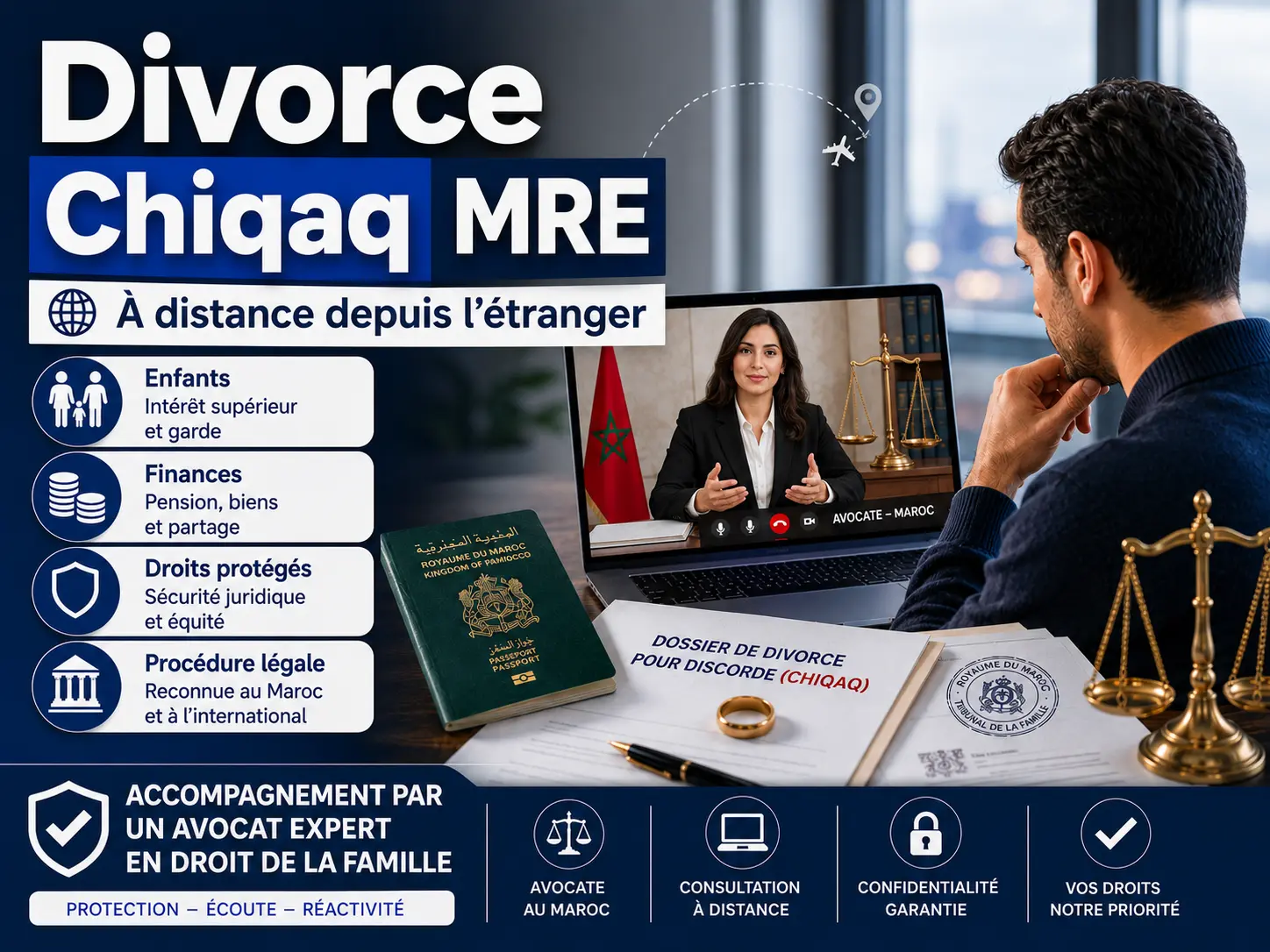
Geographical distance should never prevent the protection of your marital and family rights. However, for Moroccans residing abroad (MREs), initiating a separation from another country can become a real legal ordeal, due to distance, unfamiliarity with applicable rules, and sometimes burdensome administrative formalities.
Pour répondre à ces difficultés, le Family Code marocain prévoit des mécanismes adaptés aux résidents à l’étranger. Cet article vous aide à comprendre en détail le divorce chiqaq Maroc, une procédure de séparation moderne, encadrée et fondée sur la constatation d’une discorde durable entre les époux.
Nous verrons les principes de cette forme de dissolution of marriage, sa mise en œuvre depuis votre pays de résidence, le rôle essentiel de l’avocat, ainsi que la protection des intérêts financiers et des enfants. L’objectif est de vous offrir une vision claire, structurée et rassurante des démarches à entreprendre.
Divorce due to discord (Chiqaq) in the Family Code (Moudawana)
Legal definition and context: what is divorce for discord?
Promulguée par le Dahir n° 1-04-22 du 3 février 2004, la loi n° 70-03 portant Code de la famille, communément appelée Moudawana, a profondément transformé le family law marocain. Avant cette réforme majeure, les procédures de séparation étaient souvent plus rigides et pouvaient placer l’épouse dans une situation de grande vulnérabilité face aux blocages procéduraux.
The legislature thus established divorce on the grounds of discord, called Tatliq li-shiqaq, codified in articles 94 to 97 of the Moudawana. This procedure allows either spouse to request separation when a deep, persistent, and mutual conflict makes the continuation of married life impossible.
A Moroccan "chiqaq" divorce is defined as a judicial separation pronounced by the family court. It does not require the prior consent of the other spouse to be initiated, thus avoiding deadlock situations when one spouse categorically refuses the separation.
The concept of the dissolution of the marital bond and its irrevocable nature
According to Article 70 of the Moudawana (Family Code), the dissolution of marriage remains an exceptional measure, as Moroccan law prioritizes the preservation of the family unit whenever possible. However, when discord is entrenched, forcing the marriage to continue can become detrimental.
Article 122 of the Moudawana establishes a fundamental principle: any divorce pronounced by the court in the context of a dispute due to discord is irrevocable (Bay'in). Unlike a revocable divorce (Rij'ii), which allows the husband to unilaterally take back his wife during the waiting period, a Shiqaq judgment results in the immediate and definitive dissolution of the marital bond upon its pronouncement.
The former spouses may only remarry by entering into a new marriage contract, with the wife's consent and the establishment of a new dowry. Furthermore, Article 128 specifies that the portion of the judgment terminating the marital ties is not subject to appeal, thus securing the civil status of the parties.
What are the grounds for divorce due to discord in Morocco?
L’un des principaux avantages du Chiqaq réside dans sa souplesse concernant les motifs invoqués. Contrairement au divorce pour faute traditionnel, qui exige parfois des preuves difficiles à réunir, les motifs de divorce due to discord in Morocco couvrent toute situation de mésentente profonde et persistante.
The Moudawana recognizes a wide range of situations that can characterize discord, including:
- Repeated verbal or physical arguments, which destroy affection and mutual respect within the couple.
- Excessive interference from the respective families in the daily life or intimacy of the marital home.
- Deep disagreements regarding the education of children, the choice of where to live, or the financial management of the household.
- Emotional neglect or material abandonment of the marital home, making cohabitation impossible.
The petitioning spouse only needs to assert the existence of a persistent dispute before the judge for the procedure to be initiated, without the obligation to list defamatory or particularly detailed grievances.
Specifics of Chiqaq for residents abroad
The specific status of the chiqaq MRE before Moroccan courts
Moroccans residing abroad receive special attention from the Moroccan judicial authorities. Article 2 of the Moudawana is explicit: the provisions of the Code apply to all Moroccans, even those who hold another nationality.
However, the chiqaq MRE is subject to specific rules of territorial jurisdiction. The application must be filed with the family court section of the competent court of first instance.
According to the rules of civil procedure, the competent court may be that of the marital home in Morocco, the wife's home, or, failing that, the place where the marriage contract was executed. For Moroccans residing abroad (MREs) whose marriage has been validated by consular services, specific provisions allow the case to be brought before the courts of Rabat when no domicile is established within the national territory.
How to file for a Chiqaq divorce from abroad?
For the diaspora, the central question is often: how to request a chiqaq divorce from abroad without making multiple costly trips? The answer lies in a specific legal mechanism: the special power of attorney, or Wakala.
Although physical presence remains the rule in principle, Article 400 of the Moudawana serves as a basis for judges to authorize representation by a lawyer in situations of residence abroad.
Here are the main steps to initiate the remote procedure:
- Drafting the special power of attorney: The applicant must go to the Moroccan consulate in their country of residence, or to a local notary with legalization and apostille, to establish an authentic power of attorney. This mandate must clearly name the chosen lawyer in Morocco and specify that they have the authority to initiate the Chiqaq procedure.
- Submission of original documents: The file must contain the original Moroccan marriage certificate, or its consular transcription, copies of identity documents, birth certificates of children and proof of income.
- Referral to the court: The appointed lawyer files the written request with the family law section of the competent court, which officially opens the legal case.
[Demandeur MRE] ➔ Establishes a special power of attorneyspecial at the consulate ➔ Send the original file
↓
[Avocat au Maroc] ➔ Dwives the requestsummer official written form ➔ [Tribunal de la famille]
The attempt at reconciliation from a distance
The conciliation hearing is a mandatory step, required by Articles 82 and 94 of the Family Code (Moudawana). The family court judge cannot grant a divorce without first attempting to reconcile the spouses in chambers. When minor children are involved, the court must even organize two separate conciliation attempts, spaced at least thirty days apart.
For Moroccans residing abroad who are genuinely unable to travel, contemporary judicial practice has adapted. The judge may agree to hear the spouse residing abroad via videoconference or by means of a letter rogatory sent to the Moroccan consulate nearest to their home.
If the other spouse resides in Morocco, they will be summoned to court in person. If reconciliation fails, or if the applicant residing abroad maintains their claim through their lawyer, the judge will draw up a report of non-conciliation and continue examining the case.
Advantages and disadvantages of the Chiqaq procedure from abroad
Initiating a divorce in Morocco from abroad has several advantages, but also some constraints that it is important to anticipate.
The advantages:
- Legal speed: Article 97 requires the court to rule on the dispute action within a maximum period of six months from the filing of the application, making it one of the fastest procedures.
- Legal security: since divorce is pronounced by an irrevocable judgment, it definitively protects spouses against abusive unilateral decisions.
- Financial fairness: the judge assesses compensation taking into account the actual responsibility of each party in the breakup.
The disadvantages:
- Coûts administratifs : mandater un lawyer in Morocco, officialiser les procurations et traduire les documents étrangers peut entraîner des frais non négligeables.
- Complexity of notifications: if the address of the defendant spouse abroad is imprecise, international notification can slow down the effective start of the procedure.
Witnesses, evidence, and the trial proceedings
Filing the application with the family court of first instance
The official process begins with the filing of a written request, signed by the lawyer. It must include the full names, occupations, and addresses of both spouses, as well as the number and ages of any dependent children. This document provides a concise overview of the situation causing the dispute.
It is essential to include the original marriage certificate. Submitting a simple copy is a common mistake that can stall the proceedings from the outset. Once the application is registered with the court registry, a case number is assigned and a reporting judge is appointed to conduct the investigation. The registry then summons the opposing party, either through a court clerk, a bailiff, or via consular channels if they also reside abroad.
The burden of proof and the role of witnesses in Morocco in a context of discord
Even though Shiqaq does not require strict proof of fault for a divorce to be granted, evidence remains important, particularly for assessing damages. Article 100 of the Moudawana specifies that facts constituting harm can be established by all admissible means of proof, including witness testimony.
During private hearings in chambers, the court may hear from family members, neighbors or relatives in order to better understand the origin and seriousness of the disagreement.
For a Moroccan living abroad (MRE), the absence of tangible evidence—such as text messages, medical reports, or bank statements demonstrating a lack of financial support—can complicate the process of assigning blame to the other spouse. If the petitioner fails to provide any concrete evidence but firmly maintains their intention to end the marriage, the judge may grant the divorce while adjusting the financial compensation based on the lack of proof of sole fault.
The stages of the hearings and the usual processing times
The Chiqaq procedure generally follows a structured schedule around several phases:
- Phase 1: Registration of the request and verification of the court's jurisdiction, within approximately 8 to 15 days.
- Phase 2: Mandatory conciliation attempt. The judge hears the parties or their lawyers with special power of attorney. If necessary, the court may appoint two arbitrators, often from the respective families, to attempt mediation.
- Phase 3: Investigation into financial aspects and custody. The judge examines income documentation and may order a social inquiry concerning housing and the best interests of the children.
- Phase 4 : jugement et consignation. Le tribunal rend sa décision en fixant les droits financiers de l’épouse et des enfants. Le conjoint condamné dispose ensuite d’un délai strict pour consigner les sommes au greffe du tribunal.
- Phase 5: Instrumentation. Once the funds are deposited, the judge authorizes two Adouls to officially draw up the divorce document.
Thanks to the framework set by Article 97, all of these steps generally take place within the legal limit of six months.
The assessment of damages and financial compensation
How does the court assess the share of responsibility?
Article 97 of the Moudawana empowers the judge to assess each spouse's responsibility in the emergence and escalation of discord. This assessment directly influences the calculation of compensation for the harm suffered by the injured spouse.
If the investigation shows that the breakdown of the marriage is entirely attributable to the husband's abusive behavior—infidelity, abandonment, violence—the court may increase the amount of damages. Conversely, if it appears that the wife left the marital home without a valid reason or systematically refuses all mediation without justification, her personal compensation may be reduced, without, however, jeopardizing her fundamental rights. In cases of shared fault, the judge will divide the financial burdens related to the separation equally.
Calculating entitlements: Mut'ah, Nafaqah and pension arrears
When pronouncing the divorce, the court determines, both globally and in detail, the amounts owed to the wife, in accordance with Article 84 of the Moudawana:
- The consolation gift (Mout'a): this is a compensatory payment granted to the wife to redress the harm caused by the separation. The judge assesses it according to the length of the marriage, the husband's financial situation, and the degree of abuse observed during the separation.
- La pension de la période de viduité (Nafaqa de l’Idda) : l’épouse a droit à un entretien financier pendant la période d’observation légale, généralement trois mois ou jusqu’à l’accouchement si elle est enceinte. Cette pension comprend la nourriture, l’habillement et les frais de logement.
- The remainder of the dowry (Sadaq): if part of the dowry stipulated in the initial marriage contract has not been paid, it becomes immediately due and payable as a priority debt.
- Arrears in maintenance: if the husband has ceased to provide for his wife before the commencement of proceedings, the court may order the retroactive payment of the sums due, which are imprescriptible.
The fate of the children: Hadana, child support and visitation rights
La protection des enfants mineurs constitue une priorité absolue du système judiciaire marocain. Les décisions du tribunal sont guidées par l’intérêt supérieur de l’enfant.
- Custody (Hadana): According to Article 171, custody is initially granted to the mother, then to the father, and finally to the maternal grandmother. The person in charge of custody must ensure the child's physical and emotional well-being, as well as their education.
- The Alimony des enfants : le père demeure légalement tenu de subvenir aux besoins de ses enfants, notamment la nourriture, les vêtements, la scolarité et les soins médicaux. Cette obligation dure jusqu’à la majorité légale, fixée à 18 ans, ou jusqu’à 25 ans s’ils poursuivent des études supérieures. L’article 168 précise que les frais de logement des enfants constituent une obligation financière distincte de la pension alimentaire classique.
- International visitation rights: Article 182 requires the judge to organize visitation rights. In an international context, particularly for Moroccans residing abroad (MREs), the court order may adapt the arrangements: visits during summer school holidays, use of digital communication tools, and practical arrangements for travel. Furthermore, Article 179 allows the judge to prohibit children from leaving Moroccan territory without the express consent of their legal representative, the father, in order to prevent any unlawful removal.
Frequently Asked Questions (FAQ)
Do I have to come to Morocco to attend the hearings?
No. Your physical presence is not strictly required if you reside abroad and have granted a special power of attorney to a lawyer registered with a Moroccan bar association. The court may acknowledge your inability to travel and arrange the necessary conciliation attempts through your legal representative or via secure videoconferencing tools.
Will my divorce decree issued in Morocco be recognized in my country of residence?
Oui. Les jugements marocains de divorce pour discorde peuvent être reconnus à l’étranger, à condition d’accomplir les formalités de transcription locales. Vous devrez demander une copie certifiée conforme du jugement, l’acte de divorce définitif établi par les Adoul, puis faire procéder à une traduction officielle si votre pays de résidence n’est pas francophone. Ces documents permettront la mise à jour de votre état civil étranger.
What is the exequatur procedure and when is it necessary?
Exequatur is the reverse procedure: it involves having a divorce decree issued by a foreign court, for example in France or Belgium, validated by a Moroccan court of first instance. Article 128 of the Moudawana stipulates that foreign judgments are only applicable and enforceable in Morocco after receiving exequatur, in accordance with the rules of the Code of Civil Procedure. This verification ensures, in particular, that they do not contain any provisions contrary to Moroccan public policy.
For an overview of the options available to the diaspora, you can consult our dedicated section: divorce procedures for Moroccans residing abroad.
Conclusion and next steps
In summary, divorce for discord at a distance offers a structured, quick, and legally secure solution for Moroccans residing abroad who wish to end their marriage. Thanks to the six-month period stipulated by the Moudawana (Family Code) and the use of a special power of attorney, geographical distance is no longer an insurmountable obstacle to defending your family and financial rights.
Each family situation, however, has its own specific characteristics, particularly depending on the country of residence, the spouse's location, the presence of children, and the nature of the available documents. Therefore, meticulous preparation of the original documents and particular attention to international notifications remain essential.
Ne laissez pas l’incertitude juridique compliquer votre situation personnelle. Consultez un avocat expert en Family Law au Maroc afin d’engager sereinement une procédure à distance, ou reportez-vous à notre guide complet sur les procédures de divorce pour les Marocains résidant à l’étranger afin d’obtenir davantage d’informations pratiques.