
Traverser un divorce est l’une des épreuves les plus difficiles que l’on puisse vivre. C’est un chemin semé d’interrogations et d’incertitudes, où les aspects personnels, émotionnels, mais aussi financiers et juridiques se mêlent. Au Maroc, la législation du divorce est profondément enracinée dans des traditions culturelles et religieuses, ce qui rend le processus d’autant plus délicat à naviguer.
This guide is designed to enlighten you, that you may be directly affected by a divorce proceedings or that you just want to better understand the mechanisms involved. We will explore the different stages, the essential documents, as well as the rights of the spouses and children. Of mediation in the custody of the children, passing by the distribution of the property, each facet will be addressed to provide you with a clear and precise vision.
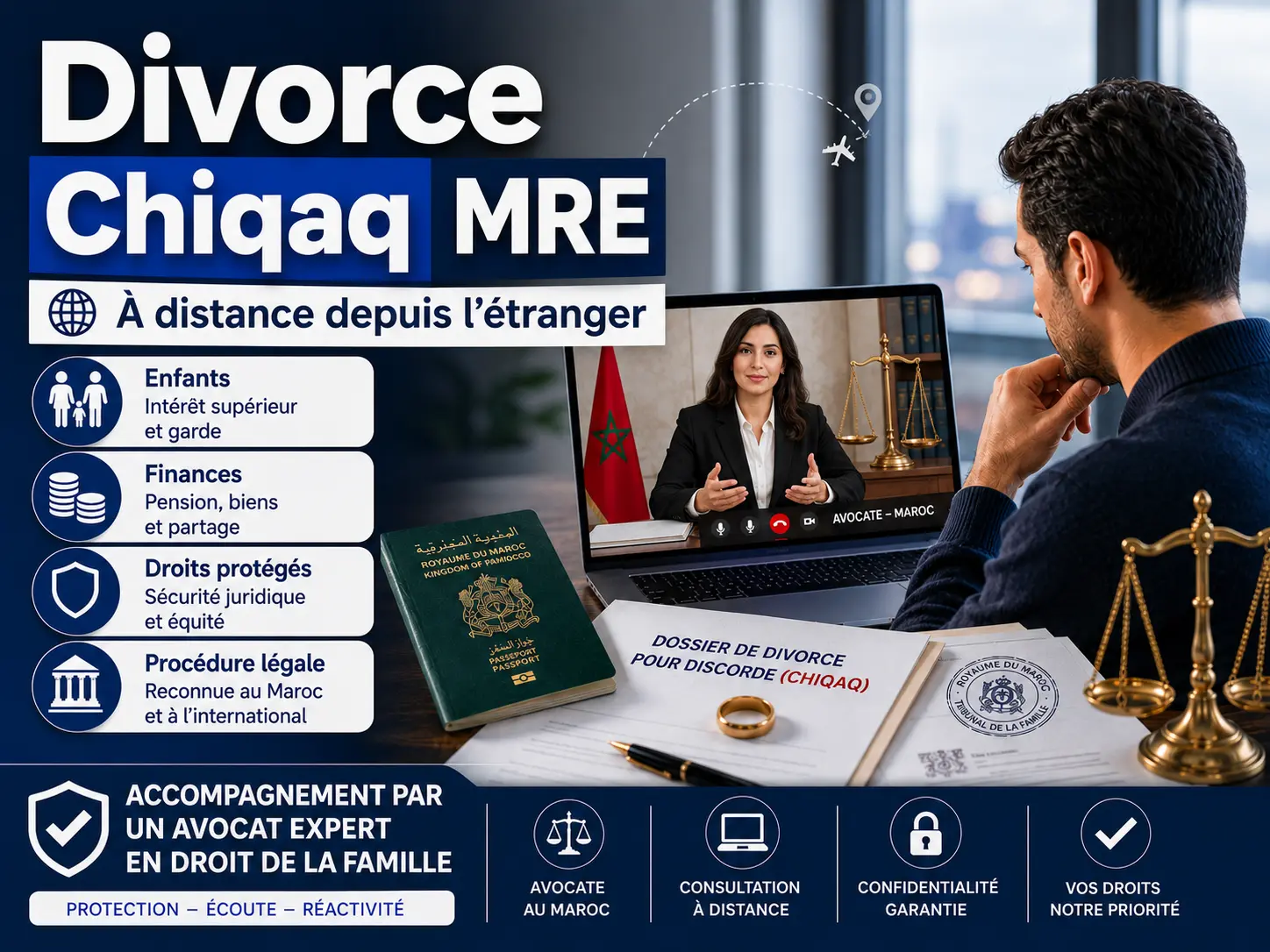
Please be aware that you're not alone(e) in this process. The firm of A. Anouide, experienced solicitor registered with the law society of Safi and employed in all courts of morocco, is at your disposal to assist you with rigor and humanity. Whether you are in Morocco or abroad (MRE), she will advise you and defend you effectively.
In Morocco, the divorce may take several forms, each with its own characteristics and legal implications for the parties involved. It is essential to understand these distinctions to choose the path best suited to your situation.
The path to the divorce usually begins by filing a formal request with the competent court. This application must be complete and include all required documents, such as the marriage certificate, and proof of residence.
Once the application is filed, a preliminary hearing is scheduled. At this hearing, the judge reviews the documents and listening to the two parties. If the divorce is consensual, the judge will check the mutual agreement of the spouses. In the case of divorce for fault or judicial, additional evidence or investigation may be ordered. This step is crucial, and the support of an experienced solicitor as Me A. Anouide is essential to prepare your case and defend your position right from the start.
Subsequently, hearings, additional can be necessary to adjust the details of the divorce : child custody, property division, alimony. These steps can take some time, but with the support of the firm of A. Anouide, you will be guided(e) step, until the pronouncement of final judgment and its official registration.
It is fundamental to know and enforce your rights during a divorcein accordance with the moroccan law.
These rights are essential to ensure fairness and protect each party during and after the divorce.
La question des enfants est souvent la plus délicate et la plus sensible dans un divorce. Au Maroc, la législation priorise toujours l’intérêt supérieur de l’enfant. Le tribunal prendra en compte l’âge de l’enfant, ses besoins spécifiques, et la capacité de chaque parent à offrir un environnement stable et sûr.
In matters of custody of children (Hadanah), the moroccan legislation prioritizes always in the best interest of the child. It is crucial to note that, according to theArticle 164 of the Moudawana (Family Code), the mother is seen as the original in terms of Hadanah (guard), particularly if the child is young or at a sensitive stage of its development. She usually has custody until the child reaches the age of 18 years of age or depending on the specific circumstances. Furthermore, in the event of the inability of the mother to the custody, the law provides that it may be transferred to other close relatives, such as grandparents, before being assigned to the father.
The court may grant sole custody to one parent or opt for joint custody, assigning responsibilities, and the time spent with the child. In the case of sole custody, this is usually decided if a parent is deemed unable to take care of the child. In joint custody, a detailed schedule is established.
The parent not having primary custody usually has a right of access, essential for maintaining a healthy relationship with the child. Restrictions may be imposed for the safety or well-being of the child. A. Anouide is dedicated to protecting the interests of your kids and help you establish arrangements for custody and visitation that promote their well-being and stability.
Under the Moroccan Family Code (Family Code morocco), the principle is the default separation of property between spouses. Each spouse retains ownership of the assets acquired before or during the marriage, unless agreed otherwise. The property registered in the name of one of the spouses belong to him, even if the other has contributed financially.
However, theArticle 49 of the Moudawana offers an alternative. The spouses may enter into a separate written agreement the contract of marriage. This agreement sets out the management and distribution of property acquired during the union, thus allowing to establish a "financial system "specific". For example, they can decide a common property or proportions defined for each part.
This agreement is crucial. Without him, in the event of a dispute, the general rules of evidence apply. The efforts and contributions of each spouse in the constitution of the family assets are taken into account. This now includes the domestic work of women and the education of childrenrecognizing their contribution to the wealth of the household – a significant change.
In the absence of a written agreement, the court intervenes to assess the contribution of each. The judge will review all the evidence, including the contributions to non-material such as domestic work. The units vary according to the nature of the contribution and the circumstances of each case, without fixed proportion defined by the law.
The obligations and alimony are of the pillars of the divorce, to ensure the financial well-being of children and, where appropriate, of the husband to be economically weaker.
The non-payment of alimony is a serious offence punishable by penalties. Moroccan courts shall scrupulously to the application of these obligations, with mechanisms such as the seizure of wages or property. A. Anouide will advise you and defend you to enforce these critical decisions.
Despite all the good wills, divorces can sometimes escalate into conflict. Fortunately, Morocco offers a variety of remedies to resolve such disputes fairly.
Divorce is a challenge, but with right preparation and the right guidance, you can manage this time in a more effective and less stressful.
To deepen your knowledge or get help, many resources exist. The firm of A. Anouide is your ideal partner for this period. As a lawyer specializing in Family Lawit offers professional advice tailored to your specific situation, whether it is for divorce, alimony, custody of children, or any other legal issue related to the family.
Please do not hesitate to contact us to discuss your legal needs. You can reach her by phone, WhatsApp, email, or via the contact form on its website. The office is located at No. 9 Rue Ait ourir quartier sidi ouassel in Safi, but to Me A. Anouide operates in all moroccan cities, including Casablanca, Rabat, Marrakech, Agadir, Settat, El Jadida, Youssoufia, Essaouira, Khouribga, and Beni Mellal. She also offers consultations at a distance, especially for the Moroccans Residing Abroad (MRE).

Name of the firm: Amal Anouide Law Firm. She is registered with the Safi Bar Association.