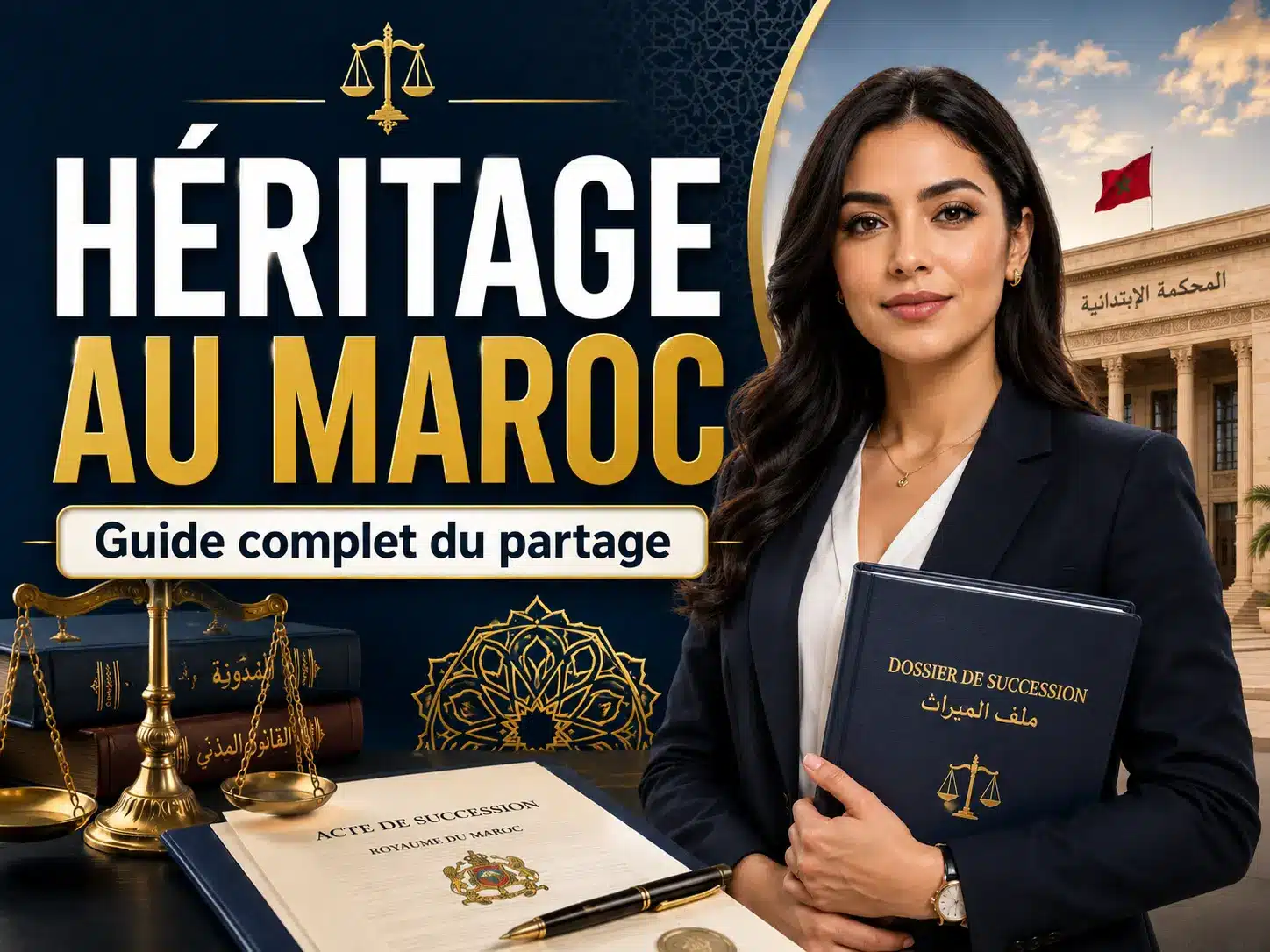
L’héritage au Maroc suit un cadre juridique précis, fixé par la Moudawana. Cette loi définit l’ouverture de la succession, les héritiers, les quotes‑parts, les empêchements et les modalités de liquidation. En Moroccan law, la succession englobe l’ensemble des biens et droits patrimoniaux du défunt, après déduction prioritaire des charges, dettes et testaments valables, avant la répartition entre les héritiers selon l’ordre légal.
Ce sujet occupe une place centrale du Family Law, puisqu’il touche à la transmission du patrimoine, à la protection des proches et à l’équilibre entre exigences religieuses et sécurité juridique. Le Code de la Moroccan family s’appuie explicitement sur l’Islam, le rite malikite et l’effort d’interprétation juridique (Ijtihad), tout en intégrant des procédures modernes applicables à tous les Marocains, y compris les ressortissants étrangers, à l’exception des Juifs marocains soumis à leur propre statut personnel. Cet article s’inscrit dans le dossier global « Droit de la Famille au Maroc », dont il constitue une pièce maîtresse pour appréhender la transmission patrimoniale après le décès.
Fundamental principles of Moroccan inheritance law
La Moudawana consacre un livre entier à la succession et la définit ainsi : l’héritage est la transmission d’un droit au décès de son titulaire, après liquidation de la succession, au profit de celui qui y prétend légitimement, sans contrepartie ni libéralité. La succession comprend les biens et droits du défunt, mais elle n’est pas distribuée immédiatement : cinq catégories de charges doivent être réglées, dans un ordre impératif.
Legal sources: the Moudawana and the Maliki rite
The Code de la Famille constitue la source principale du droit des successions. Son préambule rappelle que le texte s’appuie sur les finalités de l’Islam, l’uniformité du rite malékite et l’Ijtihad, d’où la présence d’institutions classiques telles que les Fara’id, le Ta’sib, le Hajb et le legs obligatoire. La loi s’applique à tous les Marocains, même ceux possédant une autre nationalité, ainsi qu’à certaines situations mixtes prévues par l’article 2, ce qui revêt une importance particulière pour les successions internationales.
Conditions for opening an inheritance
Succession is opened upon the actual or presumed death of the deceased, provided that the heir is alive at the time of death. The Code requires:
- the certainty of death (actual or presumed);
- the survival of the heir;
- proof of the family relationship conferring the status of heir.
A declaratory judgment is essential; until it is issued, no estate can be opened or divided. Similarly, when a series of heirs dies without the order of deaths being established, none of them can inherit from the others.
The three pillars of heritage
The inheritance process is based on the deceased, the heir, and the estate. The Moudawana (Family Code) summarizes this legally as follows: the death of the right holder, the existence of the heir, and all the assets or rights transferred after liquidation. Before any division, the estate must be liquidated according to the order established in Article 322.
- charges encumbering real property;
- funeral expenses, within reasonable limits;
- debts of the deceased;
- valid and enforceable will;
- inheritance rights of heirs.
This hierarchy is crucial. Many families believe that the heirs immediately acquire all the assets, whereas in reality the division only takes place after the settlement of liabilities and the possible execution of the will.
Categories of heirs and order of priority
Article 334 distinguishes four categories: heirs by Fardh only, heirs by Ta'sib only, those who combine both qualities, and those who can fall under one or the other depending on the family configuration.
Reserved heirs (Ashab al‑Go’id)
The Fardh is an inheritance share fixed by law, allocated primarily to certain heirs. The Fardh shares consist of six fractions: 1/2, 1/4, ⅛, ⅔, ⅓ and ⅙.
Among the heirs in Fardh alone are the mother, grandmother, husband, wife, and maternal brother and sister. Others, such as the daughter, son's daughter, father, or grandfather, may receive a fixed share depending on the circumstances.
Quotes-usual parts
|
Heir
|
Part
|
Main condition
|
|
Husband
|
½
|
If the deceased wife leaves no descendants
|
|
Husband
|
¼
|
In the presence of offspring
|
|
Wife
|
¼
|
The deceased had no descendants
|
|
Wife
|
⅛
|
Presence of offspring
|
|
Only child
|
½
|
No wires present
|
|
Two or more girls
|
⅔
|
No wires present
|
|
Mother
|
⅓
|
No descendants or multiple legal siblings
|
|
Mother
|
⅙
|
Presence of a child, a son's child, or two or more brothers/sisters
|
|
Father
|
⅙
|
Presence of a child or a son's child
|
The share of a single individual can increase, decrease or disappear depending on the other heirs present; this is the logic of Hajb and inheritance competitions.
Heirs by agnation (Asaba) and the role of the remainder
Ta'sib involves inheriting either the entire estate if there are no heirs with a sufficient fixed share, or the remainder after the allocation of Fardh shares. Asaba heirs include the son, the son's son, the full brother, the half-brother, paternal uncles, and their male descendants, according to the legal order.
The priority among Asaba is based first on the proximity of the degree, then on the strength of the kinship tie: at equal degrees, the full relative takes precedence over the blood relative. The father and the grandfather can combine Fardh and Ta'sib in certain cases; for example, when the father competes with a daughter or the daughter of his son, he receives one-sixth as Fardh and the remainder as Asaba.
The principle of "double for the male"
When male and female heirs are in the same line of succession, the male receives twice the share of the female. This rule applies in particular to:
- for the daughter in the presence of sons,
- for the son's daughter in the presence of the son's son,
- for full or blood sisters in the presence of their corresponding brothers.
It should be noted that this principle does not apply to all inheritances. In several cases, a woman receives a fixed share (wife, mother, only daughter) without any division with a man of the same rank. The "double for the male" rule only applies in specific cases of Ta'sib or residual division, and not as an absolute rule.
Inheritance rights of women in Morocco
The Moroccan Family Code organise explicitement les parts successorales des femmes, sans laisser place à la négociation privée. Elles peuvent hériter en qualité d’épouse, de mère, de fille, de fille du fils, de sœur, d’aïeule ou de légataire obligatoire.
Widow : a quarter of the estate if the deceased has no descendants, an eighth if he has. This share is fixed and cannot be eliminated.
Only child : half in the absence of sons.
Multiple daughters : two-thirds if no son is present. In the presence of a son, they become Asaba and the division follows the rule of double for the male.
Mother : one third if the deceased has no descendants or multiple legal brothers/sisters; otherwise, one sixth, even if the brothers/sisters are excluded.
Strict application of the Moudawana
The text of the Moudawana does not grant judges any general power to rewrite inheritance shares; it mandates a rigorous application of the categories of Fardh, Ta'sib, Hajb, and obligatory bequests. The preamble reaffirms the Code's grounding in the objectives of Islam, the Maliki school of thought, and Ijtihad, which implies a meticulous examination of the family composition at the time of death.
The will (Wasiya) in Moroccan law
The will is drawn up before the division of the estate, but after the settlement of priority obligations. Article 322 places it after debts and before the rights of the heirs.
The available third
Article 369 stipulates that one-third of the estate may be freely bequeathed, particularly to grandchildren of a son or daughter who predeceased the deceased or who died simultaneously with the deceased. This provision demonstrates that the estate is not entirely free from all constraints; the will operates within the limits set by the Moudawana (Family Code).
Will in favor of an heir
The text does not detail a general rule concerning a will in favor of one heir with the agreement of the others. It suffices to note that the Moudawana considers the will as a separate transaction, integrated into the order of liquidation, and that the Tanzil is treated as a will, subject to the same rules, notably the rule of Tafadol (double for the male).
Settlement of a real estate inheritance
The division of real estate is often the most contentious aspect of an inheritance, as the property is physically indivisible in the short term and may be encumbered by debts or encumbrances. Legally, it forms part of the estate like any other asset and is only divided after all liabilities have been settled.
Inventory and liquidation of assets
The liquidator, assisted by two notaries, draws up an inventory of all the deceased's assets. He identifies any outstanding debts and claims, which the heirs must disclose. Debts are settled: first from recovered receivables, then from available cash, and finally, if necessary, from the proceeds of the sale of movable and immovable property.
Jointly owned property and exiting joint ownership
After the expenses have been paid, each heir receives their legal share. They can then:
- to remain in temporary joint ownership,
- to be awarded the property with financial compensation
- or proceed with a public auction (or a sale by auction between heirs) to obtain the division in cash.
The text does not specify the "titled property vs Melk" regime or the procedure at the Land Registry, but it clearly indicates that the sale or allocation of the property can only take place after liquidation.
Inheritance proceedings in Morocco: procedure and formalities
The deed of inheritance (Iratha) formalizes the identity of the heirs and paves the way for the liquidation and subsequent distribution of the estate. The guardianship judge must order its preparation when there are minor heirs.
Role of the adouls
Article 267 requires the judge to order the establishment of a certificate of inheritance listing the heirs and the measures for the protection of minors. Article 394 specifies that each heir may obtain, from the two notaries, a copy of the certificate of inheritance and the inventory indicating their share.
Required documents
The text states that the document must identify the heirs and be based on the estate inventory. Proof of death can be presented to the court by any admissible means; notaries (adouls) are involved in drafting the document and preparing the inventory. The file does not provide an exhaustive list of required administrative documents (death certificate, family record book, etc.).
Fees and taxes
No precise schedule of fees for notaries, notaries, or taxes is provided in the extracts consulted. However, it is known that inventory, liquidation, and, where applicable, sale fees may be added to the overall costs of the estate.
Special cases and complex situations
Dual nationality and residents abroad
Article 2 stipulates that the rules of the Code apply to all Moroccans, even those holding another nationality. This provision is essential for Moroccan families living abroad, as it ensures the universality of the Moroccan inheritance system.
Exclusion from inheritance (Al-Me’)
The Code clearly lists the impediments to inheritance: lack of succession between Muslim and non-Muslim, disavowed paternal lineage, murderer of the deceased (who does not inherit and does not receive the Diya), etc. Disinheritance (Hajb) can be total or partial, but certain heirs (son, daughter, father, mother, husband, wife) can never be completely disinherited.
Conclusion
Pour toute succession complexe—bien immobilier, héritiers à l’étranger, mineurs, conflit sur l’Iratha ou difficulté à déterminer les quotes‑parts—il est vivement recommandé de consulter un avocat spécialisé en droit of the family ou un professionnel compétent. Vous trouverez également d’autres guides détaillés sur le Family Law au Maroc, afin de replacer l’héritage dans le cadre plus large de la Moudawana.
FAQ
- What's happening‑t-il if the dThe deceased only left daughters ?
An only daughter receives half of the inheritance. Two or more daughters together receive two-thirds, in the absence of sons. Any remaining portion is distributed according to the rules of Ta'sib or return of the remainder.
- What are the time limits for settling an estate?
The text does not specify a single time limit. The duration depends on the composition of the estate, the amount of liabilities, the presence of real estate, and the degree of conflict between heirs.
- A no- a Muslim can-il hinherit from'a Muslim' ?
No. Article 332 excludes any inheritance between a Muslim and a non-Muslim.
- What are the notary and adoul fees for the division of property?
The file does not provide a precise price list. It only confirms the involvement of the adouls (notaries) for the inheritance deed and the inventory.
- The widow inherits‑t-she always ?
Yes. She receives one quarter if she has no descendants and one eighth if she has descendants, a share which cannot be eliminated.
- Can- We share a property without selling it ?
Yes, if the heirs agree to allocate it to each according to the appraised value or through a bidding process among themselves. If they cannot agree, an auction becomes necessary.
- The little ones-children can- they hinherit if their parents are ofecedbefore the great‑parent ?
Yes. Article 369 provides for a mandatory legacy to grandchildren from a son or daughter who predeceased or died simultaneously with the deceased, within the limit of the available third.