Key Points to Remember:
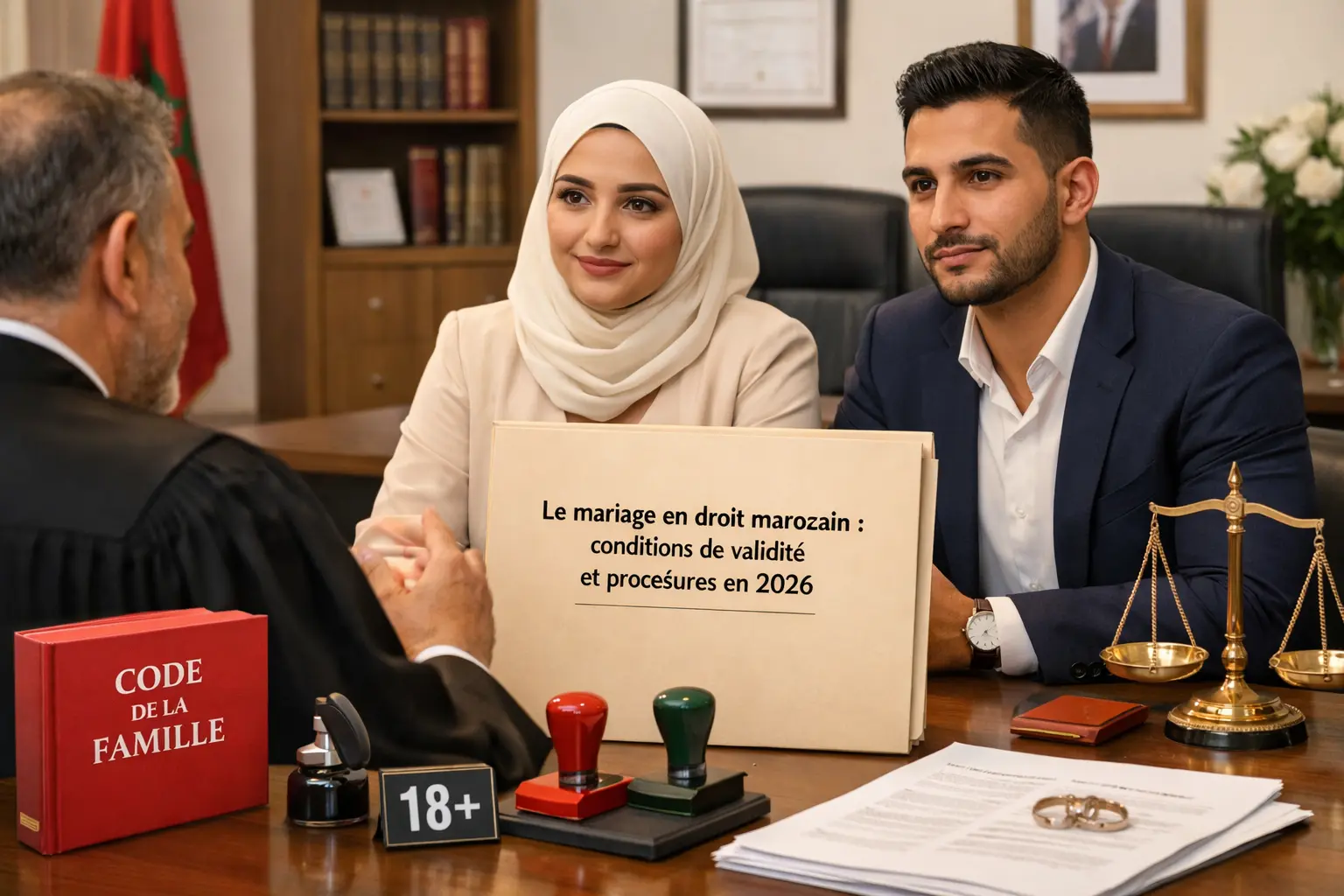
Marriage under Moroccan law It constitutes a pact based on mutual consent aimed at establishing a legal and lasting union between a man and a woman. This solemn contract is not merely an administrative formality, as it defines the legal framework of the family unit under the direction of both spouses. Understanding the provisions of the Moroccan Family Code is essential to guarantee the protection of rights of each spouse and the parentage of children.
In Morocco, the legal age for marriage is eighteen years for both men and women. Therefore, anyone wishing to marry must have reached this age at the time the marriage contract is signed.
However, the Family Code allows the judge presiding over the marriage to exceptionally authorize the marriage of a minor. This authorization must be granted by a reasoned decision, after examination of the minor's personal situation and the circumstances of the proposed marriage.
The judge may, in particular, order or consider a social inquiry and a medical examination. The aim is to verify the minor's maturity, their capacity to bear the responsibilities of marriage, and the absence of harm to their health, safety, or interests.
Judicial authorization is therefore not a mere administrative formality. It must be obtained before the marriage certificate is drawn up and allows the judge to ensure that the marriage is in the best interests of the minor.
A marriage contracted with a minor without prior authorization from a judge is not considered a valid procedure. The prospective spouses must petition the family court and obtain the required ruling before proceeding with the formalities before the adouls (notaries).
La validité du contrat de mariage suppose la réunion de plusieurs conditions relatives aux futurs époux, à leur consentement, à l’absence d’empêchements légaux et au respect des formalités prévues par le Family Code.
A person is legally entitled to marry at eighteen years of age (Gregorian calendar) for both men and women. In exceptional circumstances, a judge may authorize the marriage of a minor by a reasoned decision, after examining their situation and the necessary safeguards for their protection.
Marriage is based on the free and mutual consent of both future spouses. The offer and acceptance must be expressed clearly, immediately, and unambiguously.
Consent must correspond to the same marriage plan. In the event of an inability to express oneself orally, it may be expressed in a manner that clearly demonstrates the will of the person concerned.
Consent obtained through coercion, deception, or fraud can be challenged under the conditions provided by law.
An adult woman has the right to exercise her own marital guardianship. She may also delegate this responsibility to her father or one of her relatives, according to the conditions stipulated by the Family Code.
The rules may differ when dealing with a minor or a legally incapacitated person. In these situations, the intervention of a legal representative or a judge may be necessary.
Sadaq is the property given by the husband to the wife as a sign of his intention to establish a household. It becomes the exclusive property of the wife, who can dispose of it according to the law.
The dowry may consist of property or a lawful asset. Its amount must be determined by mutual agreement and remain in accordance with legal requirements and applicable customs.
The prospective spouses must not be subject to any legal or religious impediment preventing the conclusion of the marriage. These impediments may be related to kinship, affinity, breastfeeding, a previous marriage, or a temporary situation such as the waiting period (iddah).
The court also verifies the marital status of the parties involved and the absence of a marriage incompatible with the new marital plan.
The marriage must be concluded in accordance with the procedure laid down by the Family Code. This procedure includes, in particular, the preparation of the file, the examination by the judge in charge of the marriage, the authorization of the adouls, the drawing up of the marriage certificate and its ratification.
Compliance with these formalities ensures proof of marriage and its recognition by administrations and courts.
Moroccans residing abroad can conclude their marriage in accordance with the formalities of the country of residence, subject to compliance with the conditions provided for by the Family Code.
A copy of the document must then be filed with the Moroccan consular services within the legal timeframe. If this formality cannot be completed, a recognition procedure may be considered before the competent Moroccan court.
Before authorizing the establishment of the marriage certificate, the judge must verify that the future spouses are not in a situation that legally prevents their union.
Marriage is prohibited between certain persons related by direct kinship or by close kinship as defined by law. This prohibition applies in particular to certain ascendants, descendants, brothers, sisters, aunts, uncles, and descendants of brothers or sisters.
Certain ties created by a previous marriage or by breastfeeding can also prevent the conclusion of a marriage. These situations must be declared when filing the application so that the court can verify the legal possibility of the union.
Some impediments are not permanent. They may result, for example, from the existence of a previous marriage, exceeding the legal number of wives, the period of widowhood or another temporary situation provided for by the Family Code.
The impediment disappears only when the legal situation is properly rectified or when the legal deadline ends.
The future spouses must provide documents establishing their identity, civil status, and marital status. In cases of difficulty, prior marriage, contested parentage, or mixed marriage, a personalized legal analysis may be necessary before submitting the application.
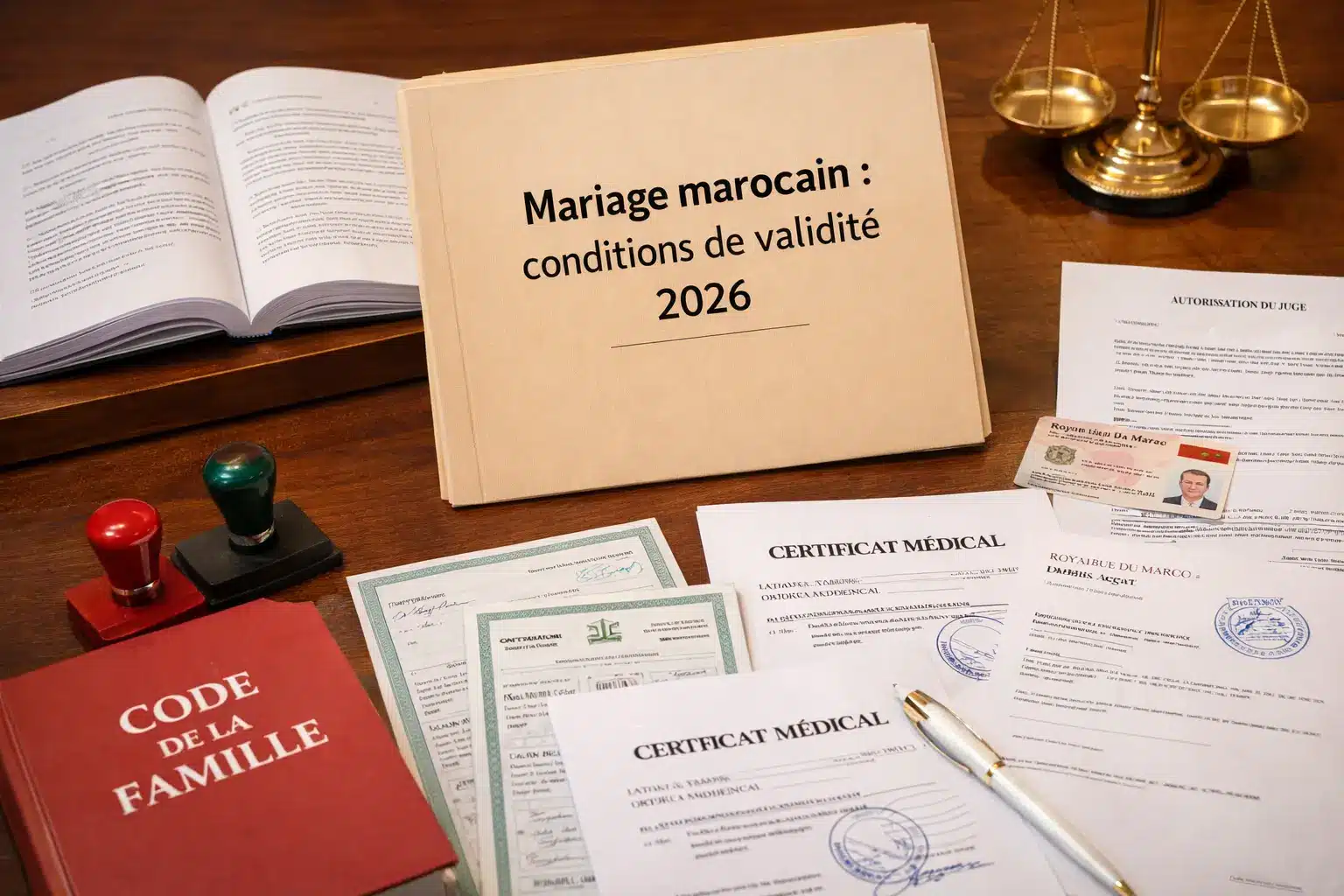
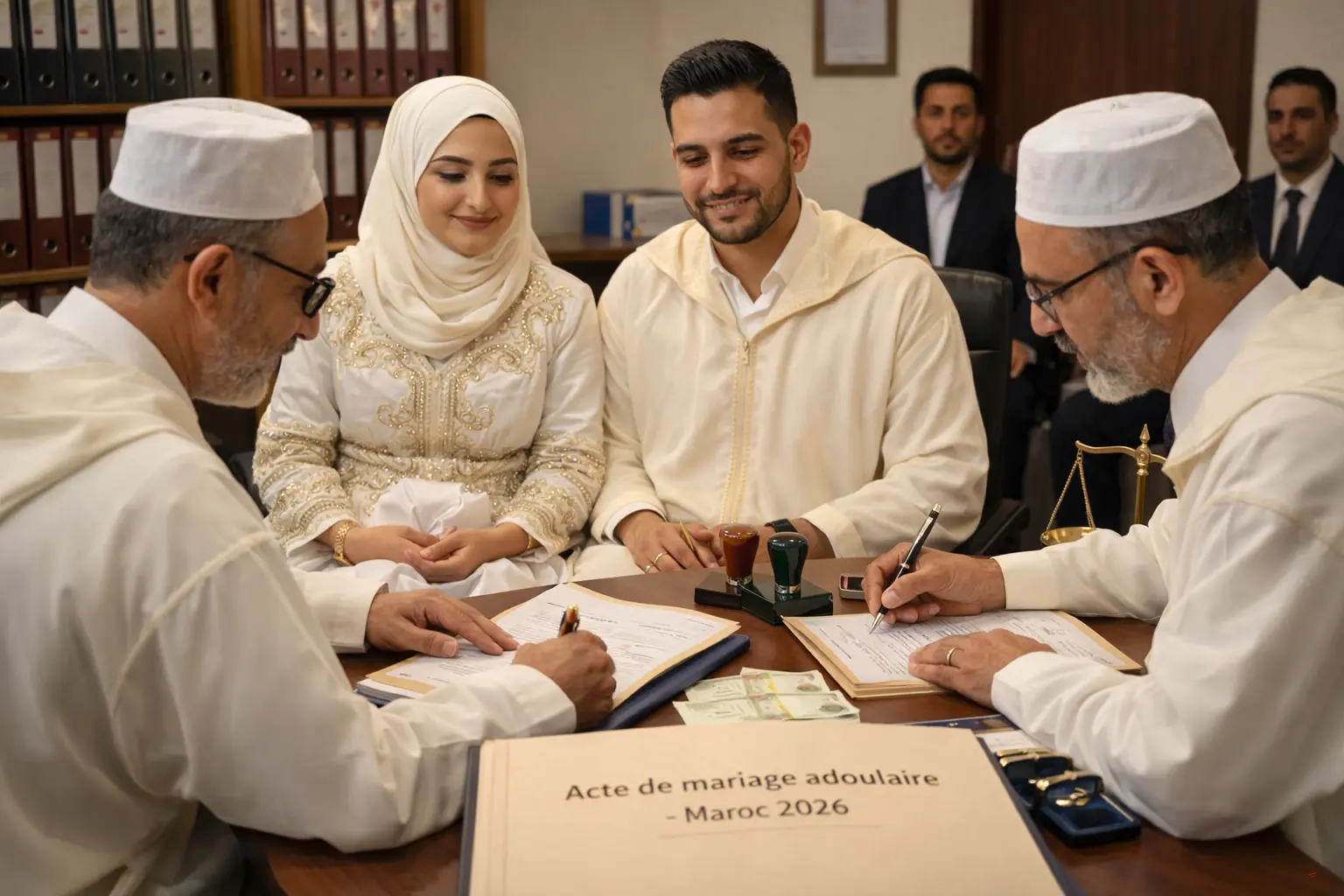
The establishment of a marriage certificate in Morocco follows a rigorous administrative procedure before the Justice Section of the familyThe intervention of the two adoul is mandatory to establish consent and draw up the official document.
L’Article 65 of the Family Code requires the creation of a file containing the following documents:
Once approved by the judge, the document is transcribed in a special register and an extract is sent to the civil registrar of the place of birth of the spouses within 15 days (Art. 68).
The list of required documents may vary depending on the couple's circumstances, nationality, place of residence, and the type of marriage. The following documents are generally required to complete the application:
– A request for authorization to establish the marriage certificate.
– Valid identity documents of both future spouses.
– A recent birth certificate extract for each fiancé.
– A medical certificate issued in accordance with the requirements of the procedure.
– Documents to verify the marital status of each person.
– Judicial authorization when the marriage concerns a minor, a request for polygamy or another special situation.
– Documents relating to nationality and residence when it is a mixed marriage or a marriage concluded by a Moroccan living abroad.
– A special power of attorney when one of the future spouses is represented by an agent.
– Any additional documents requested by the court, the consulate or the competent authorities.
Additional documents may be required in the following situations:
– Marriage of a Moroccan man to a foreign national.
– Marriage contracted abroad.
– Marriage of a minor authorized by the judge.
– Request for authorization to practice polygamy.
– Conversion to Islam or difficulty related to religion.
– Existence d’un précédent mariage ou of a divorce prononcé à l’étranger.
La liste définitive doit être confirmée auprès du Family Court ou du consulat compétent avant le dépôt du dossier. Une pièce manquante, un document non légalisé ou une traduction non conforme peut entraîner le report de l’examen de la demande.
L’Article 40 of the Moudawana Polygamy is prohibited when there is a risk of injustice towards the wives or when a non-polygamy clause has been included in the marriage contract. This practice is now exceptional and subject to judicial oversight.
The court grants authorization only if both of the following cumulative conditions are met:Article 41 are filled:
The current wife must be summoned by the court to express her opinion, and the future wife must be informed that the man is already married (Art. 43, 46).
A man wishing to enter into an additional marriage must submit an application to the competent court. He must explain the reasons for his application and demonstrate that he has sufficient resources to provide for the maintenance and rights of both households.
The file may include, in particular:
– A written request addressed to the court.
– The applicant's identity documents.
– A copy of the existing marriage certificate.
– Supporting documents relating to family situation.
– Documents demonstrating the applicant's resources and financial capabilities.
– Documents relating to the future bride.
– Any additional document requested by the judge.
The court summons the current wife to gather her statements and inform her of the application. The prospective wife must also be informed of the marital status of the man she intends to marry.
The judge examines the reasons given, the applicant's financial situation, the guarantees of maintenance, and the absence of any legal impediment. Only after obtaining judicial authorization can the formalities for establishing the new deed be pursued.
Polygamy cannot therefore be legalized solely by the will of the individuals involved. It remains subject to prior judicial review and compliance with the safeguards provided by the Family Code.
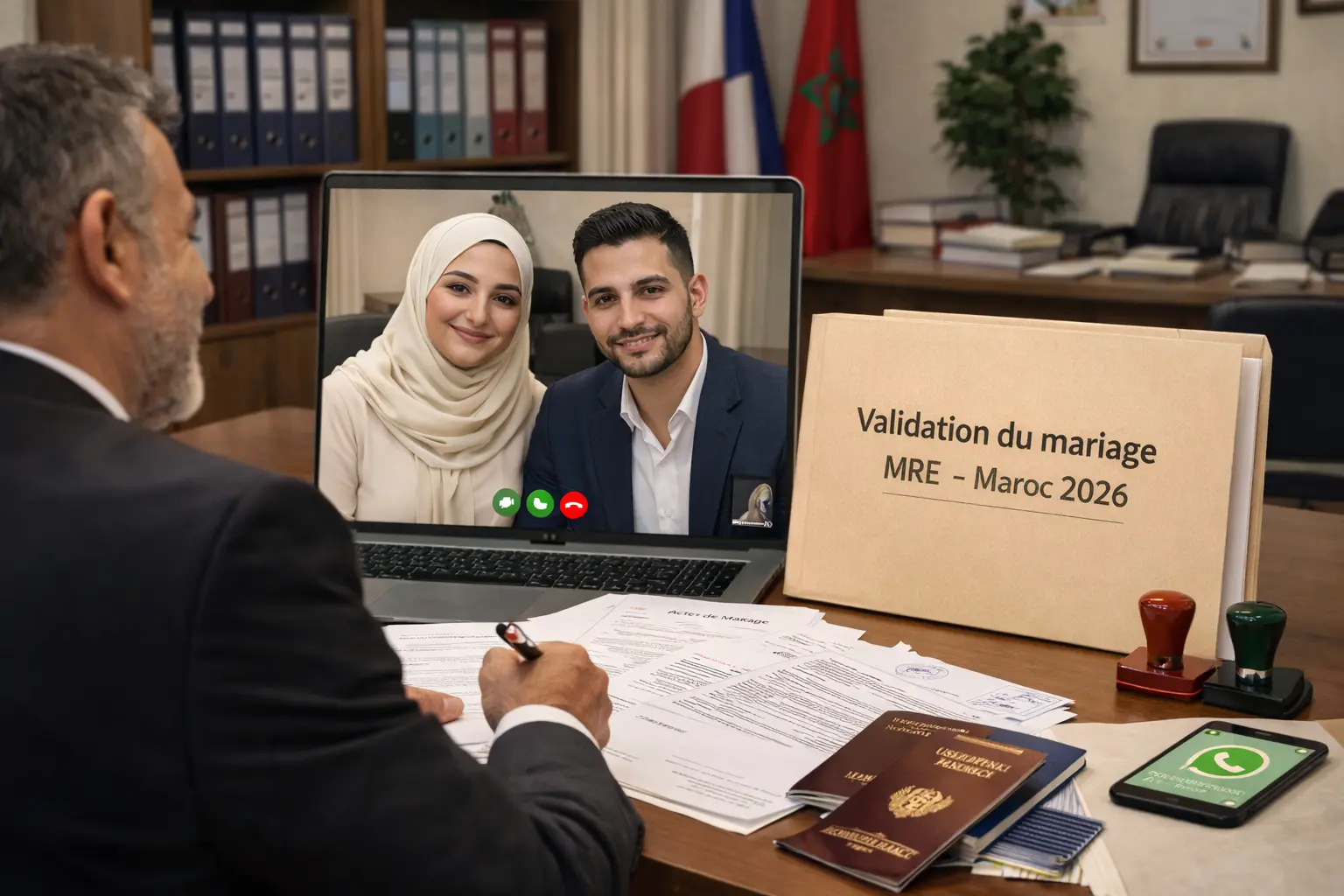
L’Article 14 of the Moudawana allows the Moroccans residing abroad to contract marriage according to the local formalities of the country of residence. For this marriage to be recognized in Morocco, the conditions of capacity, consent and the absence of legal impediments must be met.
L’Article 15 requires the spouses to file a copy of the marriage certificate with the Moroccan consular services within a period of three monthsIf it is impossible to establish the document in a timely manner, the spouses may initiate an action for recognition of marriage before the Moroccan court (Art. 16).
🌍 SPECIAL FOR MRES Moroccans residing abroad can appoint a lawyer by proxy to carry out certain validation or family dispute procedures without mandatory physical travel to Morocco.
Marriage creates reciprocal rights and duties between spouses. Article 51 of the Family Code reminds us that married life is based in particular on legal cohabitation, mutual respect, affection, fidelity, and the preservation of the family's interests.
Spouses must also cooperate in managing the household and, as far as possible, make important family decisions together. This responsibility includes, in particular, the education, protection, and care of the children.
The obligations between spouses include, in particular:
– Cohabitation with respect for everyone's rights.
– Mutual respect, trust and affection.
– The preservation of the physical and moral integrity of the other spouse.
– The contribution to the management and protection of the family.
– Consultation regarding decisions that concern children and family life.
– The protection of the best interests of children.
These obligations do not eliminate the individual rights of each spouse. They must be exercised with respect for the dignity, security, and freedom of each individual.
Article 51 should be distinguished from the rules concerning the marital property regime. In principle, each spouse retains their own separate property. However, the spouses may enter into a separate agreement specifying the terms of management and distribution of assets acquired during the marriage, within the limits provided by law.
In the absence of such an agreement, proof of each party's contribution to the acquisition or preservation of assets can become important in the event of separation or divorce.
The complexity of marriage in Moroccan law requires appropriate legal support from the outset. Early consultation allows you to:
The Master's Office Amal Anouide in Safi assists litigants through all stages of the formation and validation of their union, with the possibility of remote consultation (WhatsApp, Video conferencing) for remote customers and Moroccans Residing Abroad.
The law distinguishes between two types of irregular unions: null marriage and vitiated marriage.Article 57 defines a null marriage as one where one of the pillars of consent is lacking or when there is a perpetual or temporary impediment.
A flawed marriage, on the other hand, is annulled before consummation if it lacks a condition of validity, but can be validated after consummation upon payment of the dowry of parity (Art. 60).Article 63 allows the spouse who is the victim of coercion or fraud to request the termination of the marriage within two months of the lifting of the coercion or the discovery of the deception.
⚠️ ATTENTION – Point crucial Fraudulent maneuvers aimed at obtaining a marriage license or a certificate of fitness expose the perpetrator to the criminal penalties provided for in the law.Article 366 of the Penal Code.
The procedure of marriage in Moroccan law unfolds in several main stages, detailed in the following table in accordance with Articles 65 to 69 of the Moudawana :
Stage | Action required | Legal basis | Observation |
1. File | Preparation of administrative file (certificates, birth certificate) | Art. 65 | Filing with the Family Court Registry |
2. Authorization | Review of the file and approval by the family judge | Art. 65 (II) | The judge authorizes the notaries to draw up the document |
3. Celebration | Confirmation of consent and signatures before 2 notaries | Art. 67 | The presence of the spouses (or their representative) is required. |
4. Homologation | Affixing of the judge's seal to the original document | Art. 67 (11) | Makes the act final and enforceable |
5. Registration | Transcription in the register and sending to the civil registry | Art. 68 | 15-day waiting period after approval |

Phase 1: Preparation (Before filing a claim with the court)
Phase 2: Legal proceedings
Phase 3: Post-celebration
A: The applicant must submit a copy of the document to the Moroccan consular services within a period of three months following the conclusion of the deed in France. Legal basis: Article 15 of the Moudawana
A: A woman of legal age can contract her own marriage or delegate this to her father. The presence of a guardian is only mandatory in specific cases provided for by law. Legal basis: Article 25 of the Moudawana
A: Full marital capacity is set at 18 years old The judge may exceptionally authorize marriage below this age after an expert assessment. Legal basis: Article 19 of the Moudawana
A: Yes, marriage can be concluded by proxy subject to authorization from the family judge in charge of the marriage and compliance with strict conditions. Legal basis: Article 17 of the Moudawana
Legal warning This article provides general legal information on marriage in Moroccan law This information does not constitute personalized legal advice. Each situation is unique and requires in-depth analysis by a lawyer. The information presented is valid as of the date of publication and is subject to changes in legislation or case law. For an accurate assessment of your case, consult a legal professional. The Cabinet Anouide cannot be held responsible for decisions made solely on the basis of this article without prior consultation.
Attorney Amal Anouide, a member of the Safi Bar Association for over 13 years, is a recognized specialist in Moroccan family law (Moudawana). The Anouide Law Firm assists national and international clients, particularly Moroccans residing abroad (MREs), offering rigorous expertise to ensure the enforcement of their rights in Morocco.