

Imagine this:You are at a crossroads. What began as an eternal promise, sealed by the sacred act of marriage, has transformed into an emotional and administrative labyrinth. Whether you are a resident of Casablanca, a Moroccan living abroad in Paris or Montreal, or a foreign national bound to Morocco by heart and by law, the dissolution of the marital bond is a seismic event. But here, the earthquake is codified. It is not simply a matter of "separating," but of navigating a complex legislative masterpiece: the Moudawana.
Since the historic reform of 2004, Morocco has undergone a veritable silent revolution. Gone are the days when divorce was an arbitrary and unilateral power. nouvelle loi Divorce Morocco It introduced a philosophy of balance, of choosing the "lesser evil," and of strict judicial control. But between the dry legal texts and the reality of your case, there's a world of difference.
As legal strategy experts, we don't just read the law; we decipher it. This article is your compass. It's designed to be the most comprehensive analysis on the subject, dissecting every procedure, every right, and every financial impact with the precision of a watchmaker and the clarity of a top-tier editorialist.

To understand your rights today, you must grasp the spirit of the law that governs them. The Family Code (Law No. 70-03) is not simply a list of prohibitions. As the Preamble to the text emphasizes, this reform aims to "To preserve human dignity, without abandoning the tolerant principles of justice, equality, and solidarity advocated by Islam.".
The legislator established a fundamental principle in Article 70: Divorce is an exceptionThe dissolution of the marriage contract should only occur as a last resort, taking into consideration the rule of "lesser evil"because it inevitably leads to the breakdown of the family unit.
That's why the nouvelle loi Divorce Morocco The dissolution of a divorce has been placed under the exclusive jurisdiction of the judiciary. Whether you wish to divorce amicably or are in open conflict, you cannot bypass the judge. The judge is the guardian of fairness, responsible for ensuring that the woman is not disadvantaged and that the child is not a collateral victim of the parents' conflict.

The Moroccan system offers a range of procedures tailored to the diverse nature of marital problems. Choosing the right procedure is the first strategic decision you will make, and it will determine the duration, cost, and difficulty of your divorce.
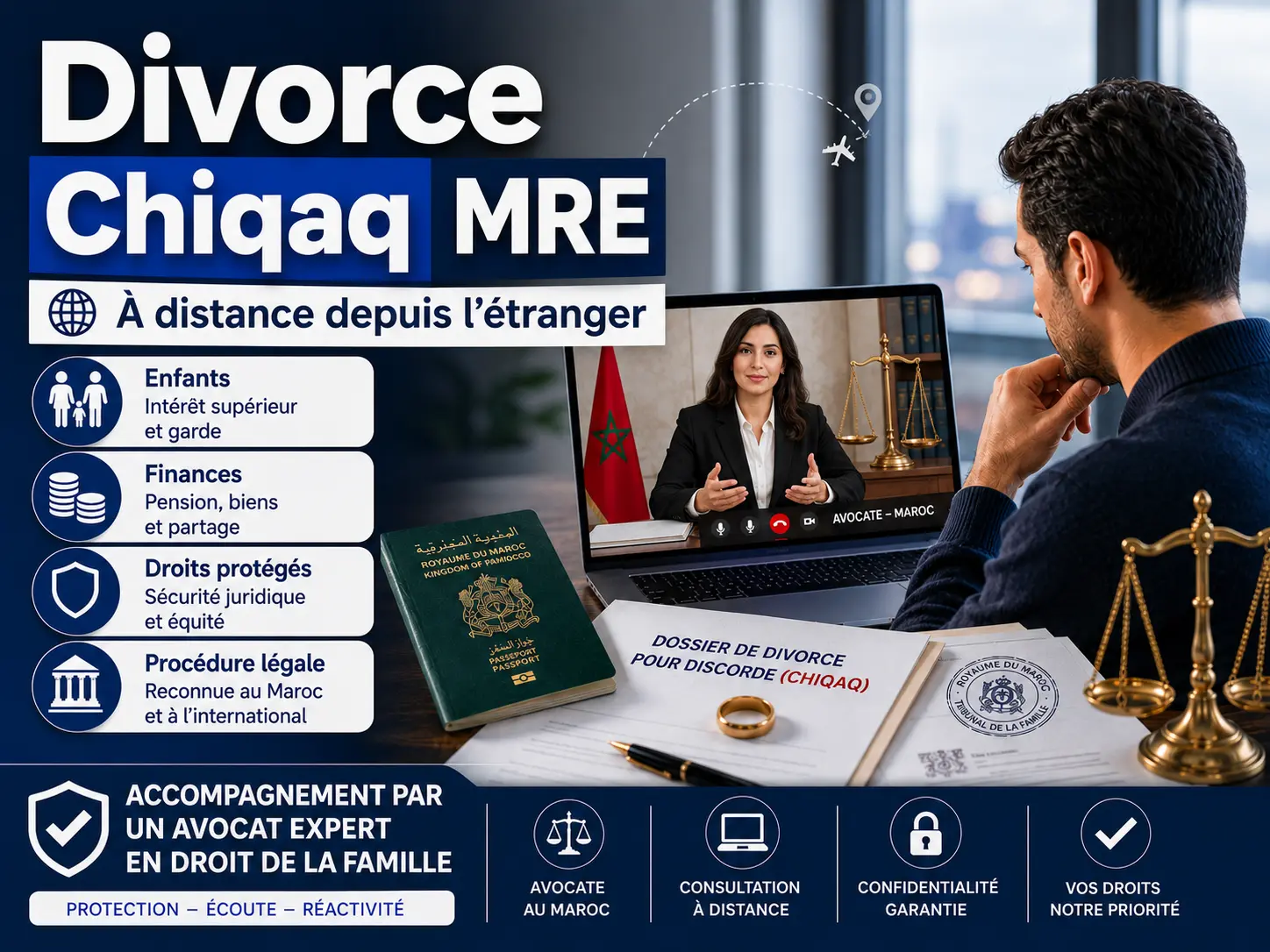
This is undoubtedly the major and most popular innovation of the reform. Planned by the Articles 94 to 97, divorce due to discord (or Chiqaq) responds to a simple reality: sometimes, living together becomes impossible, without the need to prove a "criminal" fault.
If you can still communicate with your spouse, that's the best way forward.article 114 allows the spouses to agree on the principle of the separation and, above all, on its conditions.
This is a specific procedure (Articles 115-120) where the wife "buys" her freedom. The spouses agree to divorce in exchange for compensation (often material or financial) provided by the wife.
Article 98 allows a wife to request a judicial divorce for specific, provable, and serious reasons. It is a more "technical" procedure that requires a strong case.
To clearly visualize your options, here is a structured comparison of the legal avenues available under the nouvelle loi Divorce Morocco.
Procedure | Reference Articles | Key Condition | Role of the Court | Legal Deadline (Indicative) |
Discord (Chiqaq) | Art. 94 – 97 | Persistent conflict making communal living impossible. | Attempt conciliation, appoint arbitrators, determine faults and compensation. | Max. 6 months (Art. 97). |
Mutual Consent | Art. 114 | The spouses fully agree on the separation and its effects. | Validates the agreement if it does not harm the children. | Fast (depending on space). |
Lack of Maintenance | Art. 102 – 103 | Non-payment of Nafaqa by the husband. | Checks solvency, orders payment or divorce. | Max. 1 month for the investigation (Art. 190). |
Absence | Art. 104 – 105 | Absence of spouse > 1 year. | Checks for absence and place of residence. | Variable depending on the survey. |
Redhibitory defect | Art. 107 – 111 | Serious illness or illness preventing intercourse. | Orders a mandatory medical examination. | Depending on the duration of the expert assessment. |

Let's now address the sensitive subject, but one that is essential for your future: money. New divorce law in Morocco, rights of the woman has established specific mechanisms to financially protect the wife and children.
Avant même que le divorce ne soit acté par les adoul (notaries), the spouse must deposit a sum with the court (Article 83). If this sum is not deposited within 30 days, the divorce petition is considered void (Article 86). This "package" includes, according to Article 84:
Article 187 is clear: "Everyone provides for their own needs through their own resources."However, the law mandates family solidarity.
The Child support in Morocco It covers much more than just food. According to Article 189, it includes:
How is it calculated? The court bases its decision on an average of the father's income and on the cost of living in the family's social environment (Article 190).
Please note : Any request for an increase or decrease in the pension cannot be made before one year, except in exceptional circumstances (Article 192).
This is a major step forward in the new reform of the Moroccan Family CodeArticle 168 stipulates that the accommodation costs for the child in custody are distinct child support and childcare compensation.
The father has two options:
Important : The child (and therefore the custodial mother) cannot be evicted from the family home until the father has complied with the court order concerning housing. This is a fundamental safeguard against precarious living conditions.
Type of Law | Legal Basis | Beneficiary | Calculation Method / Criteria |
Mout’â (Consolation) | Art. 84 | Wife | Duration of marriage, marital status, responsibility for the breakup. |
She (Widowhood) | Art. 84, 132-136 | Wife | Covers the 3-month period or pregnancy. |
Pension (Interview) | Art. 189-190 | Children | Father's income, child's needs, cost of living. |
Accommodation | Art. 168 | Children (+ Babysitter) | Estimated market rent or continued occupancy. |
Guard Wage | Art. 167 | Guardian (e.g., Mother) | Remuneration for childcare (excluding mother during marriage). |

In the turmoil of divorce, the child remains the absolute priority of Moroccan lawmakers. Book III of the Code devotes dozens of articles to the Child custody in Morocco, divorce.
Article 171 establishes a strict but clear hierarchy for the devolution of custody (And now) :
If none of these relatives can assume custody, the court will choose the most suitable relative, always in the sole interest of the child.
This is one of the most frequently asked questions. The answer is nuanced by Article 175. In principle, the remarriage of the mother results in the loss of custody. MOREHowever, there are crucial exceptions where it retains it:
Furthermore, if the person entitled to custody (for example, the father) remains silent for one year after learning of the mother's remarriage, he loses his right to claim custody (Article 176). This is a statute of limitations that protects the child's stability.
The parent who does not have custody retains a fundamental right: the right of visitation (Article 180).
Ideally, the parents agree on the arrangements (every other weekend, half of the holidays, etc.). Failing that, the judge decides (Article 182), specifying the times and places to prevent any manipulation or "fraudulent maneuver".

For the Moroccans Residing Abroad (MRE)Divorce is an equation with two unknowns: the law of the country of residence and Moroccan law.
Did you get divorced in France, Belgium, or the United States? This judgment is not automatically valid in Morocco. Article 128 specifies that foreign judgments are enforceable if they are issued by a competent court and based on grounds that are not incompatible with the Moroccan Code.
You will have to go through a procedureExequatur devant le tribunal marocain pour que votre divorce étranger soit transcrit sur vos registres d’état civil au Maroc. Sans cela, aux yeux de la loi marocaine, vous êtes toujours mariés (avec toutes les conséquences sur l’héritage et le remariage).
L’article 14 facilite la vie des MRE : vous pouvez contracter mariage selon les formalités administratives de votre pays de résidence, à condition de respecter les conditions de fond (consentement, capacité, absence d’empêchements) et d’avoir deux témoins musulmans. Pour le divorce, la logique est similaire : le respect des droits fondamentaux de la défense et des principes de la Moudawana est impératif pour la validation au Maroc.
Divorce is not a failure, it is a legal transition. New divorce law in Morocco The 2004 law, although it may seem complex, offers a protective and structured framework. It replaced arbitrariness with procedure, and unilateral action with adversarial proceedings.
Whether you are facing a procedure divorce rapide au Maroc via le consentement mutuel, ou engagé dans un divorce pour discorde (Chiqaq), the key lies in preparation. Understanding the difference between Mout’a and PensionKnowing your housing rights, anticipating the issue of custody in case of remarriage: this is what will make the difference between a case that is endured and a case that is controlled.
While the debates on a new reform of the Moroccan Family Code (Potentially expected around 2025) intensify, but the current framework remains your only applicable legal reality. Don't let rumors or hearsay guide your decisions. Your assets, your family, and your future deserve the precision of the law.
Your situation is unique, your defense must be too.
Don't remain in doubt. The law is a dynamic field that must be assessed on a case-by-case basis. To transform this information into a winning strategy, professional guidance is essential.
Take action now. Contact the office of Master Amal AnouideA lawyer specializing in family law is available for in-depth consultations. Together, we will make the law your best ally in writing the next chapter of your life.
As experts, we receive questions daily about the practical application of the law. Here are the legal answers to the most frequently asked questions during consultations.
The fastest procedure is undoubtedly the divorce by mutual consent (Article 114), because it is based on a pre-established agreement between the spouses. However, in the event of a conflict, the divorce due to discord (Chiqaq) is the most efficient way. Unlike older procedures that could last for years, thearticle 97 The Family Code requires the court to rule on the case within a maximum period of six months.
The Mout’â is compensation paid to the wife after the divorce. According to thearticle 84Its amount is not fixed but left to the judge's discretion, based on three criteria:
This is a major concern. In principle, the mother's remarriage lowers the guard. However, Article 175 provides for important exceptions. The mother retains custody if:
No, it's a fundamental distinction of the New divorce law in Morocco. L’article 168 clearly stipulates that accommodation costs are distinct child support (Pension), of the remuneration for childcare and other expenses. The father must either provide accommodation in kind or pay a rental amount fixed by the court.
Not automatically. For a foreign judgment to be recognized in Morocco, it must go through a specific procedure.Exequatur (Article 128). The Moroccan court will verify that the foreign judgment is not contrary to Moroccan public policy and that it was issued by a competent court. Without this step, you remain married in the eyes of the Moroccan administration.
Failure to maintain the property is a valid ground for judicial divorce (TatliqAccording to thearticle 102If the husband refuses to pay despite having the means, the court can grant the divorce immediately. If he is insolvent, the court will grant him a grace period (maximum 30 days) before granting the divorce. Furthermore, desertion of the family is a criminal offense.
L’article 171 establishes a clear order of priority for custody (And now) :