Key Points to Remember:
The New law divorce in Morocco In 2026, judicial oversight was strengthened to ensure fairness between spouses and the protection of children. Understanding the different forms of dissolution and procedural timelines is essential to securing one's financial and family rights. This article analyzes current reforms, maintenance obligations, and specific procedures for Moroccans residing abroad.
L’Article 78 of the Moudawana stipulates that the Divorce is the dissolution of the marriage contract exercised under the supervision of the justice system. Moroccan law requires that anyone wishing to divorce must request authorization from the court of the marital home or the wife's home.
The New divorce law in Morocco stipulates that a divorce can only be validated if it is formalized by two Adoul Dissolution is permitted only after judicial authorization. Any separation outside of this framework is subject to penalties and has no legal effect on the civil status of the spouses.
L’Article 94 of the Moudawana governs divorce due to discord (sure), initiated when a deep disagreement makes living together impossible. This procedure is the most frequently requested because it allows either spouse to request a legal separation.
The family court must attempt a conciliation between the spouses in chambers. If mediation attempts fail, the judge pronounces the divorce and ruling on rights financial within a period not exceeding six months.
L’Article 114 of the Moudawana It allows spouses to agree on the principle of separation, with or without conditions. This type of divorce, known as consensual divorce, requires the submission of a written agreement document to the court.
The court attempts to reconcile the parties before authorizing the Adoul to draw up the divorce decree. This procedure is irrevocable once it is initiated, guaranteeing a quick and less conflictual separation for the children.

L’Article 115 of the Moudawana defines the khol' such as a buyout divorce where the wife offers financial compensation to the husband. If the spouses agree on the principle but disagree on the amount, the court intervenes to determine the sum.
The judge assesses the compensation taking into account the duration of the marriage and the amount of the dowry (Charity) and the reasons for the divorce. If the wife is a minor, the consent of her legal representative is mandatory to validate the financial compensation.
L’Article 84 of the Moudawana clarifies the rights due to the wife, including the remainder of the dowry, the widow's pension (She) and the gift of consolation (Mout’â). The New divorce law in Morocco insists on the evaluation of the Mout’â depending on the husband's financial situation.
The obligation to Alimony (allowance) covers food, clothing, medical care, and housing. In case of refusal to comply, the tribunal may order a withholding tax or apply criminal penalties for abandonment of family.
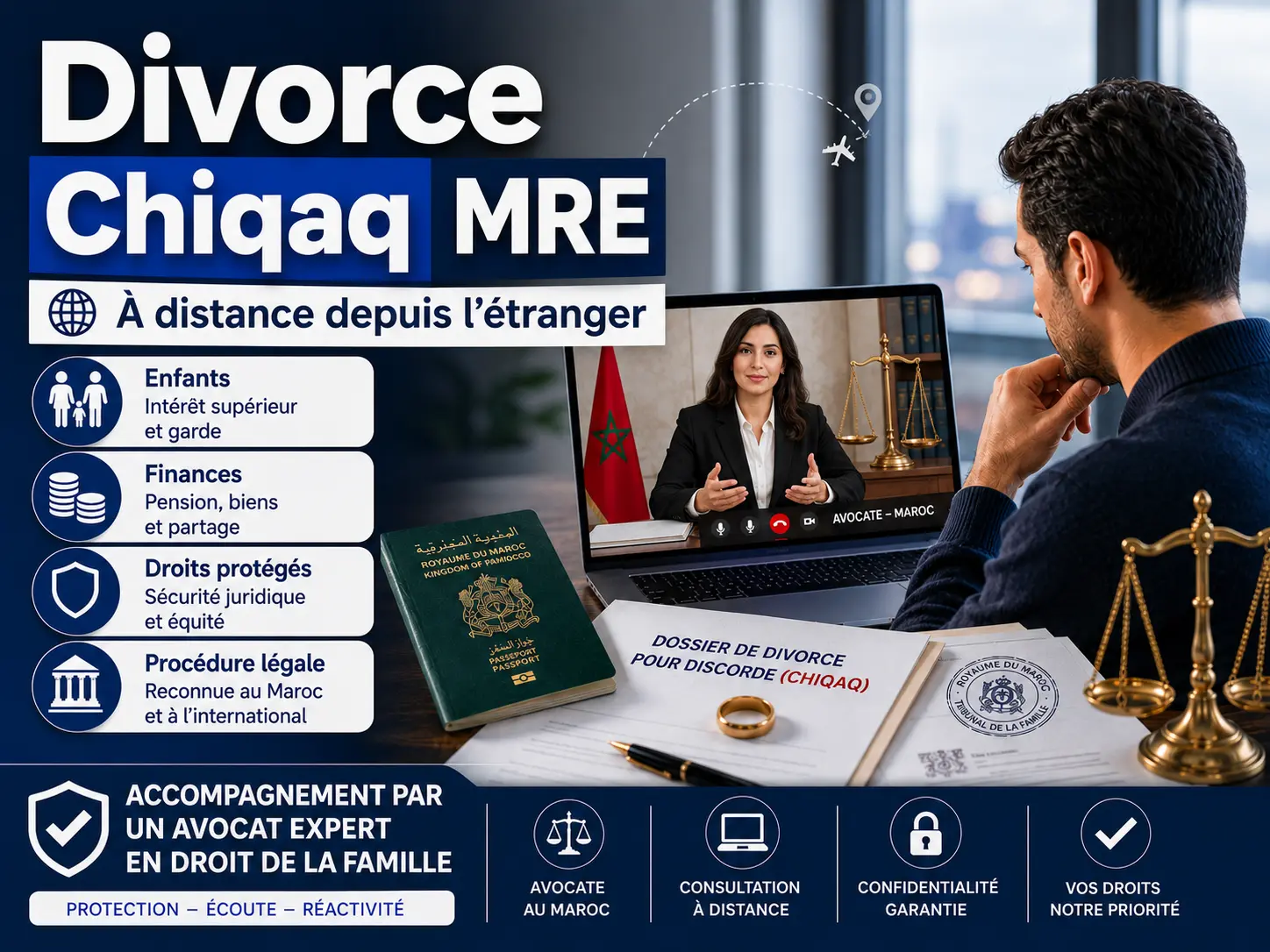
L’Article 400 of the Moudawana serves as the legal basis for authorizing certain divorce procedures by proxy for Moroccans residing abroad. This provision makes it possible to overcome the impossibility of physical travel in extreme cases.
The Master's Office Amal Anouide report them Moroccans Residing Abroad that legal assistance is crucial for managing international notifications and theexequaturForeign documents must be sworn translated and consular legalized to be valid in Morocco.
The divorce procedure unfolds in several key stages, detailed in the following table in accordance with Articles 79 to 97 of the Moudawana :
Stage | Action required | Legal basis | Observation |
1. Deposit | Written request to the family court | Art. 79 | Attach the original marriage certificate |
2. Convocation | Notification of the other party by the registry | Art. 81 | Mandatory attendance or representation |
3. Conciliation | Session in the council chamber | Art. 82 | An essential step before any judgment |
4. Judgment | Determination of rights and authorization | Art. 84 | The judge assesses the Mout’â and the Pension |
5. Instrumentation | Drafting of the deed by two Adouls | Art. 87 | Final validation of the dissolution |
The complexity of the New divorce law in Morocco requires appropriate legal support from the outset. Early consultation with the Master's Office Amal Anouide allows you to:
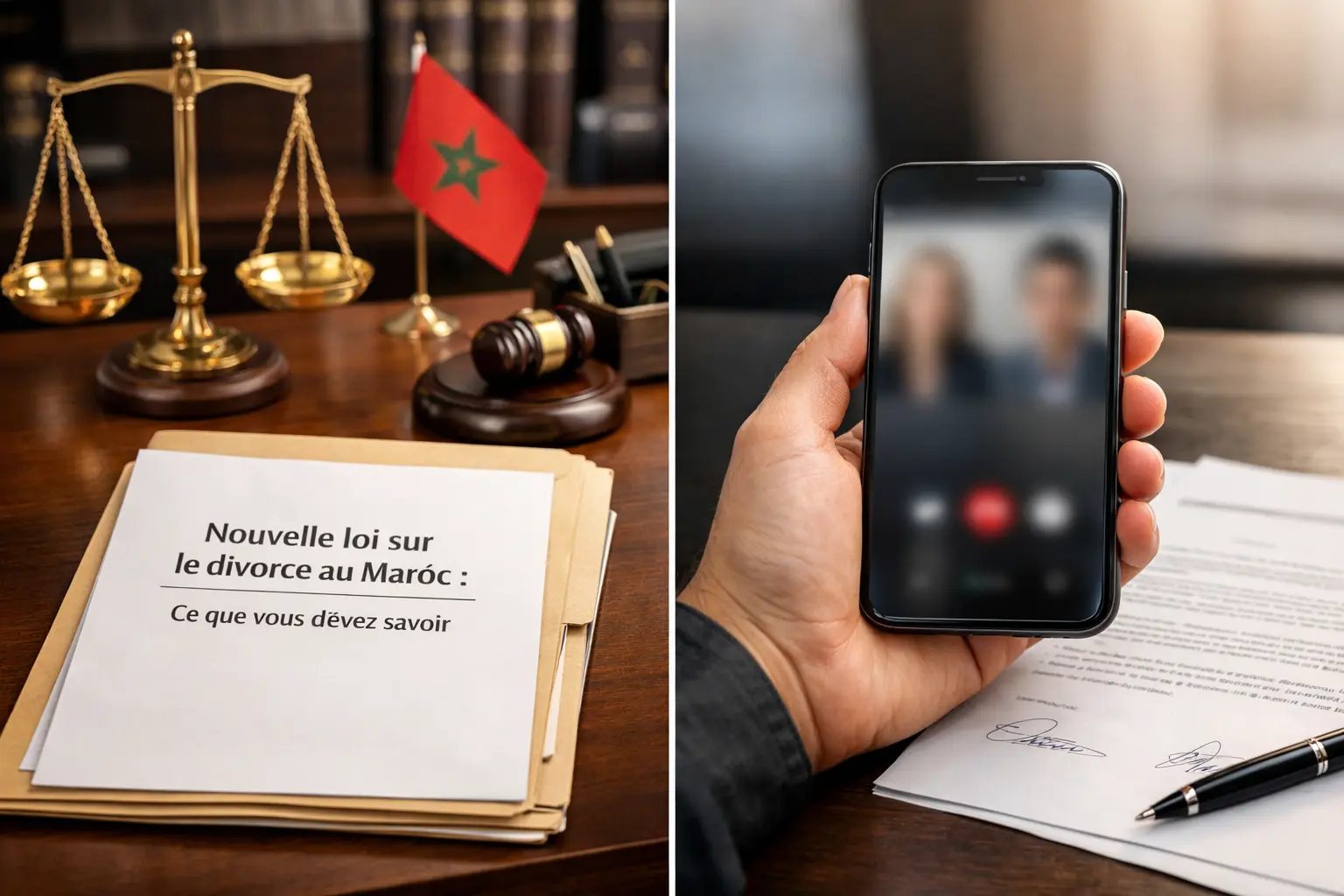
The Law Firm of Attorney Amal Anouide in Safi accompanies litigants throughout Morocco, with the possibility of remote consultation (WhatsApp, Video conferencing) for remote customers and Moroccans Residing Abroad.
Phase 1: Preparation (before filing a claim with the court)
Phase 2: Legal proceedings (after filing the application)
R : L’Article 97 of the Moudawana requires the court to rule within a maximum period of six months from the date the application is filed.
A: Yes, if the husband refuses the maintenance without proving his indigence, the court can pronounce the divorce after a period of 30 days. Legal basis: Article 102 of the Moudawana.
R: The Family Code allows the judge to authorize the power of attorney in exceptional cases for residents abroad, by referring to theArticle 400.
A: They include the remainder of the Charity, the pension for the period ofShe and the gift of consolation (Mout’â). Legal basis: Article 84 of the Moudawana.
A: No, the husband's obligation to provide maintenance remains regardless of the wife's income, according to established case law.
Law Firm – Safi Bar Association Consultations by appointment (in person or remotely) 📍 Address No. 9, Ait Ourir Street, Sidi Ouassel district, Safi, Morocco 📞 Phone : +212 648 933 990 📧 Email : avocateanouide@gmail.com 💬 WhatsApp +212 648 933 990 (remote consultations available) 🌍 Specialties : Family LawReal estate law, Criminal law, Labor law Consultations in French and Arabic | Support for Moroccans Living Abroad
Legal warning This article provides general legal information on the New divorce law in Morocco This does not constitute personalized legal advice. Each situation has its own specific characteristics requiring in-depth analysis by a lawyer. The information is valid as of the date of publication and is subject to legislative changes. Cabinet Anouide cannot be held responsible for decisions made solely on the basis of this article without prior consultation.
Legal Sources Legislation :

Attorney Amal Anouide, a member of the Safi Bar Association for over 13 years, is a recognized specialist in Moroccan family law (Moudawana). She assists a national and international clientele, particularly Moroccans residing abroad (MREs), offering rigorous legal solutions and remote consultations via videoconference.