Key Points: The Essentials of Divorce in Morocco (2026)
This strategic summary presents the critical information for navigating the Moroccan Family Code (Family Code) and the Family Court.

This guide provides a legal and practical analysis of the divorce procedure in Morocco, in accordance with Family Code (Moudawana). Its objective is to clarify each step of the process, from the initial request to the final judgment, in order to enable informed decision-making. This article provides direct answers to fundamental questions raised by divorce proceedings.
Who is this guide for?
This guide is for anyone considering or going through divorce proceedings in Morocco who wants to understand, step by step, what the Family Court requires and decides. It is particularly useful if you are:
Types of Divorce and Duration
Moroccan law primarily distinguishes between two paths. The divorce by mutual consent is a quick procedure, contingent upon a complete agreement between the spouses on all the consequences of the separation. In contrast, the divorce for discord (True) is a contentious legal procedure initiated in the event of disagreement. In accordance with Article 97 of the Family CodeThe court is required to rule on the application within a maximum period of six monthsAlthough this is the legal timeframe for the initial proceedings, the actual duration can sometimes be longer depending on the complexity of the case or any appeals.
Costs and Financial Aspects
The costs of a divorce procedure in Morocco include all court fees, professional fees and financial obligations imposed by the court in order to protect the rights of the wife and children.
The costs of the procedure include fixed court fees, fees of a lawyer, and the deposit of the wife's financial rights. The calculation of the alimony (Nafaqa) and the liquidation of assets are arbitrated by the judge, who bases his decision on the respective incomes of the spouses and the financial needs of the family.
Child Protection
The protection of children during a divorce in Morocco is governed by the fundamental principle of the best interests of the child, enshrined in the Moudawana and systematically applied by the courts.
The childcare (Hadana) is a central decision made by the court by systematically prioritizing the best interests of the childThe judgment precisely sets out the terms of the visitation rights for the non-custodial parent and the amount of child support due for the maintenance and education of the children.
This guide details the four procedural phases before the Family Court, from the filing of the petition and the mandatory conciliation attempt to the pronouncement and notification of the judgment. The objective is to provide you with the essential legal information to understand your rights, anticipate the steps, and collaborate effectively with a lawyer specializing in this area. Family Law they have Morocco.

The first obstacle is understanding the different options. Besides divorce by mutual consent, Moroccan law (Moudawana) distinguishes several forms of divorce: 1. Divorce under judicial supervision: Requested by the husband.
The wife can request a judicial divorce for one of the six causes following, in accordance with Article 98 of the Family Code:
However, understanding these options is the first fundamental step to regaining control of your situation.
It's not just a matter of terminology; choosing the right path has a direct impact on the duration, the cost of divorce proceedings in Moroccoand the level of conflict you will endure.
According to Article 71 of the Family Code, marriage can be dissolved in five ways: by the death of one of the spouses, by termination, by divorce under judicial supervision (whether initiated by the husband or by mutual consent), by judicial divorce (Tatliq) requested by the wife, or by divorce with compensation (Khol').
Type of Divorce | Who Is It Really For? | Advantages & Key Objectives | Points of Vigilance & Reality on the Ground |
Divorce by Mutual Consent | For couples who, despite the breakup, are able to communicate and agree on all The consequences: child custody, alimony, division of assets. | Speed and Savings: This is by far the fastest and least expensive procedure. Preservation: Less conflict means less trauma for children and for yourself. | The keyword is "total agreement"A poorly drafted agreement creates a risk of post-divorce disputes. If it omits essential clauses (e.g., alimony reassessment, visitation arrangements), it can be challenged later. A lawyer ensures that the agreement is legally sound to prevent these future conflicts. And divorce lawyer in Morocco ensures that the agreement is balanced and protects your rights in the long term. |
Divorce for Discord (True) | This is the most frequent case, ahead of the family court in MoroccoFor couples where communication has broken down, where grievances run deep, and where an amicable agreement is simply impossible. | A Guaranteed Way Out: It allows a divorce to be obtained even if the other spouse refuses or obstructs. Protection by the Judge: It is the judge who will determine all rights (pension, etc.), offering a protective legal framework if you fear not getting what is owed to you. | Expect a longer, more expensive, and emotionally draining process. The process includes attempts at mediation and the appointment of arbitrators, which lengthens the proceedings. stages of divorce in Morocco. |
Divorce with Compensation (Khol') | Primarily for the wife who wishes to initiate divorce proceedings but cannot prove specific harm, and who is willing to give up some of her financial rights in exchange for her freedom. | Initiative and Speed: It gives the wife a powerful tool to end the marriage quickly, without having to prove any "fault" on the part of the husband. | The "compensation" must be negotiated carefully. Without the help of a lawyer specializing in divorceYou risk giving up much more than necessary. This is not a "sale" of your rights, but a specific legal mechanism. |
The type of divorce proceedings The choice of divorce court directly determines the duration, cost, and level of conflict in the legal proceedings before the Family Court. This initial decision will define the scope of the battle, the length of the fight, and the resources you will need to dedicate to it. The divorce process in Morocco is divided into four procedural stages. the Family Court.
The 4 stages of the divorce procedure in Morocco (Moudawana):
The judicial process consists of the filing of the initial application, the mandatory conciliation hearing, the determination of financial rights, and the pronouncement of the final judgment by the family court at Morocco.
The procedure begins with the filing of a initial request written to the clerk of the Family Court.
The Initial Request is the legal document filed with the clerk of the Family Court to initiate divorce proceedings.
The starting point of all The procedure is the filing of a divorce petition (Application) to the clerk of the Family Court. This is the founding act that formalizes your intention and initiates the legal process.
Perspective d’Expert : Never underestimate this first step. A well-prepared, clear, and precise petition from your lawyer lays the foundation for a smoother process. It's your first official communication with the legal system; it sets the tone for everything that follows.

The conciliation hearing is a judicial mediation This mandatory procedure aims to determine the success or failure of dialogue between the spouses. The wife's financial stability is guaranteed during the procedure by the judicial determination of alimony (Nafaqa) and housing allowance.
L’conciliation hearing mandatory is a pillar of the Moroccan family codeIts aim is not confrontation, but the search for a solution under the guidance of a judge.
If there are children, the court must undertake two attempts at reconciliationspaced at least thirty days apart
Moroccan law is protective. Even before granting a divorce, the judge is obligated to ensure the financial security of the wife and children. This step is crucial to guaranteeing your stability.
Perspective d’Expert : This is a crucial point of no return. If conciliation fails, the spouse must deposit the sums set by the court within a period not exceeding thirty daysUntil this sum is deposited, the divorce decree cannot be issued. This is a fundamental safeguard that protects the wife from sudden financial hardship.

The pronouncement of the divorce decree does not end the proceedings.
The procedure is legally complete only after official notification of the judgment by a bailiff and the expiry of the appeal period. (Fifteen days).
The procedure is only legally complete after the official notification of the judgment by a bailiff, which triggers the appeal period. The divorce becomes final after the expiry of this period.
The oral pronunciation of divorce decree is an immense relief, but the legal end of the process requires one last formal step: the notification.
Once the process is demystified, essential and emotionally charged questions remain. This section addresses the three most frequent concerns regarding child custody, the costs of the procedure, and the length of the divorce process.
Child custody (Hadana) and child support (Nafaqa) are the priority issues in a divorce involving minors in Morocco.
The guiding principle, above all else: the best interests of the child.
Any decision by the judge regarding child custody is based exclusively on the best interests of the child.
the Child custody after a divorce in Morocco (the And now) will be guided by this one and only principle. The Moroccan Family Code establishes an order of priority (the mother, then the father, then the maternal grandmother), but the judge has the power to deviate from this order if he considers that the well-being of the child requires it (capacity, housing, morality).
Perspective d’Expert : THE husband's rights in case of divorce and the wife's rights Here, the interests of the child give way to those of the child. The debate is not about "who wins," but about "how to build the most stable and secure environment for the child." A good lawyer specializing in divorce He is not fighting for you, he is fighting for the future of your children.
The fear of unexpected expenses and an exorbitant final bill is a major source of stress. cost of divorce proceedings in MoroccoIt is divided into three main parts:
Strategic advice: Transparency is your best ally. Demand it from your lawyer a written and detailed fee agreement From the very first meeting, this document must clearly state the method of calculation (flat fee, hourly rate) and the scope of the service. It's your only guarantee against unpleasant surprises.
The anxiety of remaining "in limbo" for years is legitimate. The length of divorce proceedings in Morocco is not inevitable; it depends greatly on the path you take.
OUR law firm We recognize that every divorce case is unique. To ensure budget transparency, we provide a detailed fee agreement that explains our fee structure. We invite you to contact us for a personalized consultation.
The Next Step – How to Choose Your Ally and Take Action
Understanding procedural steps of divorce This is the basis for choosing appropriate legal representation. The following section details the criteria for selecting a specialist lawyer.
And divorce lawyer in Morocco is not simply a service provider; he is your strategic partner, your confidant, and your advocate during one of the most vulnerable periods of your life. Choosing him lightly would be a fundamental mistake.

Faced with a multitude of choices, focus on these three pillars to make your decision.
Contact our firm for an initial consultation to discuss your situation.
You have endured enough uncertainty. You deserve support that protects your rights as a spouse, secures your children's future and allows you to approach this new chapter with the serenity you aspire to.
Navigating this process alone is a risk you shouldn't take. Let an expert take the helm.
Our firm is dedicated to defending families and individuals going through the ordeal of divorce. We are here to listen to your story, assess your situation, and work with you to develop the fairest and most effective strategy.
Contact us today for a free, confidential consultation. It's the first concrete step towards your peace of mind.
Conclusion :
At the end of this guide, the divorce proceedings in Morocco It should appear less like an insurmountable mountain and much more like a marked path, with clear steps and rules. Our goal was to transform your anxiety into knowledge, and your confusion into strategy.
You now understand the fundamental difference between a divorce by mutual consent and one divorce for discord (True)You know that theconciliation hearing is a formal step, which the duration of the divorce proceedings can be controlled and that the cost is not an obscure inevitability, but a set of elements that can be anticipated.
Most importantly, you know that your rights, and especially those of your children, are at the heart of the concerns of Moroccan family codeWhether it's the Child custody, of the Alimony or of the just division of assets after divorceThe law has put in place safeguards to protect you.
The divorce decree is not an end in itself; it is the gateway to your future. The choice of your divorce lawyer in Morocco is the key that will allow you to cross this threshold with confidence and not with fear.
Remember: this process, while difficult, is not the end of your story. It is the first page of a new chapter that you now have the power to write.
You must gather the following documents: your original marriage certificate, your identity documents (national identity card or passport), and the children's birth certificates. Your lawyer will handle the official request to complete the divorce file.
The average duration varies depending on the type of procedure, the level of conflict between the spouses, the court's workload, and the completeness of the case file. In this regard:
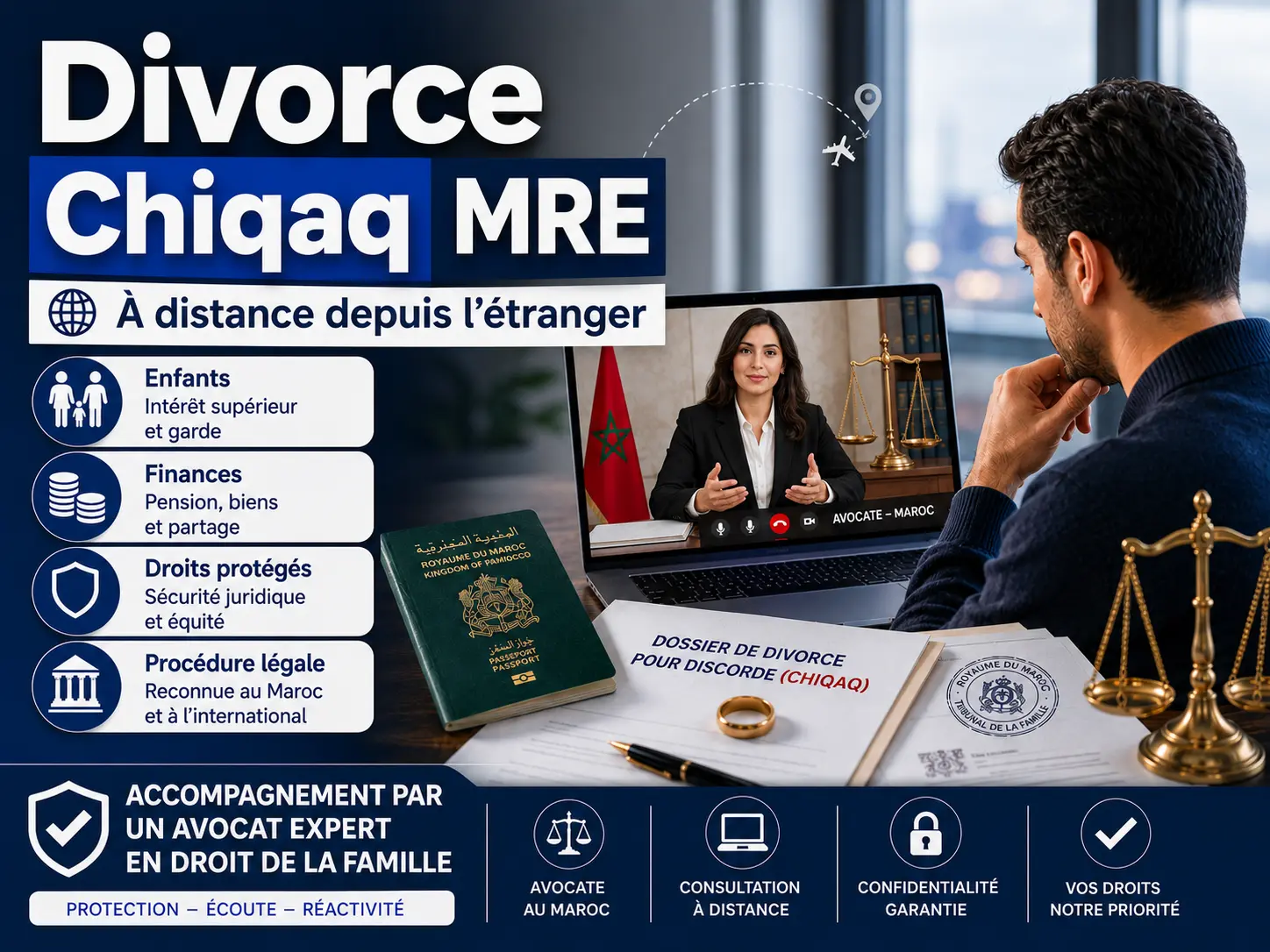
Absolutely. The procedure for Moroccans residing abroad (MREs) is common. The Moroccan court has jurisdiction, and it's often the simplest solution, especially if the marriage took place there. Specific steps (exequatur) are then required to have the judgment recognized in your country of residence.
The choice between divorce by mutual consent and divorce for discord (Chiqaq) depends on the degree of agreement between the spouses on custody, property and financial obligations.
Mutual consent is the best option if you agree on everything (custody, property, alimony). It's faster and cheaper. Dispute resolution (Chiqaq) is the only solution if an agreement is impossible and you need a judge to decide.
If he refuses an amicable agreement, you cannot remain stuck. The law protects you. You must initiate divorce proceedings based on discord (Chiqaq). After an attempt at reconciliation, the judge can grant the divorce even without the other party's consent.
A member of the Safi Bar, Amal Anouide has over 13 years of experience within the Moroccan judicial system. A true guardian of the law, she has established herself as a leading figure in the application of the Moudawana (Family Code) and the defense of the interests of individuals and businesses. Her firm, renowned for its rigor and compassion, combines in-depth knowledge of legislation with a modern approach to client relations, particularly for Moroccans residing abroad and international investors.