Alimony, called allowance In the Moudawana, it constitutes a legal obligation of maintenance arising from marriage, kinship, or a commitment. It is not limited to a simple monthly sum: it embodies the protection of the family, social equilibrium, and the effectiveness of judicial enforcement.
Contrary to popular belief, there is no single, automatic scale. The judge determines the amount on a case-by-case basis, taking into account the debtor's resources, the creditor's needs, the cost of living, and social customs. This approach makes the matter both technical and profoundly human.
In Moroccan law, the allowance This refers to the legal obligation of maintenance, particularly between spouses and for the benefit of children. The Moudawana specifies that this obligation arises from marriage, kinship, and commitment, and covers food, clothing, medical care, children's education, and everything else that is usually considered essential.
La pension alimentaire occupe une place centrale dans les contentieux familiaux, car elle touche à la stabilité matérielle des enfants, à la dignité de l’épouse et à l’exécution concrète des droits après séparation ou divorceThe Family Code a d’ailleurs renforcé cette protection en instituant une justice de la famille spécialisée et en imposant un traitement rapide des litiges relatifs à la pension.
Le justiciable recherche souvent un chiffre précis, alors que la loi raisonne en critères, non en forfaits. Ainsi, le montant de la pension alimentaire par enfant au Maroc n’est jamais fixe : il dépend d’un examen individualisé du dossier, des preuves produites et du pouvoir d’appréciation du juge.
Article 189 stipulates that maintenance includes food, clothing, medical care, education, and everything else that is essential. In practice, the allowance covers basic living expenses as well as normal healthcare, hygiene, and daily living costs. The judge takes into account the child's age, health, and social circumstances: an infant, a school-aged adolescent, or a child with a disability will not have the same needs.
L’article 168 distingue clairement la pension alimentaire des frais de logement de l’enfant gardé. Le parent débiteur peut donc être tenu de verser, en plus de la nafaqa, une indemnité autonome pour le logement ou de payer le loyer fixé par le tribunal. L’enfant ne peut être contraint de quitter le domicile conjugal qu’après l’exécution du jugement relatif à son logement.
Children's education is explicitly included in maintenance (Art. 189). Registration fees, supplies, and ordinary school expenses are therefore taken into account, provided they correspond to the child's previous standard of living. In the event of divorce, Article 85 specifies that pension rights are based on living conditions and educational status prior to the separation, in order to avoid a sudden disruption of living standards.
The rules governing a wife's alimony differ from those concerning children. The husband must provide for his wife's maintenance from the moment the marriage is consummated, and this right remains even if the marriage is consummated after the marriage contract is executed. In the event of divorce, the wife may receive alimony during the waiting period (the period of mourning), the remainder of which is then paid to her husband. charity and, where applicable, housing costs. If the divorce is irrevocable and the ex-wife is pregnant, the alimony continues until the birth; otherwise, it is limited to housing until the end of the pregnancy.She.
Article 190 of the Moudawana states that the court relies on the statements of the parties, the evidence produced and, where appropriate, the opinion of experts.
Article 189 stipulates that the assessment of maintenance costs is based on an average of the debtor's income, the creditor's situation, the cost of living, and social norms. The judge examines salaries, rental income, professional resources, and, more broadly, indicators of the actual standard of living. Thus, a debtor who declares little income but maintains a high standard of living cannot evade their obligations.
Le créancier peut être l’épouse, l’enfant ou, dans certains cas, les parents. Pour les enfants, le juge considère l’âge, la santé, le niveau scolaire, les besoins quotidiens et les conditions de vie antérieures. Pour l’épouse, le droit dépend du cadre matrimonial et de la situation juridique du divorce. La protection des enfants s’étend généralement jusqu’à la majorité ; elle peut se prolonger jusqu’à 25 ans pour les études supérieures, voire au-delà pour les enfants handicapés.
Il n’existe pas de grille nationale imposant un montant uniforme de pension alimentaire par enfant. Le juge exerce un pouvoir d’appréciation, encadré par les articles 189 et 190, et peut recourir à des experts pour affiner l’évaluation des revenus ou des besoins. Cette absence de barème n’est pas un vide juridique, mais le résultat d’un choix législatif favorisant une appréciation individualisée plutôt qu’un automatisme parfois injuste.
Les demandes de pension alimentaire relèvent de la justice de la famille. Le Code de procédure civile modifié prévoit que ces demandes sont traitées en référé, avec des décisions exécutoires sur minute, même en cas de recours.
The judge must rule within a maximum period of one month; this speed constitutes one of the major innovations of the Moudawana.
The more complete the file, the more precise and appropriate the decision will be.
L’article 179‑bis du Code de procédure civile autorise le juge, dans le mois suivant la demande, à ordonner une pension alimentaire provisoire en fonction du bien‑fondé de la demande et des preuves présentées. Cette mesure urgente protège les familles qui ne peuvent pas attendre plusieurs mois sans ressources.
Article 191 allows the court to determine the means of enforcing the judgment: wage garnishment, asset seizure, or any other measure appropriate to the debtor's situation. The judgment remains in effect until another judgment replaces it or the right to a pension legally ceases.
Article 202 stipulates that non-payment for more than one month constitutes abandonment of family, punishable by law. This provision increases the pressure on recalcitrant debtors, without, however, replacing enforcement proceedings.
The text mentions the creation of a Family Support Fund, intended to support the implementation of the Family Code. Although the precise details are not outlined in this excerpt, this mechanism constitutes an institutional support tool when the practical enforcement of court judgments encounters difficulties.
Child support is not fixed. It can be revised if the child's needs change (health, education) or if the debtor's income changes.
Article 192 imposes a period of one year between two requests for modification, except in exceptional circumstances.
The judge re-examines these elements using the same method as during the initial determination, in order to restore the previous balance.
The child support in Morocco repose sur une idée simple : protéger concrètement l’épouse et, surtout, l’enfant, tout en imposant une mise en œuvre juridique exigeante. La Moudawana distingue les composantes de la allowanceseparates housing from ordinary maintenance, gives the judge individualised assessment power and provides for revision of the amount in the event of a real change in circumstances.
To delve deeper into issues related to child custody, child housing, or the effects of divorce, consult our main page. Expert Guide to Family Law in Morocco. In sensitive cases, particularly when setting or revising child support, the assistance of a lawyer specializing in family law remains the safest course of action.
Until what age must child support be paid for a son or daughter?
The father must provide for the child's maintenance until they reach the age of majority, or until age 25 for children pursuing higher education. The daughter retains her right to maintenance as long as she does not have her own resources or her husband is not responsible for her support.
What happens if the father resides abroad?
The text does not detail international enforcement procedures, but the maintenance obligation remains recognized under the Moudawana. The judge can order enforcement measures against the debtor's identifiable income or assets, even abroad.
Can the mother lose her pension rights if she remarries?
The mother's remarriage does not automatically result in the loss of her entitlement to child support (Art. 175). The father remains liable for maintenance. However, remarriage may affect certain expenses related to childcare or housing.
How is the pension calculated if the father is unemployed?
The law does not provide for a fixed amount. It stipulates that no one is liable beyond their means, but that each person is presumed solvent until proven otherwise. The judge then examines the reality of the indigence, the available resources, and the creditor's needs.
Can the pension be paid directly in cash?
The text does not prohibit direct payment, but in case of dispute, the safest method remains that fixed or controlled by the courts, as it facilitates execution and proof of payment.

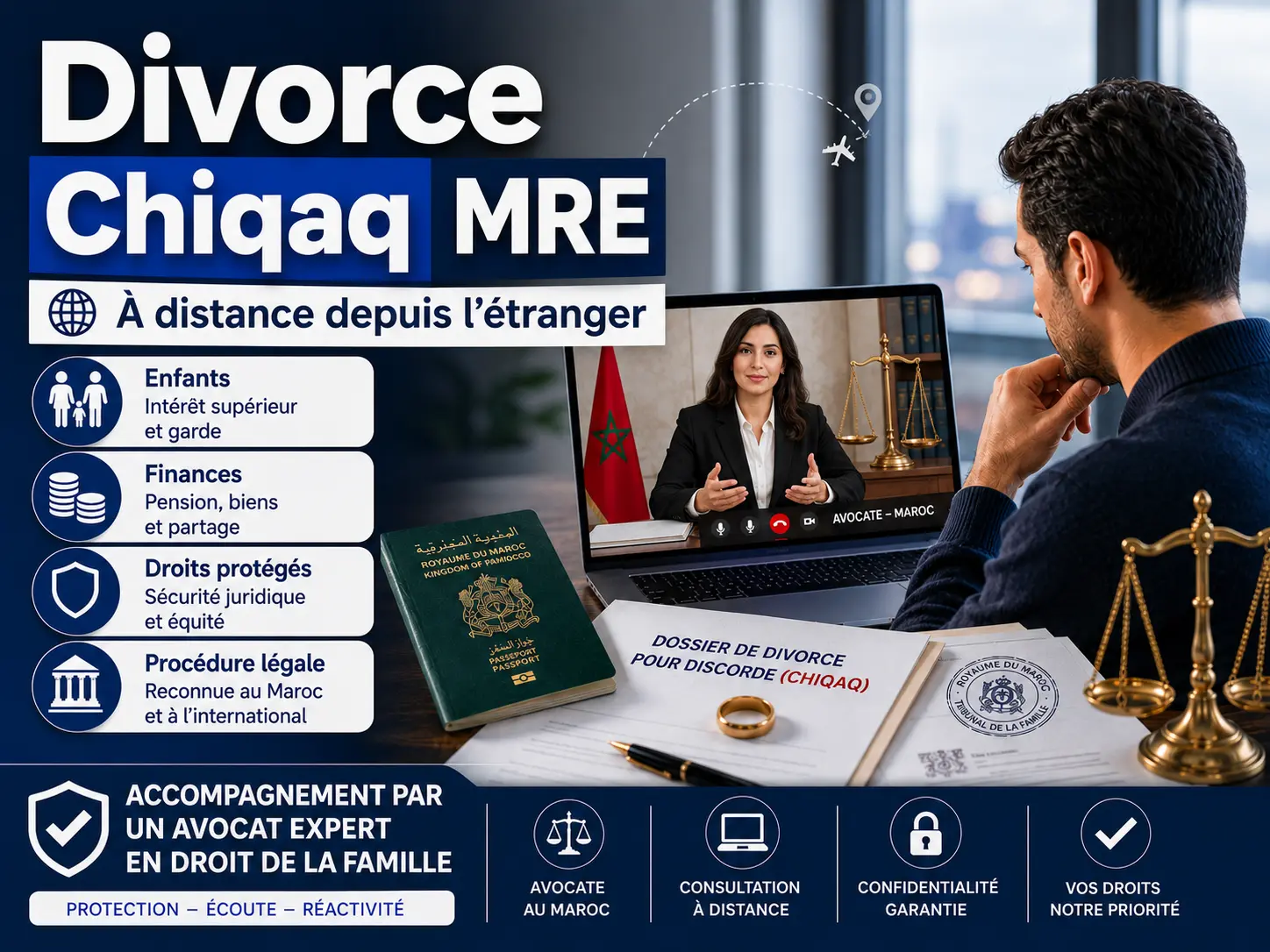
Attorney Amal Anouide, a member of the Safi Bar Association for over 13 years, is a recognized specialist in Moroccan family law (Moudawana). The Anouide Law Firm assists national and international clients, particularly Moroccans residing abroad (MREs), offering rigorous expertise to ensure the enforcement of their rights in Morocco.