

Marrying a foreign spouse in Morocco is a life project, but also a complex legal and administrative operation that requires rigorous preparation.
Between the rules of the Moudawana, the requirements of consulates, residency issues and inheritance consequences, the support of a specialist lawyer Foreign marriage has become a real strategic asset.
Mixed marriages are steadily increasing: in France, approximately 14% of unions involve couples of different nationalities, and a significant proportion involve spouses from the Maghreb, including many Moroccans.
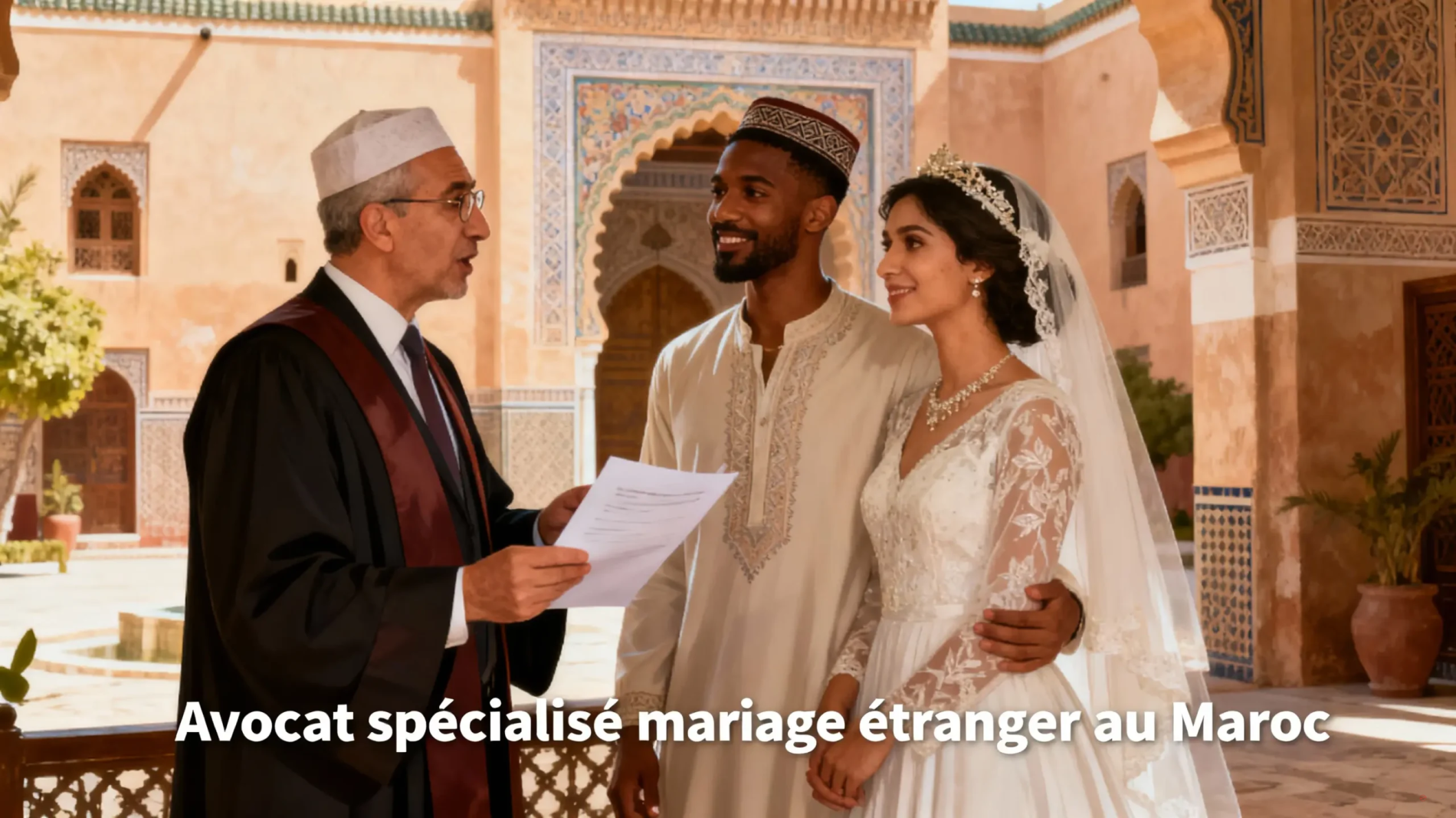
In this context, Amal Anouide A lawyer specializing in foreign marriage in Morocco assists Franco-Moroccan and international couples to secure each step, from the marriage project to the transcription and residence permit.
Key points

Recent data shows that the Mixed marriage is no longer marginal, even if it remains a minority in proportion to all marriages.
The strong presence of the Moroccan diaspora in Europe, and particularly in France, contributes to the increase in unions involving at least one Moroccan spouse.
Summary table of some key figures:
|
Indicator |
Figure / trend |
|
Mixed marriages in Morocco (2017–2021) |
27,626 mixed marriages out of 1.17 million unions registered during the period |
|
The proportion of Moroccan women in these unions |
Approximately 72.93% of Mixed marriages involve Moroccan women marrying foreigners in 2021 |
|
Franco-Moroccan marriages in France (2015) |
Nearly 3,860 marriages between French and Moroccans were celebrated in France in 2015. |
|
Percentage of mixed marriages in France (2015) |
Approximately 14% of marriages involve a foreign spouse, across all countries. |
|
Demandes de mariage mixte devant les tribunaux marocains (2023) |
9,432 applications for authorization of mixed marriage, of which 8,318 were authorized. |
These figures illustrate the need for clear and secure procedures, and justify why more and more couples are turning to a lawyer specializing in foreign marriage to avoid roadblocks.
A mixed marriage involves the articulation of several legal systems: Moroccan law (Moudawana, civil status), the law of the foreign spouse's country (for example, French law) and rules of private international law.
A lawyer specializing in foreign marriage identifies the law applicable to the celebration of the marriage, the matrimonial regime, the filiation and, where applicable, the divorce, in order to reduce the risks of conflicts of laws and invalidity.
It anticipates the requirements of the Moroccan authorities (authorization of the King's prosecutor, religious conditions, marital capacity) as well as those of the foreign authorities (certificate of capacity to marry, publication of banns, control of the absence of bigamy or obstacles).
This global perspective helps prevent a marriage that is valid in one country from being challenged or not recognized in another.
The choice of matrimonial property regime, the drafting of an international marriage contract, and the proper registration of the marriage are essential for protecting the couple's assets and inheritance rights.
And specialist lawyer analyzes the situation of the future spouses (assets in Morocco and abroad, children from a previous marriage, inheritance plans) to recommend the most suitable structure.
In the event of separation or death, the existence of a registered marriage certificate and a clear matrimonial property regime facilitates the division of assets, the determination of alimony, and the protection of the best interests of the children.
Legal support also reduces the risks associated with international custody and the illegal movement of children between France and Morocco.
A significant proportion of delays and refusals of mixed marriages stem from incomplete files (missing documents, non-compliant translations, lack of apostille, expired CCAM, civil status errors).
A lawyer specializing in foreign marriages checks each document beforehand, coordinates certified translations and legalization, and prepares the application for submission to Moroccan and consular authorities.
This professional preparation limits postponements, shortens delays, and ensures the secure transcription of the marriage in the Moroccan civil registry as well as in the French consular registers.
For couples living in France, this then facilitates obtaining a residence permit for the foreign spouse and access to social rights.
The Moudawana fixe les conditions de fond du mariage au Maroc : capacité matrimoniale, consentement, absence d’empêchement légal (parenté, alliance, polygamie non autorisée, etc.).
In principle, the minimum age for marriage is 18, with strictly regulated judicial exemptions, and the announced reform of Family Code aims to further strengthen the protection of minors.
For mixed marriages, prior authorization from the King's prosecutor is practically essential before the ceremony, including when the marriage takes place abroad and then needs to be recognized in Morocco.
Religious conditions remain central: a Moroccan Muslim woman can only marry a Muslim man, which implies, where applicable, a formal conversion of the foreign husband.
The list of required documents varies depending on the nationality and situation of each spouse, but generally includes: a full birth certificate, an identity document, a certificate of celibacy or capacity to marry, a criminal record check, a medical certificate, and proof of residence.
For the foreign spouse, a certificate of capacity to marry or a certificate of custom is often required by their country's consulate and must be legalized or apostilled according to international regulations.
Documents written in a foreign language must be translated by a sworn translator recognized by the Moroccan courts, and then, if necessary, legalized or apostilled to be admissible.
The lawyer ensures the consistency of information (name, surname, dates, parentage) across all documents to avoid suspicions of fraud or refusals of registration.
Here is a summary table of the documents most often requested for a mixed Moroccan-foreign marriage (to be adapted to each situation with a lawyer specializing in foreign marriage):
|
Key element |
Moroccan spouse (indicative) |
Foreign spouse (indicative) |
|
Birth certificate |
Extract or recent full copy issued by the Moroccan civil registrar |
A recent, legalized or apostilled, full copy with a sworn translation into Arabic/French |
|
Proof of identity |
Valid national identity card or passport |
Valid passport and, where applicable, residence permit or proof of residence |
|
Certificate of celibacy / capacity |
Certificate of celibacy or equivalent document issued by the Moroccan authorities |
Certificate of capacity to marry or customary law issued by the competent consulate or embassy. |
|
Criminal record |
Extract from the Moroccan criminal record or anthropometric record, as appropriate. |
Extract from criminal record of country of origin or residence, translated and legalized/apostilled |
|
Religious certificate / conversion |
Where applicable, attestations relating to religious practice or conversion |
Certificate of conversion to Islam if required for marriage to a Moroccan Muslim woman |
|
Home address and social situation |
Proof of address, employment status and income if requested |
Proof of local or foreign residence, income, previous marital status |
A lawyer specializing in foreign marriages verifies the consistency of all these documents (names, dates, parentage) to avoid suspicions of fraud or postponements of the case.
Polygamy remains strictly regulated and subject to judicial authorization, with conditions of motivation and financial capacity that are very difficult to meet in practice.
Proposed reforms to the Family Code tend to further restrict this possibility, particularly in cases where monogamy is an explicit condition of marriage.
In cases of religious difference, conversion requirements can hinder marriage plans if they are not addressed both legally and ethically.
For future spouses who are minors, judicial authorization is exceptional and closely monitored, with a high risk of invalidation if the procedure has not been fully respected.
The first task of a lawyer specializing in foreign marriage is to conduct a complete audit of the future spouses' situation: nationalities, places of residence, previous marital status, children, assets, and life plans.
This audit helps determine the applicable law, the competent jurisdiction in the event of future disputes, and the best strategy for celebrating and recognizing the marriage in both countries.
The lawyer also identifies areas of concern: discrepancies in spelling on the documents, lack of transcription of a divorce Foreign nationality, inconsistencies in dates, or even the risk of refusal based on religious requirements.
Depending on the couple's profile, he defines a realistic timeline and action plan including the necessary consular, judicial, and notarial procedures.
The lawyer assists the couple in gathering all the necessary documents: recent birth certificates, certificates of celibacy, attestations of non-polygamy, criminal record, proof of residence, identity documents, and photographs.
In case of loss or error, he arranges requests for duplicates with the Central Civil Registry Service in France, Moroccan municipalities, or the relevant consulates.
He oversees certified translations and the legalization/apostille of foreign documents to guarantee their admissibility before Moroccan and consular authorities.
This advance preparation significantly reduces the risk of the case being postponed or of suspicion of a fraudulent marriage.
For Franco-Moroccan couples, applying for a certificate of capacity to marry (CCAM) from the French consulate in Morocco is a key step.
The lawyer prepares the CCAM file, anticipates the publication of the banns, and ensures that the deadlines, generally several weeks, are met before the certificate is issued.
He communicates with consulates, notaries, civil registrars, and, if necessary, the public prosecutor's office to streamline the procedure and quickly resolve any potential issues.
The presence of a structured legal advisor is particularly valued by government agencies, which helps to expedite the processing of complex cases.
The CCAM certifies that the future spouses meet the legal requirements for marriage in France and that no legal impediment has been identified.
The application is submitted to the relevant French embassy or consulate, based on a file including a birth certificate, proof of nationality, identity document, proof of address, and information about the future spouse.
The procedure includes the publication of marriage banns and, sometimes, an interview or hearing with the future spouses to verify the seriousness of their marriage plans.
An expired or non-compliant CCAM (Certificate of Capacity to Marry) may lead to the French administration refusing to subsequently recognize the marriage.
When a marriage is celebrated abroad (for example, at a town hall in France), its recognition in Morocco requires transcription in the Moroccan civil registry.
The spouses must submit a complete file (foreign marriage certificate, identity documents, proof of nationality, consular certificates and translations) to the relevant municipality or family court.
Once the transcription is completed, a Moroccan marriage certificate is issued, allowing the couple to assert their rights before all government agencies in the Kingdom (filiation, inheritance, family benefits, etc.).
Without this step, the recognition of marital status in Morocco remains fragile, with potentially serious practical consequences.
Without transcription, children may encounter difficulties obtaining consistent Moroccan civil status documents, which complicates travel, school registration, and certain administrative procedures.
Property rights (real estate acquisitions, inheritance, pensions) are also more difficult to assert in the absence of clear and recognized proof of marriage.
In the event of separation or death, the absence of a Moroccan marriage certificate can prolong procedures and create significant conflicts between families and heirs.
The specialist lawyer therefore ensures that the transcription is carried out on time, in accordance with the formal and substantive requirements.

After the marriage, regularizing the status of the foreign spouse is a priority, whether the couple settles in Morocco or France.
Depending on the circumstances, a long-stay visa, a residence permit for "spouse of a Moroccan" or "spouse of a French citizen," or other permits may be required depending on professional and family status.
The authorities generally require: a transcribed marriage certificate, proof of cohabitation, proof of income and housing, health insurance coverage, and sometimes certificates of non-polygamy.
A poorly prepared application risks visa or residence permit refusal, with direct consequences for the couple's life together and their plans.
The choice of matrimonial property regime (separation of property, community property, or personalized regime) has a major impact on the ownership, management, and division of the couple's assets.
In Morocco, the practice often favors a system similar to separation of property, but the Moudawana allows for the inclusion of specific clauses in a marriage contract.
For a Franco-Moroccan couple, it is often advisable to consider a marriage contract drawn up by a notary or a competent authority, then translated and legalized to be enforceable in both countries.
A lawyer specializing in foreign marriage advises spouses on the law applicable to their matrimonial property regime and coordinates, if necessary, with a notary and an international tax advisor.
The taxation of international couples depends on their tax residence, the country where their assets are located, and applicable tax treaties, particularly between France and Morocco.
A poor choice of asset structuring can lead to double taxation, high inheritance taxes, or obstacles during the transfer of assets.
The lawyer, in conjunction with a tax specialist, can propose solutions (prenuptial agreements, investment allocation, protection of heirs) to secure the transfer of assets.
These questions are particularly important when the spouses own property both in Morocco and in Europe.
In the event of separation, it is necessary to determine which court has jurisdiction (Moroccan or foreign jurisdiction) based on the nationality of the parties, their habitual residence, and the place where the marriage was celebrated.
The choice of jurisdiction can have very different consequences on the procedure, its duration, the division of assets, and child custody.
An experienced lawyer specializing in Moroccan private international law analyzes these criteria and recommends the most protective strategy for his client.
This expertise is essential to avoid parallel or contradictory proceedings in two countries.
For a judgment of divorce or a custody decision For a birth certificate issued abroad to have legal effect in Morocco, an exequatur procedure is generally required.
The juge marocain vérifie notamment la compétence de la juridiction étrangère et le respect de l’ordre public marocain.
The lawyer prepares a complete file (foreign decision, certificate of no appeal, sworn translations, legalization) to facilitate this recognition.
Without an exequatur, it can be difficult to enforce enforcement in Morocco. alimony or a custody decision made abroad.
The courts place central importance on the best interests of the child in custody, visitation rights, and the determination of habitual residence.
Disputes are more sensitive when parents live in two different countries or plan to move after separation.
The specialist lawyer strives to negotiate or secure the validation of balanced agreements, while also anticipating the practical arrangements for implementation in each country.
He can also request precautionary measures to prevent the child's unilateral removal to another state.

For a mixed marriage case, it is recommended to choose a lawyer who regularly practices in this area. Family Law Moroccan and cross-border issues (France–Morocco, Europe–Morocco, etc.).
Experience with international marriages, CCAM (Certificate of Capacity to Marry), transcription, residence permits, and exequatur is an important indicator of competence.
Fluency in French and Arabic is essential, and proficiency in English is an added advantage for couples involving a third partner.
An established network with consulates, notaries, and civil registrars often helps to reduce delays and streamline exchanges.
A reputable lawyer will provide a detailed quote specifying fees, expenses (translations, legalization, travel), and the stages of their work.
Clarity regarding the billing method (flat rate or hourly rate) and estimated deadlines minimizes misunderstandings.
It is recommended to sign a fee agreement and to keep all written confirmations of the steps taken.
Client reviews, membership in a recognized bar association (Casablanca, Rabat, Safi, etc.) and the lawyer's responsiveness are also key factors.
Amal Anouide, a lawyer specializing in foreign marriages in Morocco, puts her practical experience in Franco-Moroccan and international cases at the service of couples who wish to get married, regularize a marriage already celebrated, or secure the transcription and residency.
Their support covers the audit of the file, the preparation of documents, the management of contacts with consulates and Moroccan authorities, as well as follow-up until the transcription and issuance of residence permits.
Accustomed to issues of matrimonial property regimes, asset protection, and private international law, she offers a comprehensive approach ranging from marriage planning to the potential management of disputes (divorce, custody, enforcement of judgments).
This comprehensive approach allows couples to focus on their life project, entrusting the legal and administrative aspects to a dedicated professional.
Before consulting, it is helpful to gather all available documents (originals and copies), as well as a clear timeline of the project and the steps already taken.
Preparing a list of questions (deadlines, costs, risks, strategy) makes the meeting more efficient and clarifies expectations from the outset.
It is advisable to ask the lawyer about their working languages, their experience in international marriages, and their handling of French-Moroccan consular procedures.
Once the mission is defined, the signing of a written agreement establishes the framework for the relationship and provides security for both parties.
Many couples turn to unauthorized intermediaries who promise quick solutions, but expose themselves to document fraud and administrative rejections.
It is best to entrust the case to a lawyer registered with the bar or to duly recognized professionals (notaries, sworn translators).
Cash payments without an invoice, the absence of a written contract, or unrealistic promises of timeframes should raise red flags for prospective spouses.
Keeping all proof of sending and filing documents with government agencies and consulates is essential to demonstrate the couple's good faith in case of difficulties.
Marriage between a Moroccan and a foreign spouse is a family affair, but also a demanding legal process that requires perfect coordination between Moroccan law, foreign law, and consular regulations.
Consulting a lawyer specializing in foreign marriages helps ensure the validity of the marriage, avoids application rejections, prepares the transcription process, and anticipates issues related to residency, assets, and, if necessary, divorce.
Amal Anouide, a lawyer specializing in foreign marriages in Morocco, offers comprehensive support, from the preparation of the case file to the recognition of the marriage in both countries and the regularization of the foreign spouse's status.
A personalized assessment and a clear quote provide you with visibility on the steps, deadlines, and costs, while giving you every chance to ensure your wedding project is completed under the best possible conditions.
To secure your mixed marriage in Morocco or the recognition of a marriage celebrated abroad, it is recommended to contact a competent firm without delay to begin preparing your case as soon as possible.
FAQ
The specialized lawyer guides Franco-Moroccan or international couples through the entire process. They verify the accuracy of documents (birth certificates, certificates of celibacy, certified translations), advise on matrimonial property regimes, coordinate with the French consulate and Moroccan authorities, and represent the spouses before the civil registry or the court if necessary. Their role minimizes the risk of invalidation and protects the rights of children and the foreign spouse.
A lawyer is skilled in navigating the interplay between Moroccan law (Moudawana, Civil Code) and foreign law, such as French law. They identify conflicts of law, anticipate refusals to register marriages, optimize matrimonial property regimes, and expedite the processing of documents. Their intervention prevents translation errors, unnecessary delays, and additional costs associated with incomplete files.
Standard documents include a full birth certificate, a certificate of celibacy or legal capacity to marry issued by the consulate, passport copies, proof of residence, possibly a prenuptial medical certificate, and a declaration of non-polygamy. Foreign documents must be translated by a certified translator and legalized or apostilled depending on the country of origin.
The French consulate in Morocco requires supporting documents (birth certificate, identity document, certificate of celibacy, or certificate of custom). It verifies that there are no impediments under French law and may issue a certificate or attestation useful to the Moroccan civil registrar. Processing times and conditions vary; the lawyer prepares the file to avoid delays.
The transcription process involves submitting a complete file to the relevant municipality or court. The civil registrar verifies the accuracy of the documents and records the marriage in the Moroccan registers, thus enabling the issuance of a Moroccan marriage certificate. This has implications for parentage, inheritance rights, and access to social benefits.
Processing times vary from a few weeks to several months depending on the completeness of the application and administrative procedures. Costs include administrative fees, certified translations, legalization/apostille, travel, and attorney fees. A lawyer will provide a detailed quote and streamline the process to minimize costs and delays.
Polygamy is strictly regulated and subject to financial conditions and authorization. Marriages between people of different religions may require clarification regarding conversion or specific formalities. The marriage of a minor requires judicial authorization and carries a high risk of annulment. The lawyer assesses each situation and proposes the best legal strategy.
The lawyer directs clients to certified translators, verifies attestations, arranges for apostilles or legalizations depending on the issuing country, and prepares the documents required by the Moroccan civil registrar. He ensures that the translations comply with the required formats and prevents rejections due to improperly authenticated documents.
After marriage, the lawyer assists with the application for a long-stay visa or residence permit by gathering the marriage certificate, proof of income, proof of accommodation, and other required documents. They provide assistance in case of refusal, prepare administrative or legal appeals, and advise on post-marriage obligations (local registration, renewals).
The choice of marital property regime (separation of property, etc.) depends on the couple's financial objectives and inheritance rights. The lawyer provides advice, drafts the contract, and arranges its registration with the notary or the relevant authority. For international couples, the lawyer coordinates cross-border validity and collaborates with a tax specialist to optimize the tax and inheritance implications.
The lawyer determines the competent jurisdiction (France or Morocco) based on habitual residence, nationality, and the location of the ceremony. They assist with the division of assets, the determination of child support, and child protection (custody, visitation rights). They prepare protective measures and exequatur procedures to enforce foreign judgments in Morocco.
Without registration, a couple may encounter difficulties in establishing legal parentage for their children, accessing social benefits, or resolving inheritance and property matters. The lack of registration can complicate residency procedures and lead to legal consequences in the event of separation. Registration secures their rights in Morocco.
Choose a lawyer experienced in international and family law, fluent in French and Arabic (or English), with a consular network (French consulate in Morocco) and verifiable references. Request a detailed quote, information on billing methods (flat fee or hourly rate), and verify their bar association membership (Casablanca, Rabat). Transparency and responsiveness are essential.
Gather copies of full birth certificates, identity documents, certificates of celibacy, proof of residence, any contracts, a timeline of events, and specific questions regarding deadlines and costs. Provide the original documents or certified copies for a quick review of the case. The lawyer will conduct an assessment and propose a plan of action.
Do not entrust your documents to unauthorized intermediaries, verify the authenticity of certified translators, refuse opaque payments, and demand written confirmations. Be wary of promises of immediate results. For legal security and a clear service agreement, choose a lawyer registered with the bar association.
No. Recognition requires transcription or registration with the Moroccan authorities. A complete file, compliant with Moroccan civil status requirements and consular formalities, must be submitted. The lawyer coordinates the procedure to guarantee validity and legal effects in Morocco.
Fees vary depending on the complexity of the case, the time required, and the tasks involved (audit, file preparation, representation). A lawyer will often offer a flat fee for complete preparation or an hourly rate. Request a detailed quote including disbursements, translation, and legalization costs to avoid surprises.
In some cases, it is possible to specify the law applicable to the marriage contract. A lawyer can advise on drafting the applicable law clause to avoid future conflicts and ensure its enforceability across borders. This option requires a thorough analysis of private international law and its implications for assets.