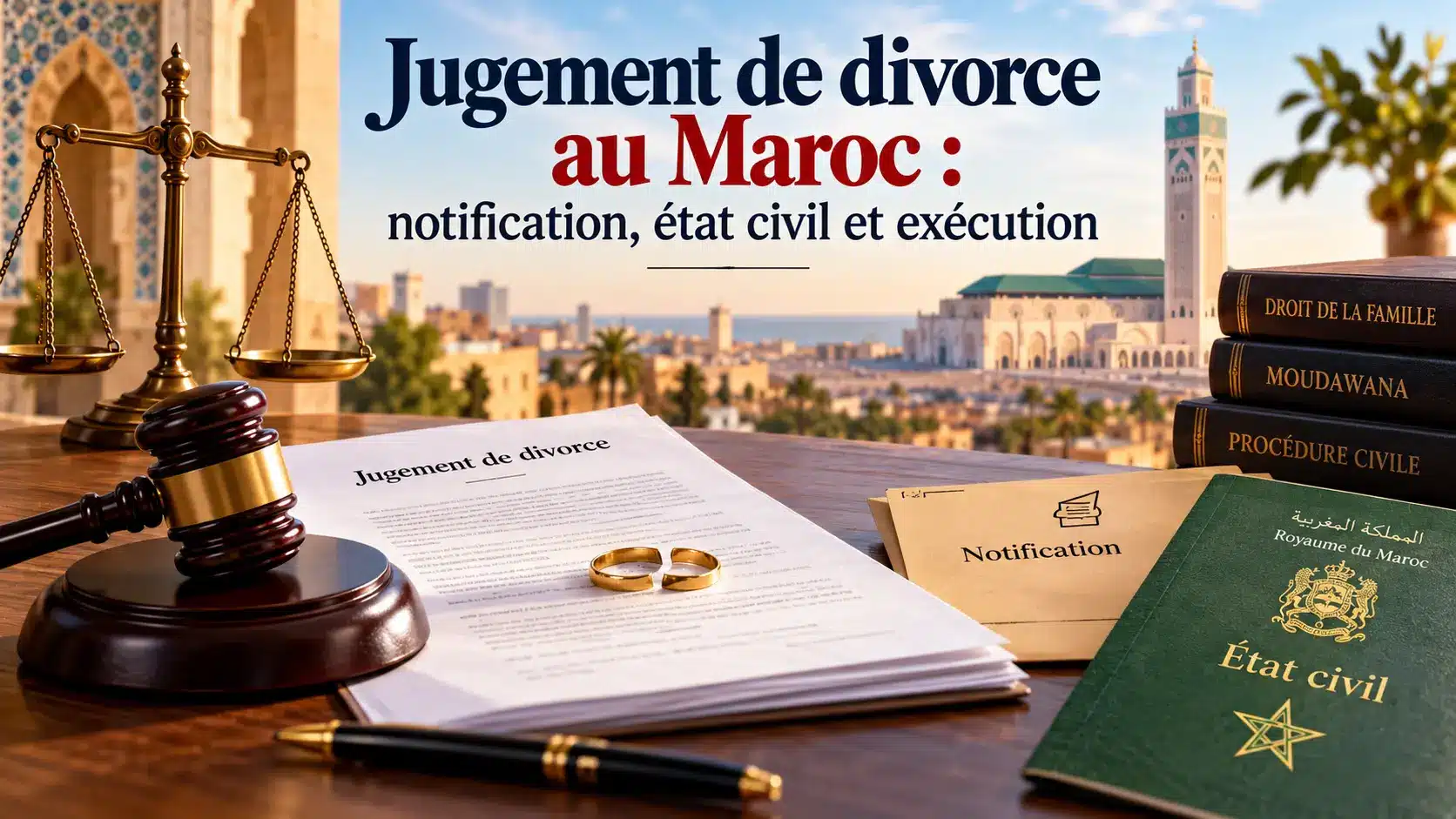
Navigating a divorce process, particularly in Morocco, is a complex life event. Understanding the various aspects of this procedure is essential for making informed decisions. Moroccan divorce involves specific legal and personal considerations, which can vary depending on your situation, especially if you are a Franco-Moroccan couple.
This This guide explores the different types of divorce recognized in Morocco., the legal framework that governs them, as well as the implications for couples, including the crucial aspects for a successful procedure.
The Fundamentals of Moroccan Divorce 2026
To understand Moroccan divorce, it is essential to examine the foundations of its family law system. Family Law Moroccan culture is deeply influenced by various factors, including religion and culture.
Overview of the Legal System Family in Morocco The family law system in Morocco is governed by the Moroccan Family CodeThe Family Code, which has undergone several significant reforms, notably in 2004. This legislation aims to balance the rights and responsibilities within the familyThe 2004 reforms had a considerable impact, notably by strengthening women's rights and improving child protection in matters of divorce and custody.
Influence of Religion and Culture Islam plays a leading role in the divorce law in MoroccoThe laws are directly influenced by Islamic principles and precepts governing divorce proceedings. Social traditions and practices also influence how divorce is perceived and handled.
Differences with the French System Moroccan divorce differs from divorce in France due to its grounding in Islamic law and its cultural specificities.
Aspect | Moroccan Divorce | Divorce in France |
Religious Influence | Heavily influenced by Islam | Secularism, separation of Church and State |
Procedure | Subject to the Moudawana and Islamic principles | Governed by the Civil Code |
Matrimonial Property Regime | Separation of assets by default | Community limited to acquisitions |
The Different Types of Marriage Dissolution in Morocco
The divorce in Morocco It can take different forms, each with its own characteristics and legal implications. Understanding these nuances is crucial for navigating the process effectively. The Moudawana primarily distinguishes between "Talaq" (طلاق) and "Tatliq" (تطليق).
Types of "Talaq" (Divorce initiated by the husband or by agreement)
The "Talaq" (الطلاق) is generally the act by which the husband ends the marriage, or a divorce pronounced by mutual agreement.
- Le Talaq avant consommation (Divorce before consummation)
- This type of divorce is irrevocable (بائن).
- If the divorce takes place before the consummation of the marriage, the wife is entitled to half of the agreed dowry (sadaq).
- The wife is considered divorced from the moment the marriage contract is concluded, even without consummation, if the separation requires a Talaq.
- There is no right to a dowry if the marriage is annulled, if the annulment is due to a fault of the wife or if it is requested by the wife for a fault of the husband, or in the case of divorce in a marriage by delegation (tafwid).
- Le Talaq révocable (الطلق الرجعي)
- This type of divorce is revocable (رجعي).
- The husband has the right to take back his wife during the `idda (waiting period) without her consent, but he must have this resumption attested by two adouls.
- The notaries must immediately inform the judge, who must summon the wife to inform her. If she refuses to return, she can resort to the Tatliq procedure for Chiqaq (discord) provided for in Article 94 of the Moudawana.
- A Talaq pronounced with a number (for example, "I divorce you three times") is considered only one Talaq.
- Le Talaq par accord mutuel (Divorce by Agreement)
- This type of divorce is irrevocable (بائن).
- The spouses can agree on the principle of ending the marital relationship unconditionally, or with conditions that do not contradict the provisions of the Moudawana and do not harm the interests of the children.
- Following this agreement, one or both parties submit a request for a Talaq to the court, along with authorization for authentication. The court attempts conciliation, and if this fails, it authorizes the attestation and authentication of the Talaq.
- Le Talaq par compensation (Divorce by Khul' - Khol)
- This type of divorce is irrevocable (بائن).
- The spouses may agree to a divorce by Khul' (compensation) under conditions which do not contradict the Moudawana and do not harm the interests of the children.
- If the wife is of legal age, she can enter into the Khul' for herself. If she is a minor, she is only obligated to pay the compensation with the consent of her legal guardian.
- The wife can recover what she paid in Khul' if she proves that the Khul' was the result of coercion or harm caused by the husband. The divorce is effective in all cases.
- Anything that is legally permissible as a commitment can serve as compensation in Khul', without waste or exaggeration.
- If the spouses agree on the principle of Khul' but disagree on the compensation, the matter is brought before the court for an attempt at reconciliation. If reconciliation fails, the court pronounces the Khul' after assessing the compensation, taking into account the amount of the dowry, the duration of the marriage, the reasons for requesting Khul', and the wife's financial situation.
- If the wife insists on Khul' and the husband does not respond favorably, she can resort to the Chiqaq (discord) procedure.
II. Types of "Tatliq" (Divorce pronounced by the court at the request of the wife)
The "Tatliq" (التطليق) is a divorce pronounced by the court at the request of the wife for specific legal reasons.
- Le Tatliq pour discorde (Divorce for Discord – Chiqaq)
- This type of divorce is irrevocable (بائن).
- This legal recourse can be initiated by either spouse in the event of discord. The court must make every attempt at reconciliation.
- If reconciliation is impossible and discord persists, the court attests to this in a report and pronounces the Tatliq as well as the financial rights, taking into account the responsibility of each spouse in the cause of the separation when estimating what can be granted to the other spouse.
- The dispute must be adjudicated within a period not exceeding six months from the date of filing the application.
- Le Tatliq pour non-respect d'une condition du contrat de mariage (Divorce due to breach of a condition in the marriage contract)
- This type of divorce is irrevocable (بائن).
- Any violation of a condition of the marriage contract is considered a grievance justifying a claim for Tatliq.
- Le Tatliq pour préjudice (Divorce for Harm – Dharar)
- This type of divorce is irrevocable (بائن).
- Any act by the husband, or any shameful or immoral behavior, which causes material or moral harm to the wife, making her unable to continue the marital relationship, is considered harm justifying a request for Tatliq.
- The facts of harm can be proven by any means, including testimony heard by the court in chambers.
- If the wife does not prove the harm, but insists on her request for Tatliq, she can resort to the Chiqaq procedure.
- Le Tatliq pour non-fourniture de pension alimentaire (Divorce for non-spending)
- This type of divorce is revocable (رجعي).
- The wife can request Tatliq if the husband does not pay the mandatory alimony.
- If the husband has assets that allow for the collection of alimony, the court orders the enforcement of the alimony and does not pronounce the Tatliq.
- In the event of proven incapacity of the husband, the court sets a period not exceeding thirty days for him to pay the alimony, failing which the divorce will be pronounced, except in the case of force majeure or exceptional circumstances.
- The court grants the divorce immediately if the husband refuses to pay alimony without proving his incapacity.
- Le Tatliq pour absence (Divorce for absence)
- This type of divorce is irrevocable (بائن).
- If the husband is absent from his wife for more than a year, the wife can request Tatliq.
- The court ascertains this absence, its duration and its location by all means, and notifies the husband whose address is known of the request so that he may respond to it, informing him that in the event of proof of absence, the court will pronounce the Tatliq if he does not return to live with his wife or does not bring her to him.
- Le Tatliq pour défaut ou infirmité (Divorce for defect)
- This type of divorce is irrevocable (بائن).
- The following are considered as defects affecting the stability of married life and justifying a request for termination of relationship: defects preventing marital cohabitation and serious and incurable illnesses (within one year) endangering the life or health of the other spouse.
- The conditions for acceptance of the application are that the applicant was not aware of the defect at the time of the marriage, and that he did not express consent to the defect after becoming aware of it and after the impossibility of cure had been proven.
- Le Tatliq pour serment d'abstinence (Îla') et désertion (Hajr) (التطليق للإيلاء والهجر)
- This type of divorce is revocable (رجعي).
- If the husband takes a vow of abstinence (Îla') or deserts his wife, she can petition the court, which grants her a four-month grace period. If the husband does not return after this period, the court pronounces the divorce.
- The Tatliq for the husband's imprisonment
- If the husband is sentenced to more than three years in prison, the wife can apply for Tatliq after one year of her incarceration. In all cases, she can apply for Tatliq after two years of her incarceration.
- Annulment of marriage due to husband's change of religion
- The marriage of a Muslim woman to a non-Muslim man is a temporary impediment. If the husband changes religion (from Islam to another religion), the temporary impediment becomes active again, which necessitates the annulment of the marriage.
Le Talaq par procuration (agency)
- Although the Moudawana does not explicitly provide for Talaq by proxy, as the procedure requires the presence of both spouses for reconciliation, it has been exceptionally permitted, particularly for Moroccans residing abroad and sailors. This is justified by the silence of the legislature and the reference to the Maliki school of thought (by Article 400 of the Moudawana), which permits proxy in Talaq.
The Legal Framework of Divorce in Morocco 2026 (In-depth Analysis)
The Moudawana, or Family Code, is the central element of the Moroccan legal framework regarding divorce. Adopted in 2004, it brought significant changes to the family law system in Morocco.
The Courts Competent in Divorce Matters
- Court of First Instance Competent in matters of divorce, child custody and alimony.
- Court of Appeal : Competent to hear appeals against decisions of the court of first instance.
Divorce Procedure in Morocco: Step by Step
The Moroccan divorce procedure, although complex, can be broken down into several key steps.
- Preparation and compilation of the file
- It is essential to gather all the necessary documents before filing for divorce. This includes the original marriage certificate, children's birth certificates (if applicable), proof of income and assets, and documents relating to property acquired during the marriage.
- Filing of the divorce petition
- Once the file is ready, the application is submitted to the appropriate court. The type of divorce will determine the specific procedure.
- The mandatory conciliation phase
- After the application is filed, the court will attempt to mediate between the parties. This step is mandatory and aims to resolve disputes amicably.
- Conciliation sessions are usually presided over by a judge or a mediator. Conciliation may result in an amicable agreement or fail, leading to legal proceedings.
- The judgment and its effects
- If mediation fails, the case goes to trial. The court will issue a verdict that will take into account various factors, including child custody, division of assets, and child support.
- Possible recourse
- If you are not satisfied with the judgment, you can appeal.
Official Registration of the Divorce and Reconciliation
- The person wishing to divorce must request authorization from the court to have the divorce certified by two adouls in the jurisdiction of the court where the marital home, or the wife's home, or the place of her residence, or the place where the marriage contract was concluded is located.
- After the court's attempt at conciliation, if it fails, it will authorize the attestation and authentication of the Talaq.
- The resumption (راجع) is attested and authenticated by the authentication judge only after the acceptance of the resumed wife and her non-attachment to the Tatliq procedure for Chiqaq.
Divorce in Morocco: How Long Does It Take?
The duration of a divorce in Morocco can vary considerably depending on several factors.
Average Duration According to Divorce Type
- Divorce by mutual consent (Talaq by mutual agreement) is generally the fastest, and can be settled in a few months.
- Unilateral divorce (Talaq) may take longer due to formalities and notification delays.
- Divorce for harm (Dharar) often requires investigation and evidence, prolonging the procedure.
Factors That Can Lengthen the Procedure
- The complexity of dividing assets, especially if they are numerous or complex.
- Disagreements over child custody, which may require court intervention.
How to Speed Up the Process
- Agree on the main points of disagreement before taking legal action.
- Provide all necessary documents from the start of the procedure.
- Collaborating with an experienced lawyer.
The Division of Assets During a Moroccan Divorce
Moroccan divorce involves a division of assets which requires a thorough understanding of the applicable matrimonial regime.
The Matrimonial Regime in Morocco In Morocco, the matrimonial regime is governed by the Moudawana, which defines the rules for managing assets during marriage and their division in the event of divorce.
The Division of Assets Acquired During Marriage
- Assets acquired during the marriage are divided according to the principle of « Political Card »which takes into account the contribution of each spouse to the acquisition of these assets.
- This assessment can be based on financial evidence, receipts, and testimonials.
The Special Case of Real Estate Real estate acquired during marriage is subject to specific rules. Its division can be complex and often requires the intervention of an expert.
Financial Compensation Rights
- In the event of a divorce, spouses may be entitled to financial compensation for their contribution to the marriage. This compensation is determined based on the circumstances of the divorce.
- The rights of a wife who is arbitrarily divorced without justification include: deferred dowry (if it exists), `idda maintenance, and "Mut'a" (consolation damages).
- The Mut'a's assessment takes into account the duration of the marriage, the husband's financial situation, the reasons for the divorce, and the extent of the husband's arbitrary action in pronouncing the divorce.
Child Custody and Alimony (Nafaqa)
Child custody and alimony are two crucial aspects in the divorce process in Morocco.
Custody Allocation Criteria Moroccan courts take several factors into account:
- The children's ages : Young children are often entrusted to their mother, while older children can express their preference.
- The concept ofbest interests of the child This is a crucial consideration. Judges assess the parents' ability to provide a stable and loving environment.
Non-Custodial Parent's Visitation Rights The parent who does not have custody of the children usually has regular and special visitation rights (holidays, events) to maintain a healthy relationship with the child.
The Calculation of the Alimony (Nafaqa) Child support is calculated based on the child's needs and the financial means of the parent required to pay it, taking into account the cost of living and educational needs.
Changes to Measures Concerning Children Custody and child support arrangements can be changed if circumstances change, such as a parent's financial situation or the child's needs.
Cross-Border Custody Problems When parents live in different countries, complications can arise regarding child custody. Moroccan courts sometimes have to cooperate with foreign jurisdictions to resolve these disputes, taking into account international laws and conventions.
Specifics of Moroccan Divorce for Franco-Moroccan Couples
Franco-Moroccan couples must navigate a complex legal landscape due to the differences between the Moroccan and French legal systems, as well as the implications of their dual nationality.
Recognition of Divorce Moroccan in France A divorce pronounced in Morocco can be recognized in France, but this requires fulfilling certain conditions, in particular if the decision was made by a competent court and if it is not contrary to French public policy.
Conflict of Laws and Jurisdictions Franco-Moroccan couples may face conflicts of laws and jurisdictions:
- Which law applies? The applicable law depends on several factors, including the nationality of the spouses and the location where the wedding will be celebrated.
- Which court should be seized? The competent jurisdiction may vary. Couples need to understand whether they should approach the Moroccan courts, the French courts, or both.
France-Morocco Bilateral Conventions There are bilateral agreements between France and Morocco that can influence divorce proceedings, aimed at facilitating the mutual recognition of court decisions.
Practical Advice for Binational Couples
- Consult a lawyer specializing in law international.
- Understand your rights and obligations under the laws of both countries.
- Anticipating the implications of dual nationality on divorce proceedings.
Conclusion: Navigating the Moroccan Divorce Process
You now have a thorough understanding of Moroccan divorce and its implications. This process can be complex, but with the necessary knowledge and resources, you can navigate it more calmly. Understanding the various aspects is essential, from the legal framework to the implications for couples, particularly Franco-Moroccan couples. Professional guidance can help you make the right decisions and avoid potential pitfalls.
Frequently Asked Questions (FAQ)
- What are the different types of divorce recognized in Morocco? Morocco recognizes several types of divorce, including Talaq (before consummation, revocable, by delegation, by mutual agreement, by Khul', by proxy) and Tatliq (for Chiqaq/discord, for non-compliance with conditions, for harm, for non-provision of alimony, for absence, for default, for Îla' and Hajr, for imprisonment).
- What is the average duration of a divorce in Morocco? The average duration of a divorce in Morocco varies depending on the type of divorce. It can range from a few months for a divorce by mutual consent to several years for more complex cases.
- How are assets acquired during the marriage divided in a Moroccan divorce ? Assets acquired during the marriage are divided according to the matrimonial regime in force in Morocco, taking into account the concept of "Kad wa Siaya" and proofs of contribution.
- What are the criteria for awarding child custody in a Moroccan divorce? Criteria for awarding child custody include the children's ages and the concept of the best interests of the child.
- How to speed up the divorce process in Morocco? To speed up the divorce process, it is advisable to prepare the case carefully, cooperate with the other party, and follow the procedural steps diligently.
- What are the rights to financial compensation in a Moroccan divorce ? The rights to financial compensation are determined based on the contributions and needs of the spouses, as well as agreements made during the marriage, and may include deferred dowry, `idda pension, and Mut'a in the event of arbitrary divorce.
- Is a Moroccan divorce recognized in France? Yes, a Moroccan divorce can be recognized in France under certain conditions, in particular if the divorce decision was made by a competent court and if it is not contrary to French public policy.
- What are the cross-border childcare issues? Cross-border child custody issues can arise when parents live in different countries. It is essential to consider the applicable laws and international conventions. resolve these conflicts.
- Qu’est-ce que la Moudawana ? La Moudawana est le Code de la famille marocain qui réglemente les affaires familiales, y compris le divorce, le mariage et la garde des enfants.
- What are the impacts of the 2004 reforms on the law of divorce in Morocco ? The 2004 reforms strengthened women's rights and improved child protection in the context of divorce.