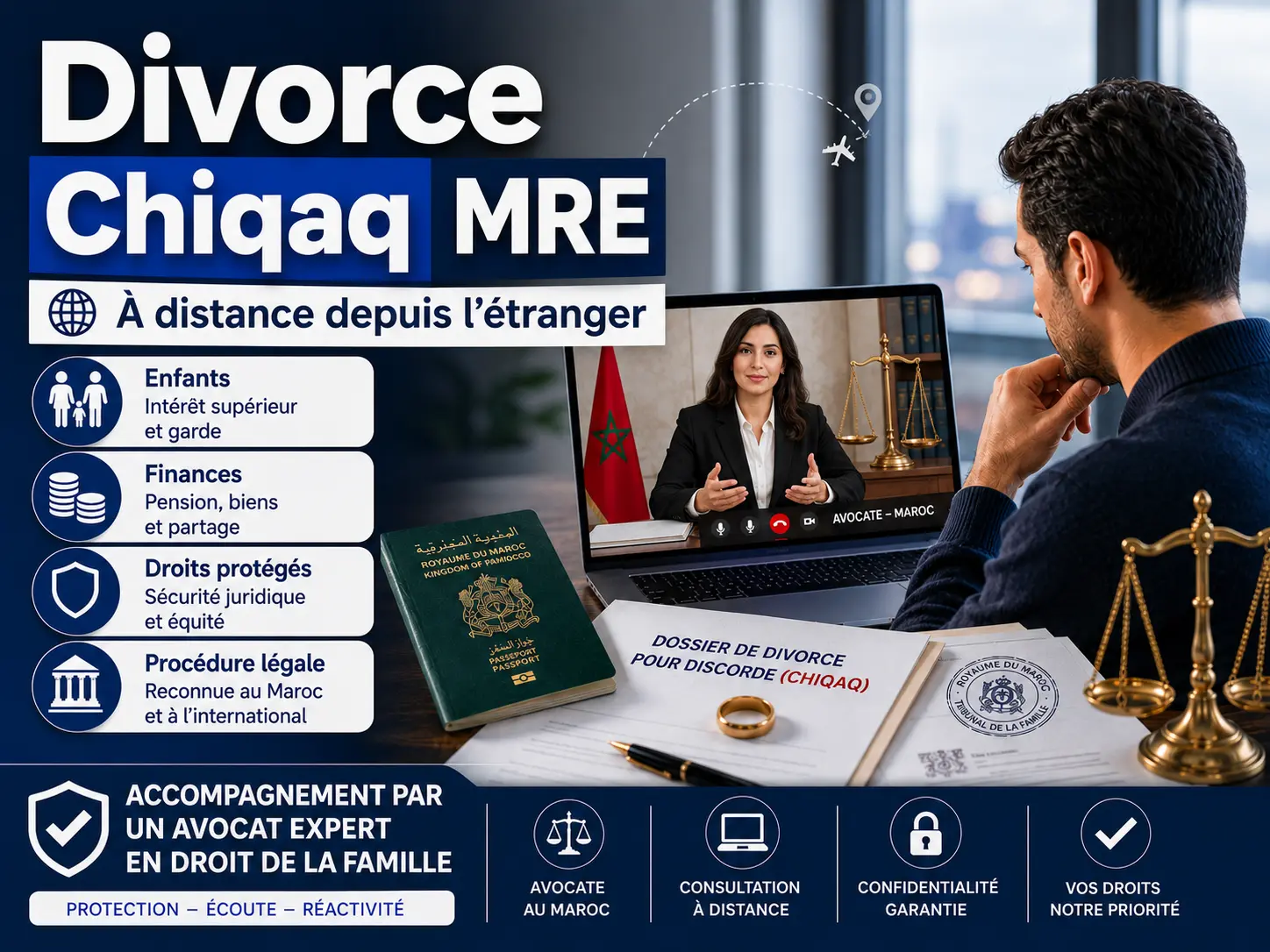
Le divorce Chiqaq occupe une place centrale dans le Family Law marocain. La Moudawana a créé une procédure judiciaire spécifique pour mettre fin à un mariage lorsque le conflit entre les époux devient durable et que la vie commune devient intolérable. Le Tribunal de la famille n’est pas seulement chargé de constater la rupture ; il tente d’abord de préserver le lien conjugal, puis tranche les questions financières, la garde et l’intérêt des enfants.
Dans l’esprit du Code de la famille, la dissolution of marriage ne doit intervenir qu’exceptionnellement, en privilégiant le « moindre mal », car elle menace la stabilité familiale et peut nuire aux enfants. C’est dans cette logique que la procédure de divorce Chiqaq a été instaurée, devenant la réponse juridique aux situations de discorde profonde, d’incompréhension persistante ou de rupture de confiance entre conjoints.
Chiqaq divorce is a judicial divorce procedure governed by Articles 94 to 97 of the Moudawana (Family Code). It is initiated when one or both spouses request the court to resolve a dispute that could lead to discord. In other words, it is a mechanism allowing a judge to intervene when the marital relationship is severely conflictual and a legal solution appears necessary.
Le texte fondateur du divorce Chiqaq se trouve dans le titre IV du livre II du Code de la famille, au chapitre consacré au Judicial divorce pour discorde. L’article 94 impose au tribunal d’entreprendre toutes les tentatives de conciliation prévues à l’article 82 avant de prononcer la dissolution du mariage.
Le préambule et le discours royal intégrés à la Moudawana montrent que la réforme de 2004 a voulu placer le divorce sous contrôle judiciaire, accessible tant à l’homme qu’à la femme, tout en renforçant les mécanismes de conciliation et d’intermédiation. Le juge devient ainsi le pivot du processus, garantissant la protection des droits de l’épouse et des enfants.
It is important to distinguish the Chiqaq divorce from the other methods of dissolution provided for in the Moudawana:
Chiqaq divorce typically occurs when there is no agreement, when proof of a particular grievance is difficult to establish, or when widespread tension makes living together impossible.
One of the major contributions of the reform is equal access to this procedure. Article 94 explicitly addresses "both spouses or either of them," meaning that both husband and wife can file for a Chiqaq divorce. In practice, a woman no longer needs only her husband's consent to leave a conflictual marriage, and a man can no longer dissolve the marriage outside the legal framework established by the Family Court.
The Chiqaq procedure follows a progressive logic: referral to the court, summons of the spouses, attempt at reconciliation, possible investigation by arbitrators, and then judgment if reconciliation fails. The judge therefore does not immediately grant the divorce; he must first determine whether the separation can be avoided.
The process begins with a petition filed with the competent family court. Articles 94 to 97 do not provide an exhaustive list of required information, but it is clear that the petition must identify the spouses and outline the dispute. It must be clear, chronological, and factual, specifying the points of contention: repeated conflicts, breakdown of cohabitation, verbal abuse, lack of communication, family interference, breaches of marital duties, or a persistent inability to resume living together. This structure complies with Article 95, which tasks arbitrators with investigating the causes of the dispute.
After registration, the spouses are summoned. Proper notification is crucial, as the validity of the procedure depends on respecting the rights of the defense. The rules of Article 81, although relating to divorce under judicial supervision, clarify the procedural logic: if the petitioner fails to appear after being personally summoned, he is considered to have withdrawn his petition; if the wife fails to appear and submits no written observations, the court issues a formal notice to her before ruling. If the address is unknown, the public prosecutor's office is contacted to locate her.
The heart of the Chiqaq process lies in conciliation. Article 94 refers to Article 82, stipulating that proceedings are held in chambers, with the possibility of hearing witnesses and other individuals relevant to understanding the conflict. The judge may appoint two arbitrators, consult the family council, or call upon any qualified person. When children are involved, the court must undertake two attempts at conciliation, spaced at least thirty days apart, demonstrating the legislative intent to provide a genuine opportunity for reconciliation before a final separation.
Si les arbitres ne parviennent pas à un accord, ou s’ils ne déposent pas leur rapport dans le délai imparti, l’article 96 autorise le tribunal à mener une enquête complémentaire par tout moyen approprié. Le juge retrouve alors une large marge d’appréciation. Lorsque la conciliation devient impossible, l’article 97 stipule clairement : le tribunal dresse procès‑verbal, prononce le divorce and ruling on rights dus, en renvoyant aux articles 83, 84 et 85. Le divorce Chiqaq n’est donc pas un simple constat de mésentente ; c’est une décision judiciaire complète qui met fin au mariage et règle les conséquences patrimoniales et familiales.
La question des indemnités pour l’épouse est souvent source d’inquiétude, certains croyant à tort qu’un divorce due to discord la prive de toute réparation. Le Code adopte une approche nuancée : il oblige le tribunal à statuer sur les droits de l’épouse et des enfants, en tenant compte de la responsabilité de chacun dans les causes du divorce.
La Mout'a
Article 84 stipulates, among the rights due to the wife, the remaining Sadaq (dowry) if applicable, alimony during the waiting period (Iddah), and a consolation gift (Mout'a). This compensation, intended to be compensatory, partially offsets the effects of the separation. It is assessed according to:
In the context of Chiqaq divorce, Article 97 stipulates that the court must consider each spouse's responsibility when assessing compensation for damages suffered. Therefore, if the discord is primarily attributable to one spouse, the compensation may be adjusted accordingly.
Illustrative example
Imagine a twelve-year marriage, two children, a wife without a stable income, and a financially well-off husband. If the discord stems primarily from serious breaches of marital duties by the husband, the judge may award a higher Mut'ah, the remaining Sadaq, the Idda allowance, and the cost of temporary housing. Conversely, in a very short marriage, without children, with shared responsibility and the husband's limited resources, the compensation will be more moderate. The Code does not establish a fixed scale; it leaves the judge to make a concrete, individualized assessment based on the specific circumstances of each case.
Article 84 specifies that, during the waiting period, the wife resides in the marital home or, if necessary, in accommodation suited to her financial situation. Failing that, the court determines the amount of accommodation costs, which are recorded among the other rights owed to the wife. This temporary accommodation should not be confused with accommodation for the children, which falls under a separate category.
L’article 85 renvoie aux règles de pension alimentaire, notamment à l’article 168, qui stipule que les frais de logement de l’enfant gardé sont distincts de la pension alimentaire, de la rémunération de garde et des autres frais. Le père doit donc assurer un logement ou en payer le loyer selon l’évaluation du tribunal. L’enfant gardé ne peut être contraint à quitter le domicile conjugal qu’après exécution par le père du jugement relatif à son logement, garantie essentielle dans les dossiers Chiqaq avec enfants mineurs.
Article 97 requires the court to rule on the action relating to the dispute within a maximum period of six months from the date the application is filed. This period constitutes the legal reference, although, in practice, certain factors may extend it.
When children are involved, the law requires two attempts at conciliation spaced at least thirty days apart, which naturally prolongs the procedure.
Article 121 authorizes the court to take provisional measures if cohabitation is impossible during the proceedings. The judge may order that the spouse reside with a close relative of either spouse, a decision that is immediately enforceable by the public prosecutor. These measures quickly protect the wife and stabilize the children's situation while awaiting the final judgment.
The Chiqaq divorce decree ends the marital bond and initiates a new phase: the settlement of financial obligations, the organization of custody, visitation rights, and registration with the civil registry. It is not simply the "end of marriage," but a foundational act for the new family structure.
Article 128 stipulates that decisions rendered in judicial divorce, khul', or termination proceedings are not subject to appeal with respect to the part that ends the marital ties. Thus, the dissolution itself cannot be challenged, even if other aspects of the judgment (alimony, custody, etc.) remain subject to ordinary appeals.
Article 171 places the child's best interests at the heart of post-divorce arrangements: custody is initially granted to the mother, then to the father, then to the maternal grandmother, before the court, if necessary, awards custody to the most suitable relative. Article 88 requires that the judgment specify the children, their ages, the person with custody, and the visitation arrangements. Article 169 reiterates that the father or legal guardian and the custodial mother must ensure the child's education and schooling.
The Chiqaq divorce is a central procedure of the Moudawana (Family Code), as it allows the Family Court to address deep-seated conflicts without requiring technical proof of a single, clearly defined fault. The procedure rests on four pillars: a mandatory attempt at reconciliation, the possible intervention of arbitrators, a statutory six-month time limit, and a complete judicial settlement of the rights of the wife and children.
Pour le justiciable, l’enjeu ne se limite pas à obtenir la dissolution du mariage, mais à constituer un dossier solide sur la procédure Chiqaq, la durée du divorce et les indemnités auxquelles la femme peut prétendre, afin que le jugement protège au mieux ses intérêts et ceux des enfants. Pour approfondir le sujet, consultez également notre page pilier : Moroccan Family Law.
Can- to initiate a divorce True sans avocat ?
The Code does not make a lawyer mandatory to bring a discord action, but, given the complexity of financial rights, evidence and custody, the assistance of a legal professional is often crucial to properly present the case and protect the interests of the spouse involved.
What's happening‑t-the yes l'one of the spouses does not prnot present ?
Absence does not necessarily prevent the proceedings from concluding, provided the summons was properly served or the public prosecutor's office was contacted to locate the address. The court may issue a formal notice, continue the investigation, or conduct a supplementary inquiry, in accordance with Articles 81 and 96.
What is the cost of legal fees?
The Family Code does not specify a fixed amount for court costs or lawyers' fees. Certain sums must be deposited with the court clerk for the rights owed to the spouse and children, but the judgment determines property and family rights on a case-by-case basis.
Can-on transforming a Chiqaq en divorce by mutual consent en cours de procEdure ?
Yes. The conciliation attempt aims precisely to allow for a peaceful resolution of the conflict. If the spouses reach a full agreement before the judgment, the dispute can be directed towards a conventional solution in accordance with the rules of the Family Court (Article 114).

Attorney Amal Anouide, a member of the Safi Bar Association for over 13 years, is a recognized specialist in Moroccan family law (Moudawana). The Anouide Law Firm assists national and international clients, particularly Moroccans residing abroad (MREs), offering rigorous expertise to ensure the enforcement of their rights in Morocco.