Key points
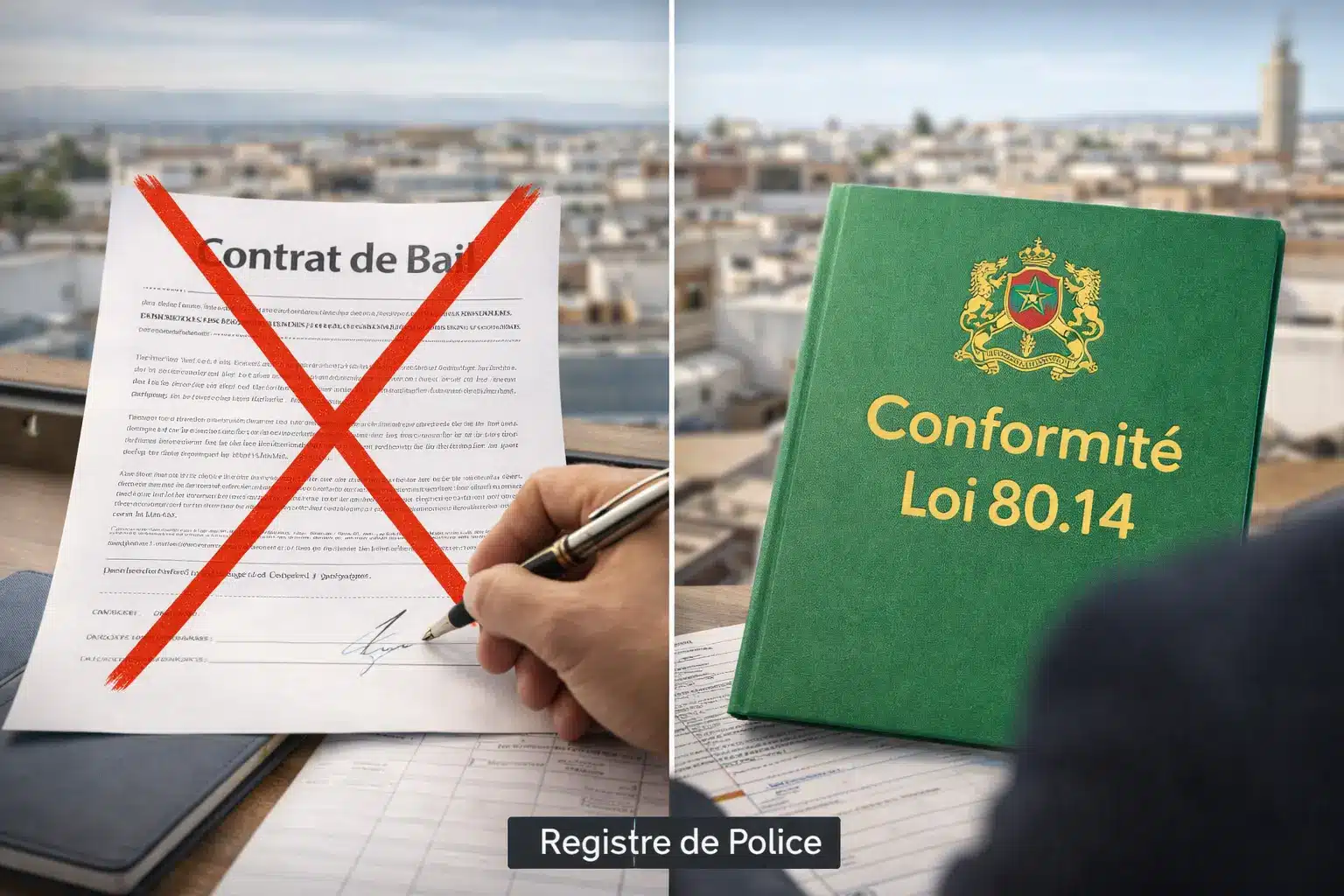
- Strict regulations: Short-term furnished rentals of less than one month are governed by the Law No. 80.14 relating to tourist establishments and other forms of accommodation.
- Homestay accommodation: This activity is legally classified as "homestay accommodation" (Iwaa' 'inda as-Sakin) when it is carried out by a natural person in his residence.
- License required: Operating a property for a period of less than one month requires a operating license issued by the competent local authority.
- Customer statement: The owner is required to declare their customers daily via an electronic platform and to keep individual records for one year.
- Civil liability insurance: La souscription à un contrat d’assurance contre les risques d’incendie, de vol et de responsabilité civile est une obligation légale.
- Sanctions lourdes : Engaging in this activity without a license is punishable by fines ranging from 50,000 to 500,000 dirhams.
The seasonal rental market and the short-term furnished residential lease has undergone a radical transformation in Morocco with the entry into force of the Law No. 80.14 and its implementing decree n° 2.23.441. Ce que le grand public appelle souvent « location de type Airbnb » ou bail de moins d’un mois n’est plus un simple contrat civil régi par le Code des Obligations et des Contrats, mais une activité réglementée sous l’étiquette de l’homestay accommodation or alternative accommodation.
L’importance de ce sujet réside dans la professionnalisation du secteur. Pour les propriétaires, il ne s’agit plus seulement de louer un bien, mais de respecter des normes de sécurité, de déclaration et de classification. Cet article détaille les procédures, les obligations légales et les précautions à prendre pour éviter les sanctions administratives et pénales.
1: The legal framework for short-term furnished rentals
In Morocco, a lease of less than one month differs from a standard residential lease (Law 67.12) due to its tourist and temporary nature. Law No. 80.14 defines tourist accommodation establishment as any establishment of a commercial nature receiving a transient or resident clientele.
1.1. Homestay accommodation
According to Article 29 of Law 80.14, homestay accommodation is a form of family-run lodging that allows individuals to host tourists in their homes for one or more nights. The number of rooms in this type of accommodation is limited by regulation to preserve its family-oriented and non-hotel character.
1.2. The tourist residence
If the owner possesses several units within an integrated complex, the activity may fall under the regime of thetourist outgrowth or of thetourist real estate developmentThese establishments are subject to a star rating system (from 1 to 5 stars or Luxury).
2: The procedure for obtaining the operating license
Article 30 of Law 80.14 and Articles 60 to 65 of Decree No. 2.23.441 specify that the operation of homestay accommodation is subject to a operating license.
2.1. The competent authority
The application must be submitted in person against a receipt to thecompetent local authority (Sulta Mahaliya). Unlike hotels which go through the Regional Investment Center (CRI), homestay accommodation retains local management.
2.2. Practical steps
- Submission of the application: Le propriétaire soumet les documents requis prouvant la sécurité et la qualité du logement.
- Check-up visit: Commissioned agents visit the premises to verify compliance with the specifications.
- Technical note: The local authority consults the regional tourism representative.
- Issuance of the license: If the opinion is favorable, the license is issued for a period of 5 years renewable.
3: The operator's daily obligations
Once the license is obtained, the owner becomes a legally responsible operator.
3.1. The electronic declaration (Tarsih)
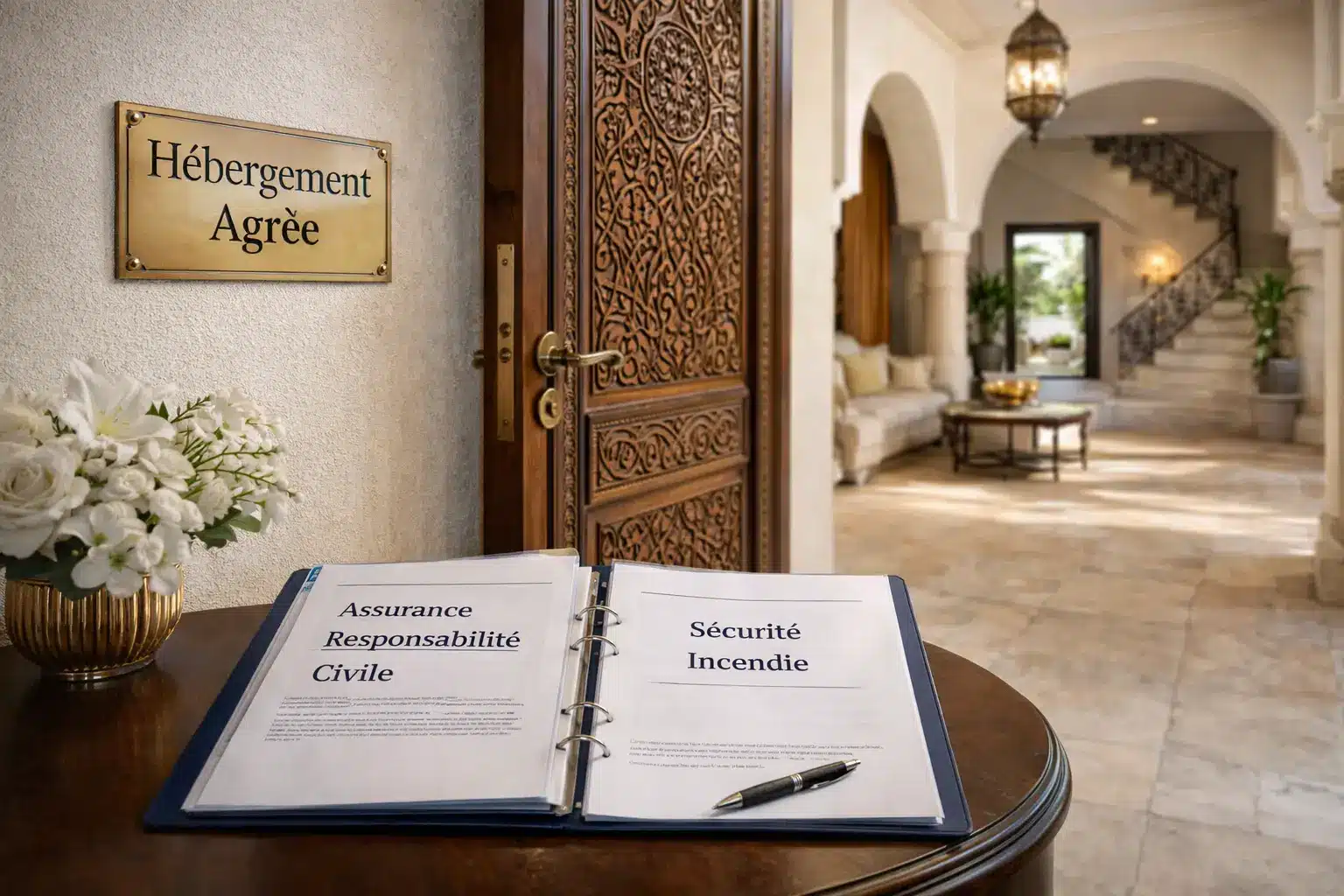
The operator must report daily to the authorities the data relating to its transient customers (domestic or foreign) via an electronic processing system. This measure aims to guarantee national security and the monitoring of tourist flows.
3.2. The individual accommodation record
Each guest must complete and sign an individual accommodation form upon arrival. The operator has a legal obligation to keep these records for a period of one year and to make them available to the National Security services or the Royal Gendarmerie upon request.
3.3. Insurance and Security
Article 34 of Law 80.14 requires all operators to take out insurance covering:
- The risks of fire.
- Theft of customers' luggage.
- Civil liability. Failure to present the insurance contract during an inspection is a major offense.

4: Practical and financial elements
Summary table: Standard lease vs. Short-term accommodation (< 1 month)
Characteristic | Residential lease (Law 67.12) | Accommodation with a local resident (Law 80.14) |
Typical duration | Long (often > 1 year) | Very short (< 30 days) |
Authorisation | None (civil contract) | Mandatory operating license |
Police statement | Not systematic | Daily and mandatory |
Assurance | Optional for the landlord | Mandatory (Liability, Fire, Theft) |
Usage | Primary residence | Tourism and leisure |
Documents required for the license (Art. 61 of the Decree)
- Copy of the National Electronic Identity Card (CNIE).
- Photos of the rooms and common areas.
- Permit to occupy or certificate of conformity.
- Certificate from a specialist engineer proving the stability and safety of the building against fire risks.
- Valid insurance contract.
- Signed commitment to respect the specifications.
Legal deadlines
- Case processing: The local authority must decide within a period of 30 days from the date of submission of the complete file.
- License validity: 5 years renewables.
- Document preservation: 1 an for customer records.
Estimated costs and taxes
- Application fee: Varies depending on the municipality.
- Tourist taxes: Collected from the customer and paid out quarterly.
- Tourist Promotion Tax (TPT): Depending on the type of accommodation.
5: Common mistakes and penalties
5.1. Mistakes to avoid
- Renting without a license: Many landlords believe that paying rental income tax is sufficient. This is incorrect; administrative authorization is separate from the tax obligation.
- Neglecting the customer file: In the event of a security incident involving an undeclared customer, the owner's criminal liability is directly engaged.
- False advertising: Publishing photos that do not conform to reality may result in immediate license revocation.
5.2. Criminal and administrative sanctions
- License violation: Fine of 50,000 to 500,000 DH.
- Lack of insurance: Fine of 50,000 to 500,000 DH with the possibility of temporary closure until regularization.
- Failure to declare customers: Prison sentence of 1 to 6 months and/or a fine 50,000 to 100,000 DH.
- Relapse: Fines are doubled if the offence is repeated within 5 years.
6: Specifics for Foreigners and Moroccans Residing Abroad
Foreign nationals and Moroccans residing abroad (MRE) are particularly active in short-term rental investment in Marrakech, Casablanca or Agadir.
- Remote management: Lawyer Amal Anouide souligne que les MRE peuvent désigner un mandataire ou un directeur de gestion déclaré auprès de l’administration pour remplir les obligations quotidiennes (déclarations, accueil).
- Repatriation of funds: Foreign investors must ensure they comply with the Exchange Office regulations regarding rental income to guarantee the possibility of subsequent currency transfer.
Conclusion
The legal framework of furnished residential lease of less than one month In Morocco, regulations have become considerably stricter to guarantee the safety of travelers and the quality of domestic tourism. While it offers attractive returns, this rental model now imposes administrative rigor similar to that of traditional hotels.
The Cabinet de Me Amal Anouide recommande vivement aux propriétaires de procéder à un audit de conformité de leurs biens. Caution is advised: A failure to declare, even unintentionally, can transform a lucrative activity into a source of serious disputes and prohibitive financial penalties.
FAQ (Frequently Asked Questions)
- Can I rent my apartment on Airbnb without a license in Morocco? No. Law 80.14 requires an operating license for any rental of less than one month, under penalty of severe fines.
- How many rooms can I rent out in "homestay accommodation"? The number is fixed by the implementing decree so as not to exceed a family capacity (generally limited to remain under the simplified regime).
- Is standard home insurance sufficient? No, you must take out a specific contract covering "risks of fire, theft of customers' belongings and civil liability" in accordance with Article 34 of the law.
- What should be done if a customer refuses to provide their identity document? Vous devez refuser l’accès au logement. La déclaration de l’identité est une obligation légale pour le client et le propriétaire.
- Is the license linked to the person or to the accommodation? It is linked to the operator for a specific property. If the property is sold, the new owner must apply for a new license.
List of legal references used
- Law No. 80.14 relating to tourist establishments and other forms of tourist accommodation.
- Decree No. 2.23.441 implementing Law No. 80.14.
- Dahir of January 11, 1932 relating to furnished houses (cited as an exception).
- Dahir No. 1.15.108 of 18 Chaoual 1436 (August 4, 2015) promulgating law 80.14.
Avertissement légal (Disclaimer)
Cet article est fourni à titre purement informatif et ne constitue en aucun cas un legal advice personnalisé. Les lois et règlements pouvant évoluer, il est fortement recommandé de consulter un specialist lawyer pour analyser votre situation particulière avant toute démarche.