
Key Points to Remember

The divorce by mutual consent in Morocco Today, it represents the preferred option for couples wishing to end their marriage amicably and quickly. For the French-Moroccans and the Moroccans Residing AbroadThe validity of an amicable divorce in France, obtained without the intervention of a judge, is a major legal issue. Understanding the mechanisms of registration and recognition is essential to updating one's Moroccan civil registry and secure future rights, such as remarriage or inheritance. This article details the current procedures and safeguards offered by the Moroccan Family Code and recent case law.
L’Article 114 of Law No. 70-03 provides that: "The two spouses may agree on the principle of ending their marital union, either without conditions or with conditions, provided that these are not incompatible with the provisions of this Code and do not prejudice the interests of the children."
The Moroccan legislature thus enshrines the autonomy of the will of husband in the dissolution of the marriage. This type of divorce, described as irrevocable (friend), does not allow for a resumption of married life without a new marriage certificate. The Moroccan Family Code However, it requires that this agreement be submitted to court review to verify its compliance with mandatory rules, including the protection of minors.
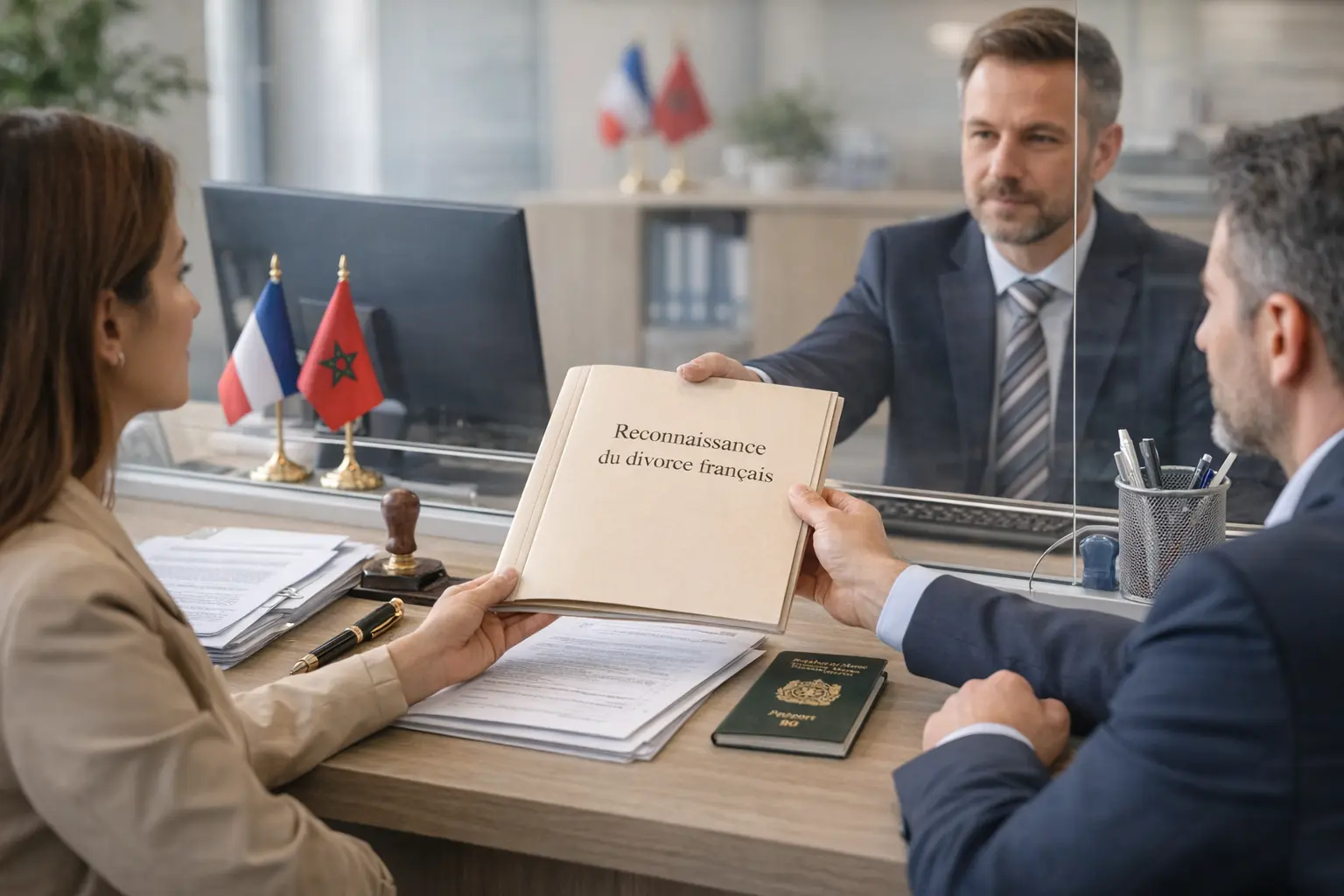
The Circular dated February 18, 2019 This constitutes a major turning point for the recognition of French "no-fault" divorces in the Kingdom. This administrative instruction follows the adoption by the French Republic of a new type of divorce by private agreement countersigned by lawyers and filed with a notary.
The Moroccan administrative commission, after studying the provisions of French law no. 2016-1547, concluded that this document was valid for theMoroccan civil registryUnlike contested divorces, this procedure allows for updating the registers without systematically requiring a formal procedure.exequatur before Moroccan courts, provided it does not contravene theMoroccan public order.
L’Article 15 of the Family Code imposes on Moroccans who have married abroad to file a copy of the document recording the end of the union with the competent authorities. For a divorce, the process follows a specific administrative procedure aimed at informing thecivil registrar from the place of birth of each ex-spouse.
The litigant The divorce decree must be sent to the Moroccan consular services in the place where the decree was issued or, failing that, to the Ministry of Foreign Affairs. These services ensure its transmission to the Family Justice Section competent to have the divorce recorded in the margins of birth and marriage certificates.
L’Moroccan public order acts as a validity filter for any foreign legal act, including the divorce by mutual consent in Morocco resulting from a French procedure. The court or the administration verifies that the agreement of husband does not infringe upon the fundamental rights recognized by the Moroccan Family Code.
Areas of concern particularly relate to children's rights: housing, the Alimony (allowance) and the garde (now). If the French divorce agreement contains provisions contrary to the best interests of the child as defined in Articles 54 et seq. of the Moroccan Family CodeMoroccan authorities may refuse the transcription in its current form.
L’exequatur is the procedure by which a Moroccan court gives executory force to a foreign court decision within the national territory, in accordance with Articles 430 to 432 of the Code of Civil Procedure. For French amicable divorce by agreement of lawyers, the Circular dated February 18, 2019 brings procedural simplification.
Since the French document is a private agreement and not a court judgment, it is treated as an administrative act of will. Thus, the simple mention of the divorce in the registers of themarital status, recourse to the judge of theexequatur is no longer an absolute prerequisite, which considerably reduces the waiting times for the litigants.

The recognition procedure takes place in several phases, from the signing of the convention in France to the final update in Morocco.
Stage | Legal deadline | Action required | Legal basis |
Consular deposit | 3 months | Filing of the translated and legalized divorce decree | Art. 15 Mudawana |
Transmission | Variable | Sending the file to the court of the place of birth | Art. 60 Mudawana |
Homologation | 15 days | Validation by the family court judge in charge of the marriage | Art. 68 Mudawana |
Transcription | Immediate | Inscription in the margin of the birth certificate | Art. 151 Mudawana |
The complexity of international recognition of a divorce necessitates tailored legal support from the outset. Early consultation allows you to:
The Master's Office Amal Anouide in Safi assists litigants in their legal proceedings divorce by mutual consent in Morocco, with specific expertise for the Moroccans Residing Abroad via remote consultations.

Phase 1: Preparation (in France)
Phase 2: Administrative procedure (Consulate or Ministry)
Phase 3: Finalization (in Morocco)
A: According to theArticle 15 of the Moudawana, THE husband must file a copy of the divorce decree within a period of three months current from the date of its conclusion. This timeframe is essential for the rapid updating of theMoroccan civil registry. Legal basis: Article 15 of Law No. 70-03
R: In virtue of the Circular dated February 18, 2019A divorce by agreement drawn up by lawyers can be registered directly with the authorities.marital status without the legal procedure ofexequaturprovided that it does not contravene thepublic orderHowever, theexequatur may remain necessary for the forced execution of financial measures (compensatory payments) on Moroccan territory. Legal basis: Circular No. 1547-2016 of the Ministry of the Interior / Article 128 of the Moudawana
R: The applicant must attach to their application the original divorce agreement, the certificate of filing with the notary, a certified translation and a copy of the National Identity Card (CIN). Legal basis: Article 65 of the Family Code
A: Yes, assistance can be provided through consular services or by appointing a lawyer in Morocco. consular power of attorney pour suivre le dossier auprès des tribunaux de la famille. Legal basis: Article 17 of the Family Code
A: The Moroccan Family Code The law stipulates that the father is responsible for the children's upkeep until they reach the age of majority (18), or 25 if they are pursuing higher education.marry A pregnant woman is also entitled to the pension until she gives birth. Legal basis: Articles 194 and 198 of the Family Code
A: The garde The child is entrusted first to the mother, then to the father, and finally to the maternal grandmother, always respecting the best interests of the child. The divorce agreement may stipulate these arrangements, subject to validation by the judge. Legal basis: Article 171 of the Family Code
A: The court resorts to the assistance of Public Prosecutor's Office to search for the address. If it remains untraceable, a curator can be appointed to protect the interests of the absentee. Legal basis: Article 81 of the Family Code
A: Fees vary depending on consular fees and translation costs. In 2026, basic court fees for homologation are moderate, excluding the fees of the...lawyer who advises the parties. Legal basis: Regulatory pricing of transplants
Glossary of legal terms
Legal Sources
Legal warning This article provides general legal information on the divorce by mutual consent in Morocco and does not constitute personalized legal advice. Each situation has specific characteristics requiring in-depth analysis by a professional. lawyerThe information presented is valid as of the date of publication and is subject to changes in legislation or case law. For an accurate assessment of your case, consult a legal professional. Cabinet Anouide cannot be held responsible for decisions taken solely on the basis of this article without prior consultation.

Attorney Amal Anouide, a member of the Safi Bar Association for over 13 years, is a recognized specialist in Moroccan family law (Moudawana). The Anouide Law Firm assists national and international clients, particularly Moroccans residing abroad (MREs), offering rigorous expertise to ensure the enforcement of their rights in Morocco.