

Key Points to Remember:
Under the principle of territoriality, a court decision rendered outside Moroccan territory cannot be enforced there without having obtained executory force through theexequatur in MoroccoThis legal procedure validates the validity of a foreign judgment so that it has legal effect in the Kingdom. Cabinet Anouide assiste les requérants dans cette démarche complexe afin de garantir la reconnaissance de leurs droits, qu’il s’agisse de divorce, de créances ou de successions.
L’Article 430 of the Code of Civil Procedure stipulates that: "Judicial decisions rendered by foreign courts are enforceable in Morocco only after they have been granted exequatur by the court of first instance of the domicile or residence of the defendant or, failing that, of the place where the execution is to be carried out."
This provision establishes the court of first instance as the sole jurisdiction competent to handle applications forexequatur in MoroccoThe judge granting enforcement limits their intervention to verifying the legality of the decision, without being able to review the merits of the case. Moroccan jurisprudence specifies that this procedure aims to verify the jurisdiction of the foreign court, the regularity of the procedure followed and the absence of any fraud against the rights of the defendant.
L’Article 128 of the Family Code (Moudawana) stipule que les jugements de divorce ou de dissolution de mariage rendus à l’étranger sont susceptibles d’exécution s’ils sont rendus par un tribunal compétent et fondés sur des motifs non incompatibles avec ceux prévus par la loi marocaine.
The legislator established this framework to protect the personal status of citizens, in particular... Moroccans Residing Abroad. L’exequatur Morocco est indispensable pour que le divorce étranger soit transcrit sur les registres de l’état civil marocain. Le Master's Office Amal Anouide emphasizes that the court scrupulously verifies whether the foreign decision does not infringe upon the rights of the wife or children, in accordance with the principles of the Moudawana.
Compliance with public order is defined by judicial practice as respect for the constitutional and religious principles of the Kingdom.exequatur in Morocco is refused if the foreign decision violates these fundamental principles.
The consistent case law of the Court of Cassation establishes that a foreign decision is contrary to Moroccan public policy in the following situations:
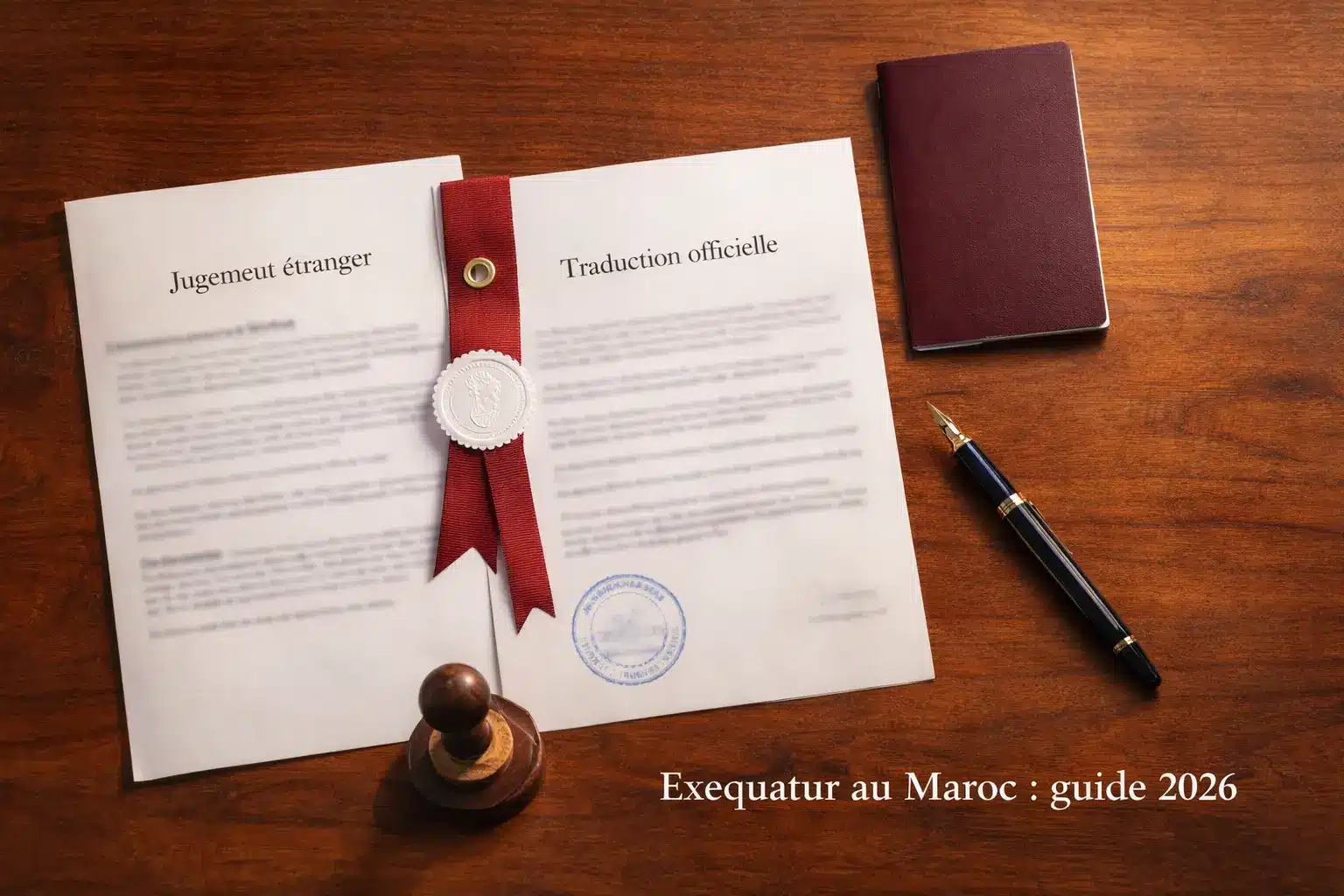
L’Article 431 of the Code of Civil Procedure requires the applicant to attach to their applicationexequatur Morocco the following parts:
The recognition procedure involves several detailed documentary requirements, as outlined in the following table, in accordance with legal sources:
Document | Type of certification | Legal observation |
Foreign judgment | Authentic shipment | Must be final and enforceable in the country of origin. |
Certificate of no appeal | Original from the foreign registry | This proves the absence of any ongoing legal challenges. |
Translation into Arabic | Sworn translator | Arabic is the official language of Moroccan courts. |
Legalization / Apostille | Consular or administrative | According to the conventions linking Morocco to the country of origin. |
The complexity of theexequatur in Morocco requires appropriate legal support from the outset. Early consultation allows you to:
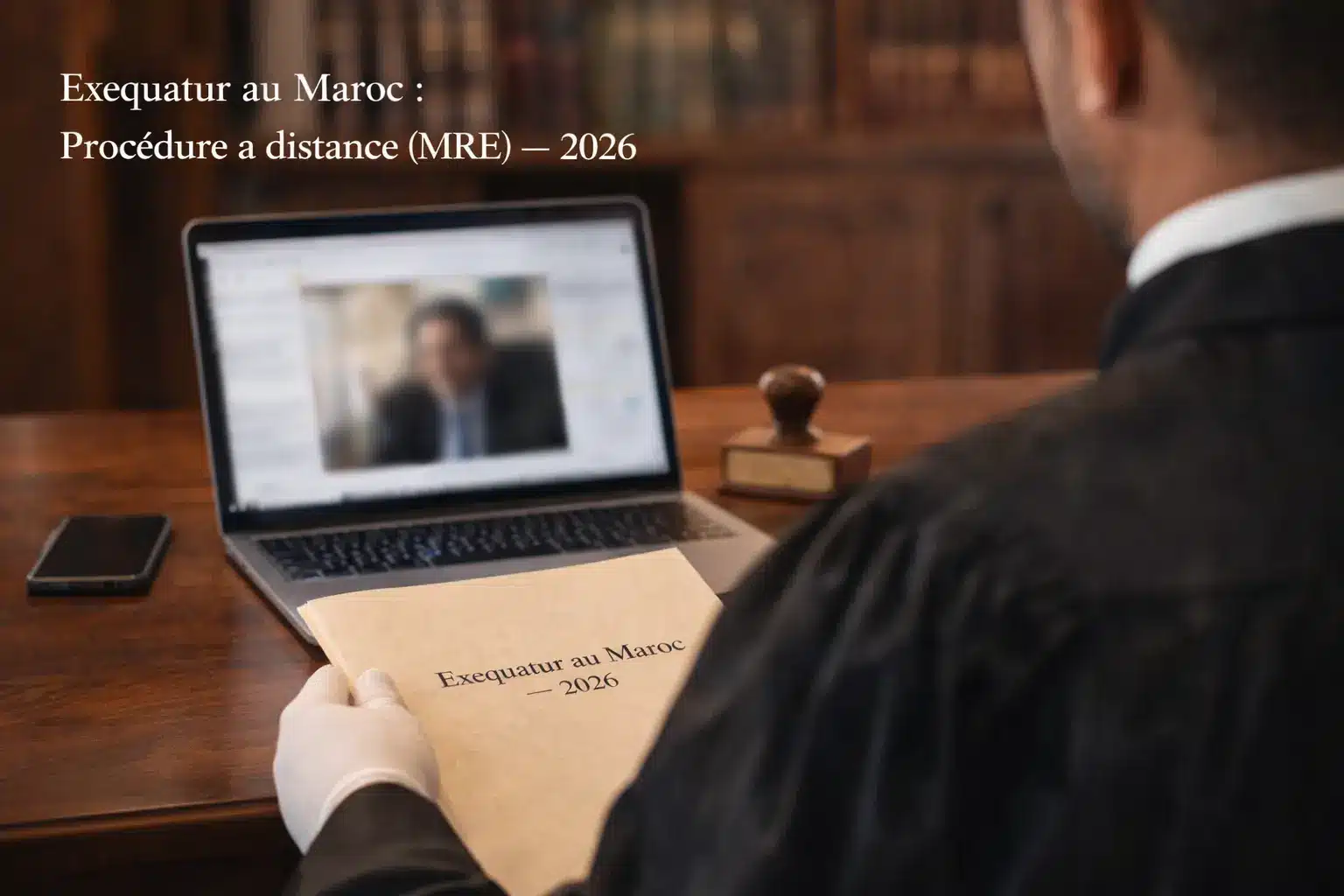
The Master's Office Amal Anouide à Safi accompagne les justiciables dans toutes les étapes de l’exequatur Morocco, with the possibility of remote consultation (WhatsApp, Video conferencing) for the Moroccans Residing Abroad (MRE).
For citizens living outside the Kingdom, theexequatur in Morocco It includes major procedural peculiarities. The Cabinet Anouide recommends Moroccans Residing Abroad to pay particular attention to the following points:
Analysis of judicial practice reveals several recurring errors made by litigants:
A: The time required varies depending on the complexity and the workload of the court. In general, the procedure can take from a few weeks to a few months. Legal basis: Common judicial practice
R: Yes, theArticle 128 of the Moudawana allows for the recognition of amicable divorces if they do not contravene Moroccan public policy. Legal basis: Article 128 of the Family Code
R : Absolument. Le justiciable peut mandater l’avocat par procuration pour le représenter sans avoir à se déplacer au Morocco. Legal basis: Code of Civil Procedure
A: No, the judge of the exequatur verifies the regularity but cannot revise the substance or modify the amounts allocated by the foreign judge. Legal basis: Article 430 of the Code of Civil Procedure
Law Firm – Safi Bar Association Consultations by appointment (in person or remotely) 📍 Address No. 9, Ait Ourir Street, Sidi Ouassel district, Safi, Morocco 📞 Phone : +212 648 933 990 📧 Email : avocateanouide@gmail.com 💬 WhatsApp +212 648 933 990 (remote consultations available) 🌍 Specialties : Family Law, Droit immobilier, Droit pénal, Assistance MRE Consultations in French and Arabic | Support for Moroccans Living Abroad
Legal warning This article provides general legal information on theexequatur in Morocco et ne constitue pas un conseil juridique personnalisé. Chaque situation présente des spécificités nécessitant une analyse approfondie par un avocat. Les informations présentées sont valables à la date de publication et susceptibles d’évolution législative ou jurisprudentielle. Pour une évaluation précise de votre dossier, consultez un professionnel du droit. Cabinet Anouide cannot be held responsible for decisions taken solely on the basis of this article without prior consultation.

Attorney Amal Anouide, a member of the Safi Bar Association for over 13 years, is a recognized specialist in Moroccan family law (Moudawana). The Anouide Law Firm assists national and international clients, particularly Moroccans residing abroad (MREs), offering rigorous expertise to ensure the enforcement of their rights in Morocco.