The exequatur of a marriage contract is the legal procedure that makes a marriage certificate celebrated abroad enforceable in Morocco. This is an essential condition for the contract to have legal effects regarding civil status, parentage, inheritance, residency, and family law disputes before Moroccan courts. In practice, until the exequatur of a mixed marriage contract is obtained, the marriage remains unenforceable against Moroccan administrations and courts, even if it is perfectly valid in the country where it was celebrated.
Why is the exequatur of a foreign marriage contract in Morocco essential?
The exequatur of a marriage contract grants legal force to a foreign document after review by a Moroccan court of its formal regularity, the jurisdiction of the issuing authority, and its conformity with Moroccan public policy, in accordance with the principles established by the Code of Civil Procedure and consistent case law. Without the exequatur of a mixed marriage contract, registration with the civil registry, recognition of parentage, and access to Moudawana rights (alimony, custody, divorce) may be denied. In Morocco.
Essential legal foundations for the enforcement of a foreign mixed marriage contract in Morocco
- Moudawana (Family Code): Article 14 allows for the conclusion of contracts abroad according to local forms, subject to the substantive conditions of Moroccan lawand validation in Morocco requires the appropriate procedure, which establishes the need for an exequatur of a mixed marriage contract to produce domestic effect.
- Code of Civil Procedure: the recognition/enforcement of foreign judgments and acts is governed by Articles 430 et seq.; doctrinal and judicial practice has deduced from this the criteria applied by the courts of first instance seized of the enforcement of a mixed marriage contract.
- Moroccan public order: the judge verifies the absence of any breach of public order (e.g., religious obstacles, unconditional polygamy, incapacity). cardinal condition for the exequatur of a mixed marriage contract.
What the judge controls
The control of public order materializes the compatibility of the foreign marriage contract with the essential principles of Moroccan law, including consent, capacity, absence of impediments, and religious conditions when relevant, before the granting of the exequatur of a contract of Mixed marriage. Formal regularity (authenticity, notifications, certified Arabic translation) and the competence of the foreign authority are also verified in support of the exequatur of a mixed marriage contract.
Typical bottom conditions
- Free and informed consent of the spouses in the act, a cardinal element for the enforcement of a mixed marriage contract.
- Capacité matrimoniale selon le Moroccan law, sous réserve d’autorisations si nécessaires, dans l’examen d’un exequatur d’un contrat de mariage mixte.
- Witnesses and religious framework for Muslim marriages, with increasing flexibility for Moroccans living abroad (MRE) mentioned in the reform debate, impacting the practice of exequatur of a mixed marriage contract.
Standard formal requirements
- Authentic copy of the document; proof of service where applicable; certificate of no recourse or equivalent, required in many jurisdictions for the enforcement of a mixed marriage contract.
- Full translation into Arabic by a sworn translator, a recurring condition for the enforcement of a mixed marriage contract.
- Apostille or chain of legalisation according to the Hague Convention 1961 to secure documentary authenticity for the purpose of the exequatur of a mixed marriage contract.
Table 1 — Document checklist (before submission)
Document | Format/Authority | Why is this required? |
Original marriage certificate | Apostille (or legalization if outside the Convention) | To attest the authenticity of a marriage contract before its exequatur. |
Sworn Arabic translation | Sworn translator in Morocco | Full legal understanding by the judge. |
Identity documents (National Identity Card/Passport) | Legible copies | Verify the identity and marital status of the spouses. |
Birth certificate (Moroccan spouse) | Recent full copy | Post-exequatur transcription of a marriage contract. |
Request for enforcement | Lawyer, numbered documents | Procedural basis of the application. |
Procedure for obtaining the exequatur of a foreign marriage contract in Morocco in 7 steps
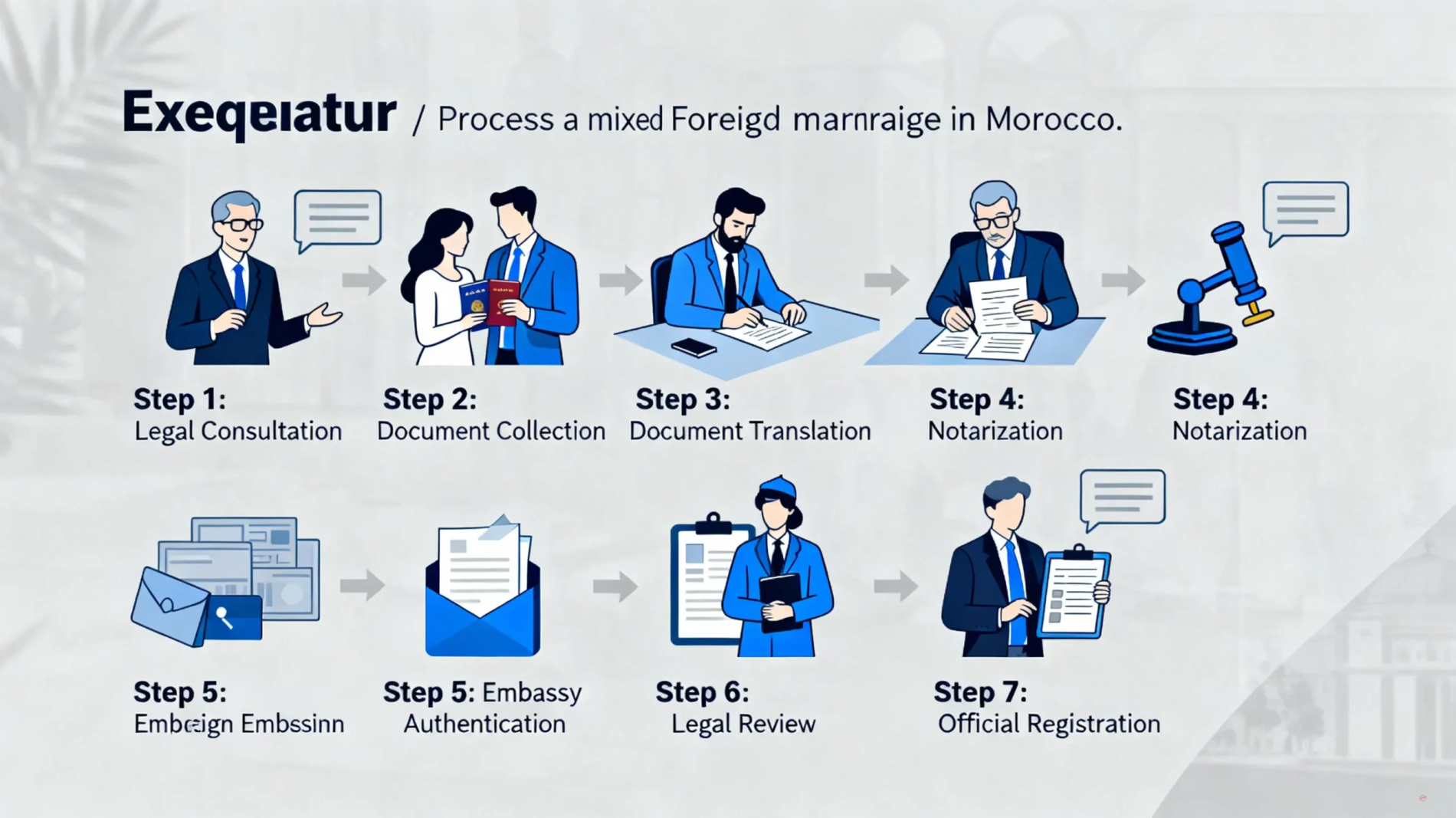
The procedure takes place before the competent court of first instance (the defendant's domicile or the place of enforcement), with notification to the public prosecutor, a hearing, and a judgment granting the contract an executory formula—the essential steps for the enforcement of a mixed marriage contract. After no appeal, registration with the Moroccan civil registry finalizes the enforceability of the marriage within the territory following the enforcement of a mixed marriage contract.
The 7 steps summarized
- Filing of the application and the file with the registry of the court of first instance, starting point of the exequatur of a mixed marriage contract.
- Communication to the public prosecutor's office for public order advice, a key step in the enforcement of a mixed marriage contract.
- Setting of the hearing date and review by the judge, often without personal presence if a lawyer is present, in the enforcement of a mixed marriage contract.
- Jugement d’exequatur et formule exécutoire rendant l’acte opposable au Maroc, cœur de l’exequatur d’un contrat de mariage mixte.
- Service and certificate of no appeal, making the decision final for the enforcement of a mixed marriage contract.
- Issuance of the enforceable copy and civil status procedures after the exequatur of a mixed marriage contract.
- Transcription in the margin of the Moroccan birth certificate to finalize the exequatur of a mixed marriage contract.
Table 2 — Typical route and indicative timeframes
Milestones | Estimated timeframe | Observations |
Filing and enrollment | 1–2 weeks | Variable depending on the registry, enforcement of a marriage contract. |
Opinion of the prosecutor's office | 1–3 weeks | Variable charge, public order point. |
Audience | 1–2 weeks after consultation | Legal representation possible. |
Judgement | Variable | Depends on the completeness of the file. |
Call delay | 10–30 days | Certificate of no appeal next. |
Transcription | A few days | After executable copy. |
Apostille or legalization: which route?
Morocco is a party to the 1961 Hague Convention, which replaces the traditional chain of legalizations for many public documents (including civil status records) with a single apostille, thus facilitating the exequatur of a mixed marriage contract. The apostille attests to the origin of the signature or seal, but does not comment on the content, which remains the responsibility of the judge when granting exequatur to a mixed marriage contract.
Table 3 — Postscript: Key points
Element | Content | Practical impact |
Documents concerned | Civil status documents, court decisions, notarial deeds | Direct use for the enforcement of a marriage contract. |
Competent authority in Morocco | Court of Appeal (Apostille Office) | Simplified national circuit. |
Scope | Authenticates signature/seal, not the content | The fund is subject to court control. |
Concrete examples of the enforcement of a foreign mixed marriage contract in Morocco
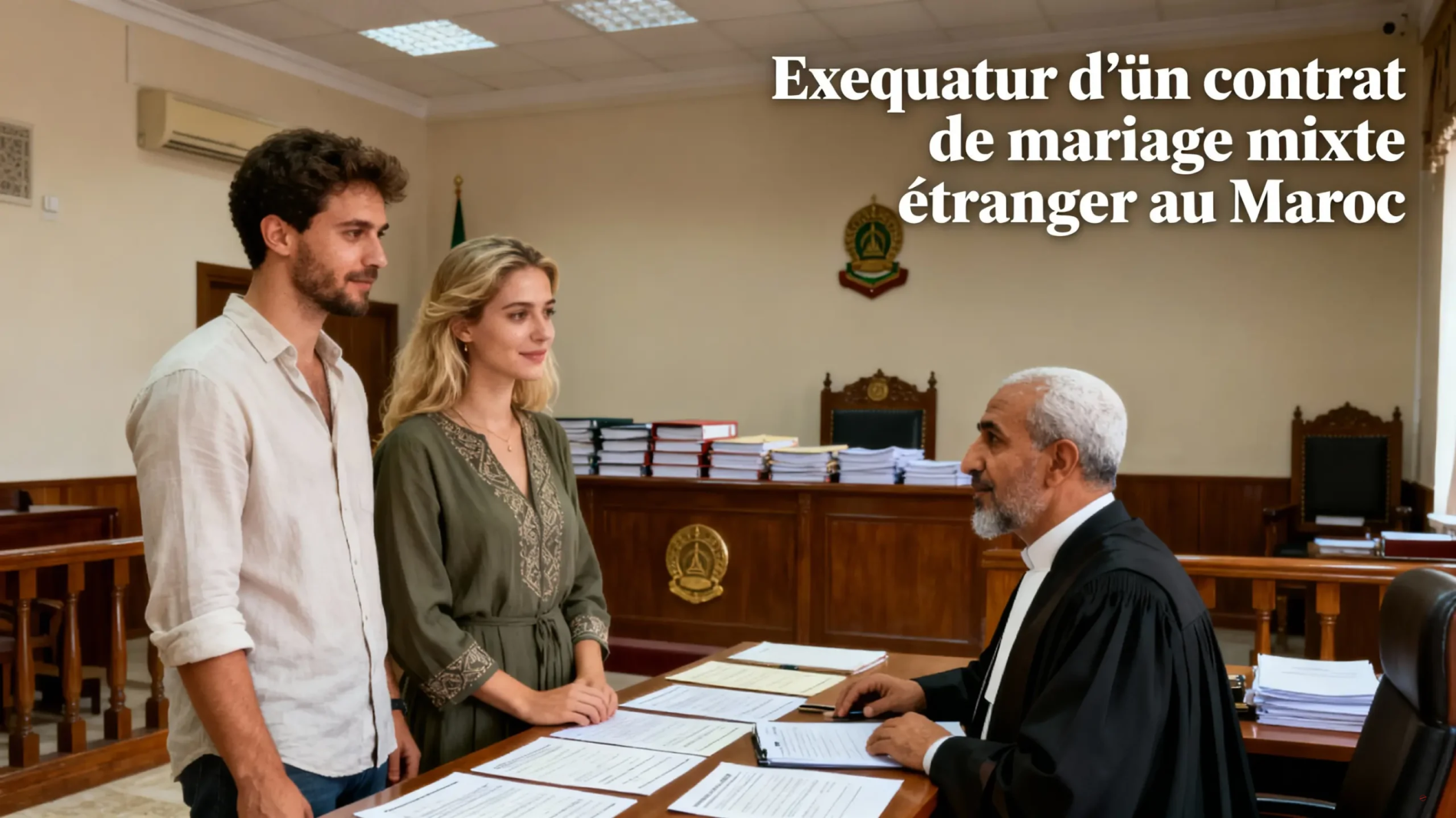
- Case 1: act celebrated in France with apostille, Arabic translation, and clear mention of consent; exequatur of a mixed marriage contract obtained and transcription in 3 months in a lightly trafficked jurisdiction.
- Case 2: omission of religious witnesses in a Muslim context; the judge verifies public order and may require additional documents, which lengthens the enforcement of a mixed marriage contract.
- Case 3: document without apostille from a non-party State; recourse to the consular legalisation chain before the exequatur of a mixed marriage contract.
Useful statistics and trends
Moroccan family courts are experiencing a steady increase in requests for recognition of foreign documents, driven by the mobility of Moroccans residing abroad (MREs) and mixed marriages. This is reflected in the growing demand for the exequatur of mixed marriage contracts, according to professional analyses and specialized publications. Average processing times vary significantly from one jurisdiction to another, and the completeness of the file (apostille, translation, certificates) remains the primary factor in expediting the exequatur of a mixed marriage contract.
Common points to be aware of
- Non-compliance with public order: cases of polygamy without legal conditions, lack of capacity, or religious obstacles may prevent the enforcement of a mixed marriage contract.
- Incomplete translation: the absence of a full translation into Arabic almost systematically delays the exequatur of a mixed marriage contract.
- Evidence of notification and non-recourse: documents often neglected but crucial in verifying the regularity of an exequatur of a mixed marriage contract.
Practical tips for successfully obtaining the exequatur of a foreign mixed marriage contract in Morocco
- Anticipate the apostille and translation as soon as the document is obtained, in order to facilitate the exequatur of a mixed marriage contract.
- Structuring a file with a list of documents, numbering and legal references, is a practice appreciated for the enforcement of a mixed marriage contract.
- To seek assistance from a specialist lawyer in Moudawana and recognition of foreign acts, to secure the exequatur strategy of a mixed marriage contract.
Conclusion
The exequatur of a mixed marriage contract is the cornerstone of the recognition of a foreign union in Morocco, conditioning civil status, parentage, and the inheritance rights and the protection offered by the MoudawanaSubject to regularity and public order review by the court of first instance. Rigorous document preparation, the use of an apostille, and guidance from a specialized lawyer help to expedite and secure the process. the enforcement of a marriage contract mixed, up to the transcription in the civil registry.
Signature and offer
Amal Anouide[Name], a lawyer specializing in Moroccan family law, assists mixed-nationality couples and Moroccans residing abroad (MREs) with the preparation, filing, and complete follow-up of the exequatur process for mixed-nationality marriage contracts, using a results-oriented and time-bound approach. For a quick review of your case and a personalized action plan, a consultation can be arranged within 48 hours to initiate the exequatur process for your mixed-nationality marriage contract in the appropriate jurisdiction.
FAQ
What is the Exequatur of a mixed marriage contract in Morocco?
- It is the decision of the Court of First Instance that makes enforceable in Morocco a marriage certificate or judgment celebrated abroad, so that it produces legal effects. comprehensive legal framework (civil status, parentage, family rights).
In what cases is an Exequatur required for a mixed marriage?
- If the marriage was celebrated outside of Morocco and you wish it to be recognized and enforceable against Moroccan administrations and jurisdictions (transcription, family procedures, social rights).
Which court has jurisdiction over the application for enforcement?
- In principle, the Court of First Instance of the defendant's domicile or residence in Morocco; failing that, that of the place where the act is to produce effect.
What substantive conditions are reviewed by the judge?
- Free consent, marital capacity, absence of legal impediments, respect for Moroccan public order (including applicable religious requirements), and consistency with the Moudawana.
What documents are generally required in the application?
- Original marriage certificate apostilled/legalised, full translation into Arabic by sworn translator, identity documents, Moroccan birth certificate, proof of notification/no appeal if applicable, Exequatur request.
Is an apostille always necessary?
- If the country of celebration is a party to the 1961 Hague Convention, an apostille is required to attest to authenticity; otherwise, the chain of legalisations must be used.
How long does an Exequatur procedure take?
- The timeframes vary depending on the jurisdiction and the completeness of the file, ranging from a few weeks to several months, with an additional period possible for appeals.
Can one request an exequatur without a lawyer?
- Legally possible, but not recommended in practice given the technical requirements (public order, documents, notifications) and the risk of rejection or delays.
What happens after the Exequatur judgment?
- After notification and certificate of no appeal, the decision becomes final and allows transcription in the margin of the Moroccan birth certificate and the enforceability of the act.
What are the main reasons for refusal or delay?
- Violation of public order (e.g., legal impediments), incomplete file (partial translation, absence of apostille/legalisation), lack of competence of the foreign authority, or notification irregularities.