Vivre à l’étranger ne suspend ni les obligations familiales ni les effets du droit marocain. Pour un Marocain résidant à l’étranger, un mariage célébré hors du Royaume, un divorce prononcé à l’étranger, une succession ouverte au Maroc ou un litige sur la garde d’un enfant restent soumis au Code de la famille, qui s’applique aux Marocains même lorsqu’ils possèdent une autre nationalité, ainsi qu’aux relations impliquant au moins une personne marocaine. Dans ce contexte, l’assistance d’un avocat famille MRE Maroc n’est pas un simple confort : c’est un véritable levier de sécurité juridique pour agir à distance, éviter les blocages administratifs et préserver ses droits patrimoniaux, parentaux et successoraux.
The Family Code was, in fact, disseminated with the specific needs of the Moroccan community residing abroad in mind. It expressly provides for appropriate mechanisms: registration of marriages contracted abroad with consular services, representation by proxy in certain circumstances, and enforcement in Morocco of foreign judgments after exequatur. In practice, the difficulty lies not only in understanding the rules, but also in correctly integrating them with Moroccan civil status, the consulate, family courts, notaries (adoul), the public prosecutor's office, and sometimes other heirs or the spouse. This is precisely where a family lawyer specializing in Moroccan expatriates becomes the operational solution: they manage the procedure, compile a compliant file, anticipate objections, and prevent a simple family situation abroad from escalating into a complex legal dispute in Morocco.
The transcription of a foreign divorce in Morocco
Why is the transcription-is it indispensable ?
Le Code de la famille encadre strictement les effets de la dissolution of marriage et organise la mise à jour des mentions d’état civil, notamment par transmission des extraits aux officiers d’état civil ou, lorsque l’un des conjoints n’est pas né au Maroc, au procureur du Roi près le tribunal de première instance de Rabat. Un divorce étranger qui n’est pas correctement relayé dans les registres marocains expose à de graves incohérences juridiques : état civil non actualisé, difficultés de remariage, contestations sur la qualité d’époux ou d’ex‑époux, et blocages dans les démarches patrimoniales ou successorales.
In other words, registering a foreign divorce in Morocco is not a minor formality. It aligns the family reality experienced abroad with Moroccan records, prevents future conflicts, and stops a former marital bond from continuing to produce administrative or social effects in Morocco.
The administrative procedure and the role of the consulate
The text stipulates that, for marriages contracted abroad under local law, a copy of the marriage certificate must be filed with the Moroccan consular services within three months, and then forwarded to the civil registrar and the competent family court. This approach highlights the consulate's central role as the point of entry for documentation related to the family life of Moroccans residing abroad (MREs), even though legal regularization in Morocco may subsequently become necessary depending on the nature of the foreign document or judgment.
In a foreign divorce case, a thorough approach involves preparing a comprehensive package: the foreign judgment, proof of its finality, identity documents, marriage certificate, birth certificates, a usable translation if necessary, and a strategy for regularization in Morocco. It is at this stage that the lawyer's role becomes crucial: they verify whether a simple administrative update is sufficient or if an exequatur procedure for the foreign judgment must first be initiated to make the decision enforceable and binding in the Kingdom.
Delays and pitfalls to avoid
The first pitfall is believing that a foreign divorce automatically produces all effects in Morocco. On the contrary, the Code specifies that divorce decrees issued by foreign courts are only enforceable after the exequatur procedures have been completed, in accordance with the rules of civil procedure. The second obstacle lies in submitting an incomplete or inconsistent file: names, dates, addresses, or document references that differ between the foreign documents and the Moroccan documents.
Another common risk concerns Moroccans residing abroad (MREs) born outside Morocco, for whom the transmission process does not always follow the logic of their place of birth but rather that of Rabat and the competent King's Prosecutor. Finally, the later the file is filed, the more difficult it becomes to reconstruct, especially if a remarriage, birth, death, or inheritance has occurred in the interim.
The role of exequatur in family court judgments
Legal definition
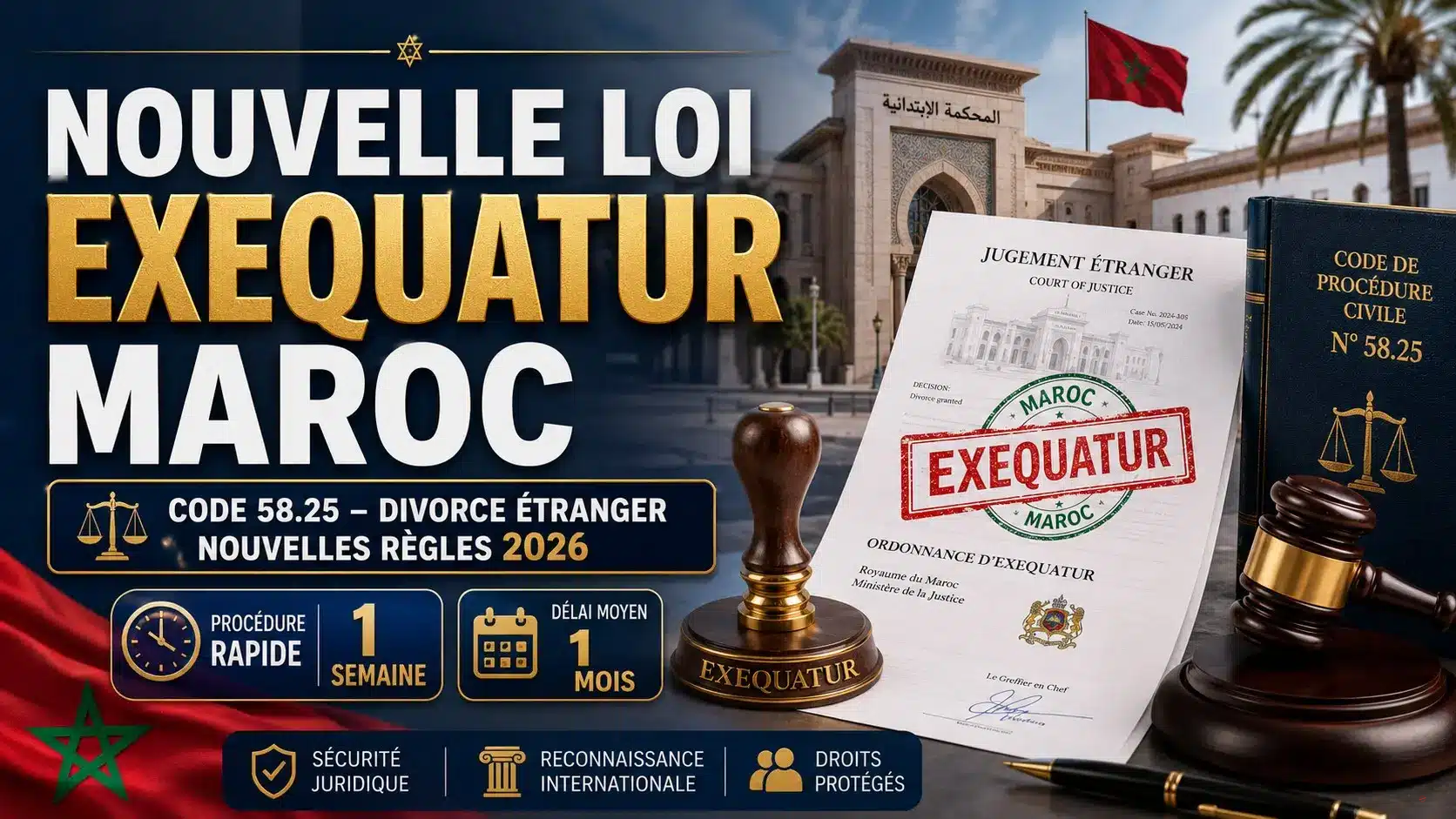
L’exequatur est la procédure qui permet de reconnaître au Maroc l’efficacité exécutoire d’un jugement rendu à l’étranger. Le Family Code énonce expressément que les jugements étrangers relatifs au divorce et les actes conclus à l’étranger devant des officiers ou fonctionnaires publics compétents ne sont exécutoires au Maroc qu’après accomplissement des procédures d’exequatur prévues par les articles 430, 431 et 432 du Code de procédure civile.
In simple terms, exequatur transforms a foreign judgment valid in its country of origin into a judgment that can be used before Moroccan authorities. Without this step, the judgment remains legally ineffective in Morocco, particularly for updating civil status records, enforcing judgments against property, or being enforceable against third parties.
Substantive and procedural conditions
The Code requires that the foreign judgment originate from a competent jurisdiction and be based on grounds compatible with those stipulated by the Family Code for the dissolution of marriage. This requirement implies a review of its compatibility with the Moroccan legal system: procedural compliance, guaranteed rights of the defense, conformity of the grounds for dissolution, and absence of conflict with fundamental principles of Moroccan law.
A well-prepared case therefore requires the submission of clear documents demonstrating the jurisdiction of the foreign court, the notification or appearance of the parties, the enforceability of the decision, and its consistency with the dissolution mechanisms permitted by the Moroccan Code. An experienced lawyer knows how to identify potential weaknesses in a foreign decision and construct the arguments that reassure the Moroccan judge of the validity of the judgment.
Proceedings before the court of first instance
Le dossier d’exequatur est porté devant la juridiction Moroccan compétente afin d’obtenir une décision rendant le jugement étranger exécutoire au Maroc. Le Code renvoie explicitement aux formalités du Code de procédure civile et confirme que cette étape est le passage obligé pour rendre effectifs les jugements étrangers de divorce et les actes familiaux.
L’exequatur ne doit donc jamais être traité comme une simple formalité de greffe : c’est un contentieux technique où la qualité de la requête, la cohérence des annexes et la maîtrise du Family Law marocain font souvent la différence entre une procédure fluide et des mois de retard.
Managing a family dispute in Morocco by proxy
Special power of attorney: validity and drafting
The Family Code authorizes, in matters of marriage, a power of attorney granted with the authorization of the family judge, provided that:
- the principal being prevented from appearing in person,
- the mandate, whether authentic or a private agreement with a legalized signature,
- the agent must be of legal age and capable.
- The power of attorney indicates the identity of the other party, the amount of the sadaq, and the desired conditions.
The text specifies that the power of attorney must be approved by the judge after verification of its compliance. Each family dispute has its own specific requirements; therefore, the special power of attorney is not a generic document. It must be legally calibrated, precise in its purpose, and drafted in such a way as to cover exactly the actions to be performed, otherwise it becomes a source of nullity or obstruction.
Documents most often required
- Copy of the principal's identity document,
- Full contact details of the agent,
- Detailed purpose of the mandate,
- Legalized signature
- References to the relevant documents (marriage, divorce, civil status or inheritance),
- Supporting documents to enable the agent and the lawyer to act effectively.
Is long-distance divorce possible for Moroccans living abroad (MRE) in Morocco?
Oui, le divorce à distance est juridiquement envisageable, mais il ne signifie jamais l’absence totale de procédure. Le Code rappelle que toute demande de divorce doit être présentée au tribunal, accompagnée de l’identité des conjoints, des informations sur les enfants et des justificatifs relatifs à la situation matérielle. Une tentative de conciliation est alors organisée par le juge.
Si la conciliation échoue, le tribunal fixe le montant à consigner pour les droits dus à l’épouse et aux enfants (reliquat du sadaq, pension de viduité, don de consolation, logement, Alimony). Le divorce à distance devient donc possible lorsque le dossier est préparé rigoureusement, que la représentation est correctement organisée et que les droits financiers et parentaux sont anticipés, et non improvisés.
Representation by a lawyer
The real challenge for a Moroccan living abroad (MRE) is not simply to be represented, but to be protected. The Family Code provides mechanisms for mediation, evidence gathering, deposit of funds, child custody and housing, and the transmission of information to the civil registry, all of which require constant procedural monitoring. Legal representation centralizes these steps, reduces travel, ensures the security of notifications, and defends the client's interests before the Moroccan family court.
For sensitive cases, the lawyer also acts as a strategic filter: he assesses whether to initiate a divorce under judicial supervision, a divorce for harm, absence or lack of maintenance, or a separate procedure relating to custody, alimony or the enforcement of a foreign judgment.
Inheritance in Morocco: Specifics for Moroccans Living Abroad
Establishing the deed of inheritance remotely
Book VI of the Family Code details the devolution, liquidation, and division of the estate. After the court examines the inventory, the estate is liquidated under its supervision; the liquidator carries out management tasks, represents the estate in court, and collects debts.
For a Moroccan living abroad, a serious inheritance case goes far beyond simply requesting a routine document (iraka). It requires considering the inventory, debts, receivables, representation of the estate, real estate, bank accounts, and any absent or disagreeing heirs. Legal assistance then becomes essential to transform a stalled inheritance process into a structured procedure that can be managed from abroad.
Real estate and bank accounts after death
The Code stipulates that the liquidator may engage experts to assess the assets and may only pay outstanding debts after authorization from the guardianship judge and approval from the heirs. Disputed debts are settled only after a final judgment. The division of assets is not contingent upon the recovery of all debts, but it may be suspended to the extent of the outstanding debt until the litigation is resolved.
These rules have a major practical consequence for Moroccans residing abroad (MREs): selling property, unfreezing an account, or distributing an inheritance without a comprehensive overview exposes them to serious disputes. A coordinated legal strategy makes it possible to distinguish between urgent matters, undisputed debts, contested claims, and necessary protective measures.
Disputes between heirs from abroad
Les successions MRE deviennent souvent conflictuelles lorsque certains héritiers occupent déjà le bien, détiennent les documents, gèrent les loyers ou prétendent avoir financé seuls des travaux. Le Code montre que la liquidation successorale se fait sous contrôle judiciaire et peut impliquer gestion, inventaire, expertise et Legal Representation. Un héritier résidant à l’étranger n’est donc pas condamné à subir : il peut agir à travers mandat et avocat pour faire constater ses droits, obtenir les comptes, contester une appropriation de fait et demander un partage équitable.
At this stage, the lawyer's role is not solely contentious; it is also preventative. Well-conducted legal mediation between heirs can prevent the family estate from becoming paralyzed and years of litigation from ensnaring it.
Conclusion
Pour les MRE, le vrai danger n’est pas seulement le conflit familial, mais la mauvaise articulation entre droit étranger, formalités marocaines, état civil, justice de la famille et preuve documentaire. Le Code de la famille offre des outils concrets : enregistrement des actes établis à l’étranger, procédure de divorce sous contrôle judiciaire, exequatur du jugement étranger, procuration spéciale, liquidation successorale sous contrôle du tribunal. Mais ces outils exigent une mise en œuvre rigoureuse.
C’est pourquoi l’accompagnement par un avocat famille MRE Maroc permet de sécuriser vos droits sans retour immédiat au pays, de réduire les risques de blocage et de traiter à distance des dossiers sensibles comme le divorce à distance, la transcription d’un divorce étranger ou une succession familiale complexe. Prenez rendez‑vous pour une Legal consultation en ligne ou demandez un devis afin d’engager rapidement votre procédure de régularisation, de divorce ou d’exequatur au Maroc
FAQ MRE
How can I get a divorce in Morocco without leaving my country of residence?
Divorce proceedings are initiated by the competent court, with a petition containing the spouses' identities, information about the children, and details of the financial situation, followed by an attempt at reconciliation. If reconciliation fails, the court determines the rights and entitlements due to the wife and children, which the husband must deposit before the divorce decree is finalized by the adoul (notary). A Moroccan living abroad (MRE) can manage their case remotely through a mandate and legal assistance, provided they properly prepare the documents, the procedural strategy, and address financial and parental issues.
What is the average cost of an exequatur procedure?
The text does not provide any specific fees or official rates. The actual cost depends on the complexity of the case, the number of documents to be processed, the translations required, the nature of the foreign judgment, and the potential level of opposition from the other party.
Is my foreign marriage certificate automatically recognized in Morocco?
The Code stipulates that Moroccans residing abroad may marry according to local formalities, provided they comply with substantive Moroccan requirements (consent, legal capacity, absence of impediments, and two Muslim witnesses). A copy of the marriage certificate must be filed with the consular services within three months of the ceremony and then forwarded to the competent Moroccan authorities. Therefore, practical recognition requires adherence to the registration process and compliance with the requirements of the Family Code.
How to hire a family lawyer for Moroccans residing abroad (MRE)?
The droit marocain de la famille accepte la représentation et la procuration spéciale lorsque les conditions légales sont réunies : précision, forme et authentification ou légalisation selon les cas. En pratique, le MRE doit préparer un mandat clair, l’accompagner de ses pièces d’identité et des documents du dossier, afin que l’avocat puisse agir efficacement devant la juridiction familiale, l’état civil, les adoul ou les administrations concernées. Plus le mandat est précis et le dossier complet, plus la gestion à distance devient rapide, sûre et efficace.