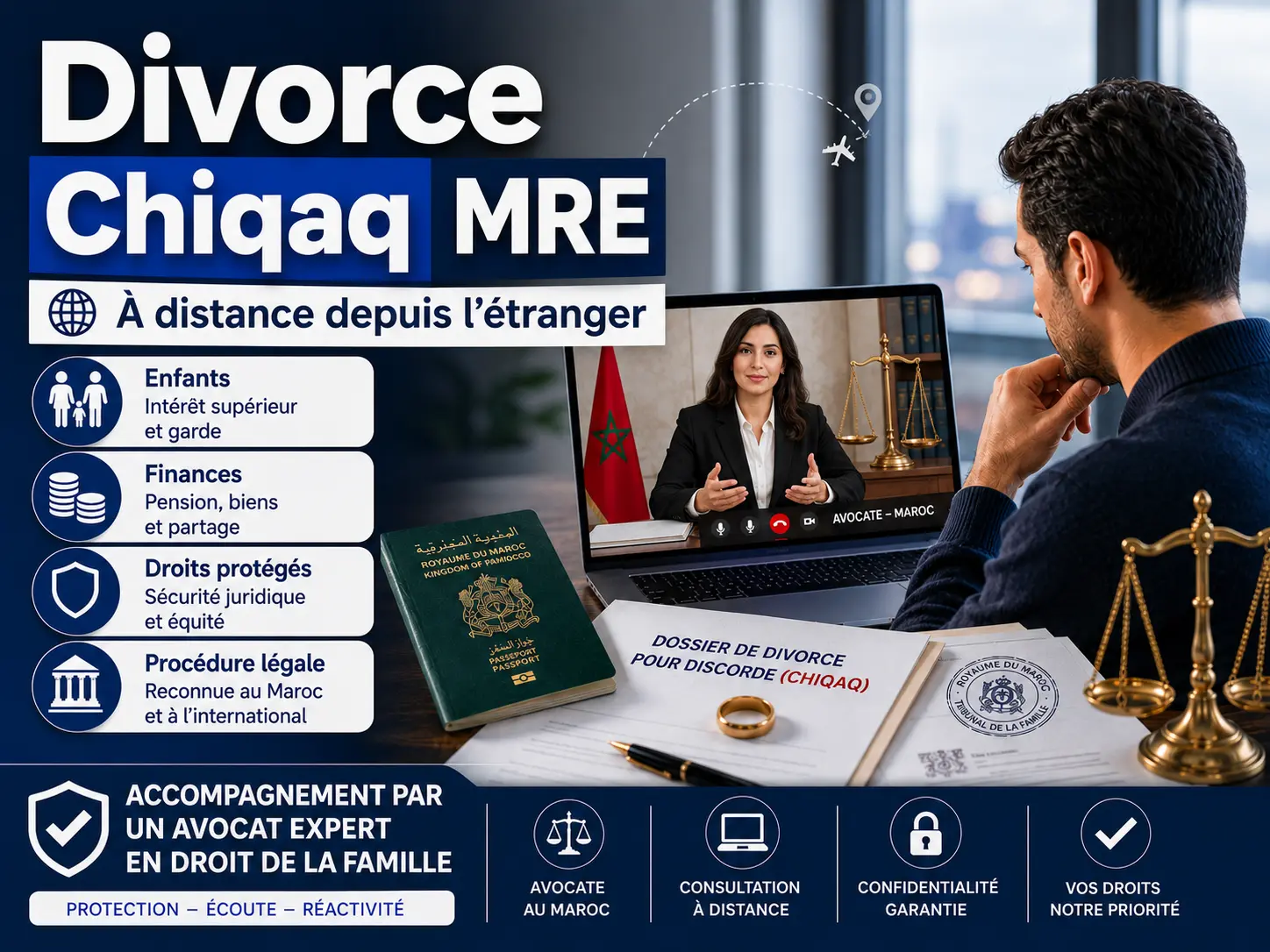
Ending a marital union is, in Morocco as everywhere else, one of the most destabilizing ordeals in life. Beyond emotional breakdowns, the process of dissolving a marriage involves a labyrinth of legal procedures which, without specialized support, can become a source of inequity and despair. This observation is even more relevant in view of the profound changes introduced by the Family Code (the Moudawana) in 2004.
This historic reform was perceived as a "genuine legislative and social revolution", aiming to consolidate the family unit on the foundations of "shared responsibility, equality, and justice" between the spouses. One of the major advances was to make divorce a "right exercised both by the husband and by the wife", but "under judicial supervision", thus limiting the abusive use of this right. Henceforth, recourse to the dissolution of marriage must only take place "only exceptionally and by taking into consideration the rule of the lesser evil", due to the fact that this dissolution "leads to the breakup of the family and harms the children".
It is precisely within the context of contentious separations/breakups that the Judicial Divorce (or Tatliq) due to harm/prejudice, failure to provide maintenance, or through the discord procedure (Chiqaq) that the expertise of a specialized lawyer becomes indispensable. The lawyer is not merely a legal technician; he is a guide who must operate "with rigor and humanity" to defend financial interests (such as obtaining the consolation gift, or Mout’â), and, above all, to guarantee the "preservation of the child's rights".
Key takeaways
- The Revolutionary Framework of Family Law Moroccan: Law No. 70-03
- The Strategic Role of the Lawyer in the Divorce Procedure Judicial (Tatliq)
- Legal Support from the Law Firm of Me Amal Anouide National Competence and Presence
- Post-Divorce Rights Defense: Alimony, Custody and Compensation for Damages (Mout’â)
- Legal Services Specific to Moroccans Residing Abroad (MRE)

Judicial Divorce (Tatliq): A Separation Supervised by a Judge
Moroccan family law, profoundly reformed in 2004 with the new Moudawana, sought to establish a better balance between the rights and duties of spouses, while placing the best interests of children above all other considerations. Within this framework, several forms of dissolution of marriage coexist, and it is essential to understand how judicial divorce differs.
- Divorce by Mutual Consent The spouses agree on the principle and consequences of the separation.
- Le Divorce par Khol' The wife obtains the divorce in exchange for financial compensation paid to her husband.
- Divorce under judicial supervision (Talaq) Historically initiated by the husband (repudiation), it is now strictly regulated by the judge to guarantee the rights of the wife.
- Judicial Divorce (Tatliq) The court grants the divorce at the request of one of the spouses, when the latter cites harm or a ground provided for by law. This is the quintessential contentious route.
The proceedings take place before the Court of First Instance, within the family law section. The judge plays a central role, not only in resolving the dispute, but also in attempting conciliation, a legal obligation aimed at preserving family ties whenever possible.
Grounds for Judicial Divorce: Establishing Your Claim Legally
Pour qu’une demande de divorce judiciaire soit recevable, elle doit impérativement se fonder sur l’un des cas expressément prévus par le Family Code. Le rôle de votre avocat commence ici : identifier le motif le plus pertinent et le plus solide au vu de votre situation.
Divorce due to Discord (Chiqaq) – The Most Common Reason
L’article 94 de la Moudawana stipule que tout époux peut demander le divorce en raison de la discorde (sureThis procedure is used when the conflict between spouses makes continuing to live together intolerable. It is the most common because it does not require the petitioning spouse to prove specific fault. Simply demonstrating the existence of a deep and insurmountable disagreement is sufficient.
The Chiqaq procedure takes place in several stages. key steps :
- Submitting the request: The lawyer files a detailed request with the court, setting out the facts without needing to go into humiliating details.
- Attempt at reconciliation: The judge summons the spouses for one or more conciliation hearings. This is a mandatory step.
- Appointment of referees: If direct conciliation fails, the court may appoint two arbitrators (often chosen from among the spouses' relatives) or a family council to attempt in-depth mediation and report to the judge.
- Judgement : If reconciliation fails, the court will grant the divorce. Its judgment will also determine the financial compensation due, taking into account each spouse's share of responsibility in the breakdown of the marriage. This is a crucial point where the quality of your lawyer's arguments can make all the difference.
Other Specific Grounds for Judicial Divorce
Although the sure While frequent, other reasons may be invoked, each with its own evidentiary requirements.
- The damage (trouble) : This ground for divorce can be invoked if a spouse suffers serious material or moral harm at the hands of their partner. This can include physical or psychological violence, abandonment of the marital home, defamatory acts, etc. The burden of proof rests with the plaintiff. Your lawyer will help you gather the necessary evidence: medical certificates, witness statements, complaints, etc.
- Lack of maintenance (allowance) : If the husband, who has a legal obligation to do so, ceases to provide for his family and is able to do so, the wife may file for divorce. The court will order him to pay within a certain period, and in the event of refusal or unjustified inability, the divorce will be granted.
- L’absence : If one spouse has been absent from the marital home for more than a year, the other spouse can file for divorce. The court will ascertain the duration and circumstances of the absence before making a ruling.
- Redhibitory defects and serious illnesses: If one spouse is afflicted with an illness that seriously jeopardizes the marriage and from which recovery is not expected within one year, the other spouse may file for divorce. This procedure requires a court-ordered medical examination.
The Strategic Role of the Lawyer Specializing in Judicial Divorce
Initiating legal divorce proceedings without legal representation is not only inadvisable but also extremely risky. A lawyer is the cornerstone upon which you can rely to navigate this difficult time with the best possible protection.
From Initial Consultation to the Development of a Tailor-Made Strategy
The initial consultation is crucial. A competent lawyer will not simply listen to you; they will ask specific questions to understand all facets of your personal, family, and financial situation.
Me. Amal Anouide, a lawyer specializing in family law at the Casablanca bar, emphasizes this initial phase: “A divorce is not just a romantic breakup; it’s the end of a legal contract with profound implications. My primary role is to demystify the process for my client, clearly explaining the possible scenarios, likely timelines, and associated costs. Together, we build a strong case that protects their interests and, above all, those of the children.”
The lawyer will help you to:
- Choosing the right grounds for divorcethe one that offers the best chances of success.
- Manage your expectations by giving you a realistic assessment of the possible outcomes.
- Prepare a negotiation strategy for the consequences of divorce, even in a contentious context.
Mastering the Procedure: From the Request to the Plea
The lawyer is your representative and spokesperson. He transforms your story and evidence into a structured legal argument.
- Rigorous preparation of the file: He lists precisely all the necessary documents (civil status documents, proof of income, documents relating to assets, proof of the reason invoked) and ensures their conformity.
- Drafting of the documents: He drafts the originating application and all submissions in response, using appropriate legal language and ensuring strict adherence to procedural deadlines.
- Representation and pleading: His presence is essential during hearings. He represents you, presents your arguments to the judge, cross-examines witnesses, and responds to opposing counsel. His legal expertise and courtroom experience are major assets.
Negotiating Crucial Issues: Children, Finances, and Assets
A divorce decree does more than dissolve the marriage; it also sets the stage for what comes next. It is in these areas that a lawyer's expertise is most valuable.
Child Custody (Hadana) and Visitation Rights
The best interests of the child are the guiding principle. The lawyer ensures that these interests are effectively defended. He argues for a custody arrangement (now) and visitation rights that are both fair to the parents and, above all, stable and secure for the children. He ensures that the judge's decision takes into account the children's ages, their environment, and each parent's ability to care for them.
Alimony (Nafaqa) and All Financial Rights
This is often the most contentious point. Your lawyer will fight for a fair assessment of everyone's rights and obligations.
- Child support: Calculating this amount is crucial. The lawyer will ensure it is based on a realistic assessment of the paying parent's income and the children's actual needs (schooling, healthcare, leisure activities, etc.). They may also request payment guarantees.
- Accommodation costs: The lawyer will ensure that the judgment orders the father to provide housing or pay housing compensation separate from child support.
- The rights of the wife: He will ensure that all of the wife's rights are claimed and correctly calculated:
- The remainder of the dowry (Charity), if it has not been paid in full.
- Pension during the waiting period (She)which lasts approximately three months.
- The gift of consolation (Mout’a), a compensatory allowance whose amount depends on the duration of the marriage, the financial situation of the spouse and the reasons for the divorce.
The Delicate Issue of Dividing Assets
In Morocco, the legal regime is that of separation of property. However, Article 49 of the Moudawana introduced a major innovation: spouses can sign a separate document to manage the assets acquired during their marriage.
In the absence of such an agreement, the situation is complex. This is where the lawyer can play a decisive role by demonstrating, through all means of proof, their client's contribution (including through their work at home) to the prosperity of the household, in order to obtain a fair share of the assets accumulated jointly.
How to Choose the Right Lawyer for a Judicial Divorce?
Choosing your advisor is the first strategic decision you will make. Take the time to find the right person.
- Check the specialization: Make sure that the lawyer has a proven and recognized practice in Moroccan family law.
- Evaluate the experience: A lawyer who regularly pleads before family divisions knows the customs, the expectations of judges, and the strategies that work.
- Demand transparency: The issue of fees should be addressed openly and honestly from the very first meeting. Request a detailed, written fee agreement.
- Test your communication and listening skills: You will be confiding very intimate aspects of your life. You need to feel confident, listened to, and understood. The lawyer must be able to explain complex legal concepts clearly.
- Find out about its reputation: Word-of-mouth, online reviews, or recommendations from other legal professionals can be good indicators.
Conclusion: Getting Support to Regain Control of Your Future
The Judicial divorce in Morocco is a path fraught with procedural obstacles and emotional challenges. Attempting to navigate it alone risks sacrificing one's rights, jeopardizing one's financial future, and enduring avoidable stress.
The intervention of a specialized and experienced lawyer, such as Me Amal AnouideThis lawyer transforms this ordeal into a managed and secure transition. Their legal expertise ensures your case is strong, your rights are vigorously defended, and the decisions made are as fair as possible. By relieving you of the burden of the legal process, they allow you to focus on what matters most: your personal recovery and the well-being of your children. Ultimately, a good lawyer doesn't just win you a case; they help you lay the sound and equitable foundations for your new life.
Frequently Asked Questions (FAQ) about Judicial Divorce in Morocco
How much does a court-ordered divorce procedure cost?
There is no single answer, as the total cost of a court-ordered divorce depends on several factors. It mainly consists of:
- Lawyer's fees: This is the most significant aspect. Fees can be fixed, hourly, or based on a success fee. A transparent discussion on this point is essential from the initial consultation.
- Legal fees: They include the stamp duty and registration fees for the application.
- Expertise fees: If the court orders an expert assessment (medical for a latent defect, financial to evaluate assets, etc.), the costs are borne by the parties.
An experienced lawyer will provide you with a clear estimate of the foreseeable costs after assessing the complexity of your case.
How long does a divorce procedure take?
The duration of a judicial divorce proceeding varies. It can range from a few months to more than a yeardepending on:
- The complexity of the case: A divorce involving significant financial stakes or an acute conflict over child custody will take longer.
- The court's congestion: The time between hearings can vary from one jurisdiction to another.
- Cooperation between the parties: Even in a contested divorce, a constructive attitude can speed things up, while systematic obstruction by one party can considerably lengthen the proceedings.
An effective lawyer will strive to move the case forward as quickly as possible while scrupulously respecting the procedural timetable.
Can I file for divorce even if my spouse doesn't agree?
Yes, absolutely. C’est précisément le principe du divorce judiciaire. Si votre conjoint refuse la séparation ou si vous ne parvenez pas à vous accorder sur les conditions, vous pouvez saisir unilatéralement le tribunal. Le motif le plus adapté dans ce cas est généralement le divorce due to discord (sure), which does not require proving fault but simply the impossibility of living together.
Who gets custody of the children (Hadana)?
Moroccan law places the best interests of the child above all else. Article 171 of the Moudawana establishes an order of priority for the allocation of custody (And now) :
- The mother
- The father
- The maternal grandmother
In the vast majority of cases, especially for young children, custody is awarded to the mother. However, the judge may decide otherwise if they deem it contrary to the child's best interests (for example, in cases of proven incapacity of the mother). The non-custodial parent retains parental authority and has visitation and overnight access rights.
What are my financial rights as a woman going through a divorce?
The Moudawana has significantly strengthened the financial rights of divorced women. Subject to the judge's decision, you may be entitled to:
- The remainder of your dowry (Charity) if it has not been paid in full.
- A pension during your period of widowhood (She), which corresponds to approximately three months after the divorce decree.
- A gift of consolation (Mout’a) This is compensation intended to offset the moral damage suffered. Its amount is determined by the judge based on the length of the marriage, the financial situation of the spouse, and the reasons for the breakdown.
As a man, what will my financial obligations be?
The financial obligations of the spouse after the divorce are primarily:
- Payment of the wife's rights mentioned above (Charity, pension d’She, Mout’a).
- Child support (Pension) This is a non-negotiable legal obligation. It must cover all the children's needs (food, clothing, schooling, health, etc.).
- Children's accommodation costs You must either provide them with decent housing or pay a monthly allowance to cover the rent. This amount is separate from child support.
What type of evidence do I need to provide for a divorce based on prejudice (darar)?
To prove harm, all forms of evidence are admissible. Your lawyer will help you build a strong case, which may include:
- Medical certificates in cases of physical violence.
- Certificates from psychologists or psychiatrists for psychological abuse.
- Testimonies from relatives, neighbors or anyone with knowledge of the facts.
- Copies of complaints filed with the police or the public prosecutor.
- Written evidence (letters, emails, messages) or bailiff's reports.
Can I represent myself in court to save money?
Although the law does not formally prohibit it in all cases, It is strongly advised against embarking on legal divorce proceedings without a lawyer. The risks are immense:
- Complexity of the procedure: You risk making mistakes (failure to meet deadlines, forgetting documents) that could cause you to lose your rights.
- Emotional charge: Facing one's spouse and the judicial system alone is an intense psychological ordeal.
- Financial and family issues: The consequences of a divorce decree are long-lasting. Incorrectly assessed alimony or unclaimed property rights can have an impact for years.
Investing in the fees of a competent lawyer is insurance to protect your future and that of your children.
What is the very first thing I should do if I am considering a legal divorce?
The first step, even before discussing it with your spouse, is to schedule a confidential consultation with a lawyer specializing in family law. Bring your essential documents (marriage certificate, identity documents, children's birth certificates). This consultation will give you a clear understanding of your situation, your rights, the options available to you, and the steps to follow, allowing you to make an informed and calm decision.