Key Points to Remember:

Managing cross-border family situations between France and Morocco requires rigorous control of the applicable law and mechanisms of recognition of actsFor dual nationals, the relationship between the Franco-Moroccan convention relating to personal status The law of August 10, 1981, and national public policy determine the validity of their marriage or the enforceability of their divorce. This article details the pillars of this judicial cooperation to provide essential clarity for those involved in legal proceedings.
Article 1 of the Franco-Moroccan Convention of August 10, 1981 establishes that the status and capacity of natural persons are governed by the law of the state of which they are nationals. This principle of law national law international private bilateral.
However, the application of foreign law is subject to a fundamental limitation defined in Article 4 of the said Convention. The court hearing the case may disregard a legal provision if it is "manifestly incompatible with the public policy" of its own State. This clause allows, for example, France to disregard certain provisions of the Moroccan Family Code or in Morocco to refuse the application of foreign rules contrary to its fundamental principles.

Article 5 of the Convention specifies that the substantive conditions of marriage, such as the age of marriage and consent, are governed for each future spouse by their national law. For Moroccan nationals, the provisions of the Law No. 70-03 (Moudawana) apply, while French is subject to French Civil Code.
The table below compares the applicable legal regimes based on the spouse's nationality to guarantee the validity of the union:
|
Legal criterion |
Spouse of French nationality |
Husband of Moroccan nationality |
Legal basis |
|
Age of capacity |
18 years of age or older |
18 years of age or older (unless an exception applies) |
Art. 19 Moudawana / C. Civ |
|
Physical presence |
Mandatoryeven abroad |
Optional (proxy possible) |
Art. 146-1 J. Civ / Art. 17 Moudawana |
|
Consent |
Free and enlightened |
Ijab et Quaboul mutual |
Art. 10 Moudawana / Art. 146 C. Civ |
|
Required document |
Certificate of Capability (CCAM) |
Adoul's marriage file |
Art. 6 Convention / Art. 65 Moudawana |
The Master's Office Amal Anouide highlights a recurring difficulty: the validity of a Franco-Moroccan marriage contracted abroad in the absence of the wife or of the French spouse. Article 146-1 of the French Civil Code requires the presence of the French spouse at the ceremony. Consequently, a marriage by proxy (wali) celebrated in Morocco for a French citizen is deemed contrary to French international public policy and cannot be transcribed into the civil registry in France.

Article 9 of the Franco-Moroccan convention relating to personal status defines the law applicable to the dissolution of the marital relationship. The hierarchy of criteria is as follows:
The competent court is generally that of the marital home (Article 11 of the Convention). The judge must ensure respect for the rights of the defense and the protection of the interests of the children during the procedure.
A divorce decree issued in one state does not automatically have effect in the other. recognition of French divorce Morocco requires a procedureexequatur in accordance with Article 430 of the Moroccan Code of Civil Procedure.
The recognition procedure follows the steps detailed in the following table:
|
Stage |
Action required of the litigant |
Legal basis |
Observation |
|
1. Collection |
Obtaining the original judgment and the certificate of no appeal |
Art. 430 CPC |
The irrevocable nature is imperative |
|
2. Translation |
Sworn translation of documents in Arabic |
Must be done by a certified translator |
|
|
3. Referral |
Filing the application for enforcement through a lawyer |
Art. 79 Mudawana |
competent court of first instance |
|
4. Control |
Verification of regularity and public order |
Art. 4 Convention |
The judge does not re-examine the merits of the dispute |
|
5. Transcription |
Registration of the divorce in the civil registry |
Art. 141 Mudawana |
A 15-day period after the judgment |

The effectiveness of family justice relies on adherence to strict deadlines to guarantee the legal security of the parties. Moroccan legislation has accelerated procedures, particularly in matters of Alimony (pension) and appeals.
The judicial time limits and indicative scales are structured as follows:
|
Type of procedure / Act |
Legal deadline |
Action required |
Legal basis |
|
Appeal (Family Matters) |
15 days |
Filing of the appeal request |
Art. 134 CPC |
|
Alimony |
1 month |
Time limit for rendering judgment |
Art. 190 Mudawana |
|
Wedding transcript |
3 months |
Submission to the consulate (for Moroccans residing abroad) |
Art. 15 Mudawana |
|
execution response |
10 days |
Formal notice to acquit |
Art. 440 CPC |
|
Waiting period (Iddah) |
3 cycles / 3 months |
Mandatory waiting period |
Art. 136 Mudawana |
The complexity of private international law and the interplay of conventions necessitate tailored legal support from the outset. Early consultation allows you to:
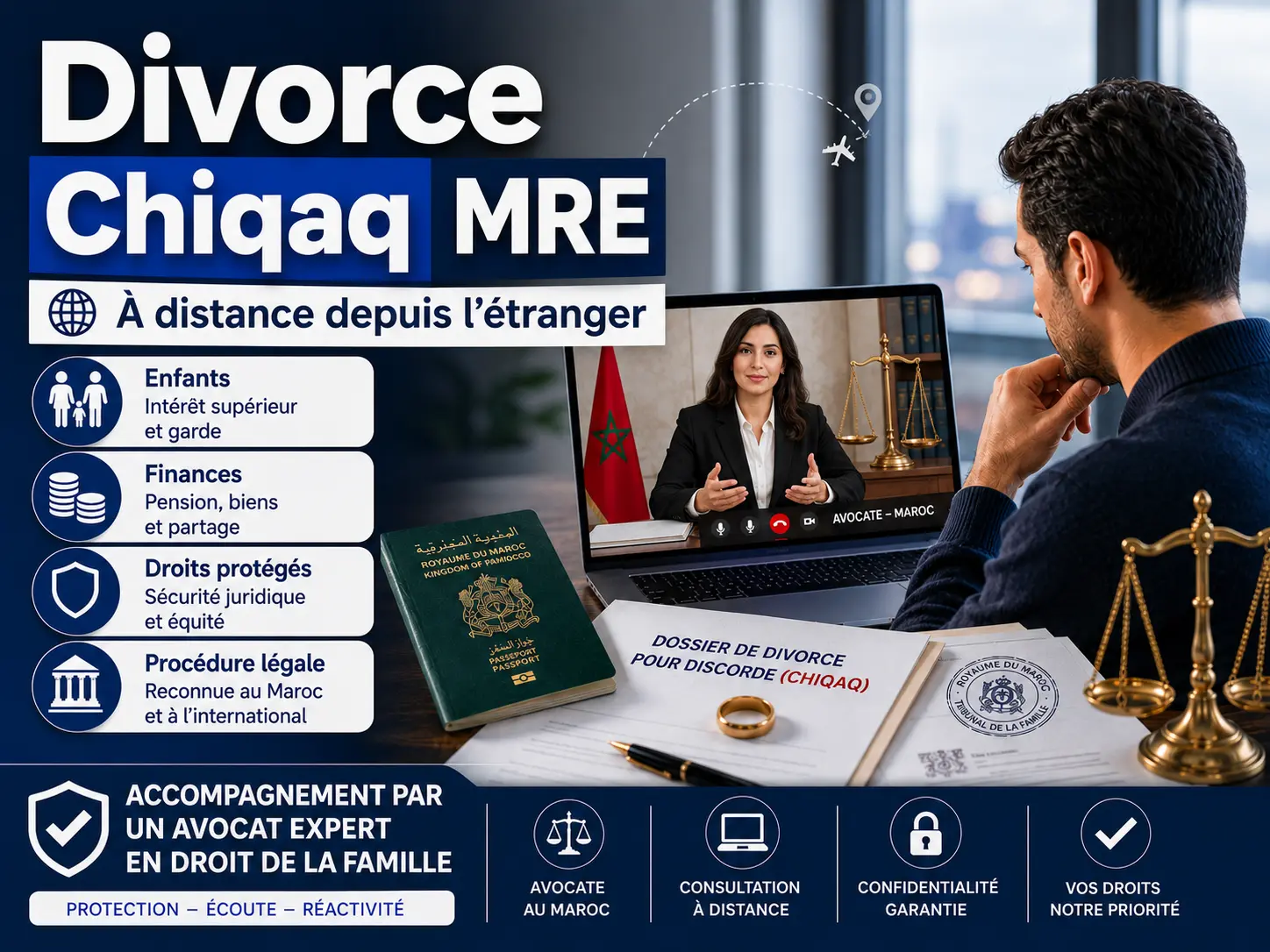
The Law Firm of Attorney Amal Anouide in Safi assists litigants in securing their family status, with the possibility of remote consultation (WhatsApp, Video conferencing) for remote customers and Moroccans Residing Abroad (MRE).
Phase 1: Preparation (before filing a claim with the court)
Phase 2: Legal proceedings (after filing the application)
Phase 3: Post-judgment (after the decision has been pronounced)

A: According to Article 9 of the Convention, divorce is governed by the law of the common nationality of the spouses. In the absence of a common nationality, the law of the common domicile applies. Legal basis: Article 9 of the Franco-Moroccan Convention of August 10, 1981
A: No, it must be subject to an exequatur before the Moroccan court. The judge verifies the jurisdiction of the French court and its conformity with Moroccan public policy. Legal basis: Article 430 of the Moroccan Code of Civil Procedure
A: The appeal period is 15 days from the date of notification of the judgment. This timeframe is an exception to the standard 30-day period, designed to expedite family law cases. Legal basis: Article 134 of the Code of Civil Procedure
A: Yes, the Anouide firm allows Moroccans living abroad to appoint a lawyer by proxy. However, for mandatory conciliation attempts (Article 81), the judge may require physical presence or authorize videoconferencing. Legal basis: Article 79 of the Moudawana
Glossary of legal terms
Legal warning This article provides general legal information on the Franco-Moroccan framework and does not constitute personalized legal advice. Each situation has specific characteristics requiring in-depth analysis by a lawyer. The information presented is valid as of the date of publication and is subject to legislative changes. For an accurate assessment of your case, consult a legal professional. Cabinet Anouide cannot be held responsible for decisions taken solely on the basis of this article without prior consultation.
Legal Sources

A member of the Safi Bar, Amal Anouide has over 13 years of experience within the Moroccan judicial system. A true guardian of the law, she has established herself as a leading figure in the application of the Moudawana (Family Code) and the defense of the interests of individuals and businesses. Her firm, renowned for its rigor and compassion, combines in-depth knowledge of legislation with a modern approach to client relations, particularly for Moroccans residing abroad and international investors.