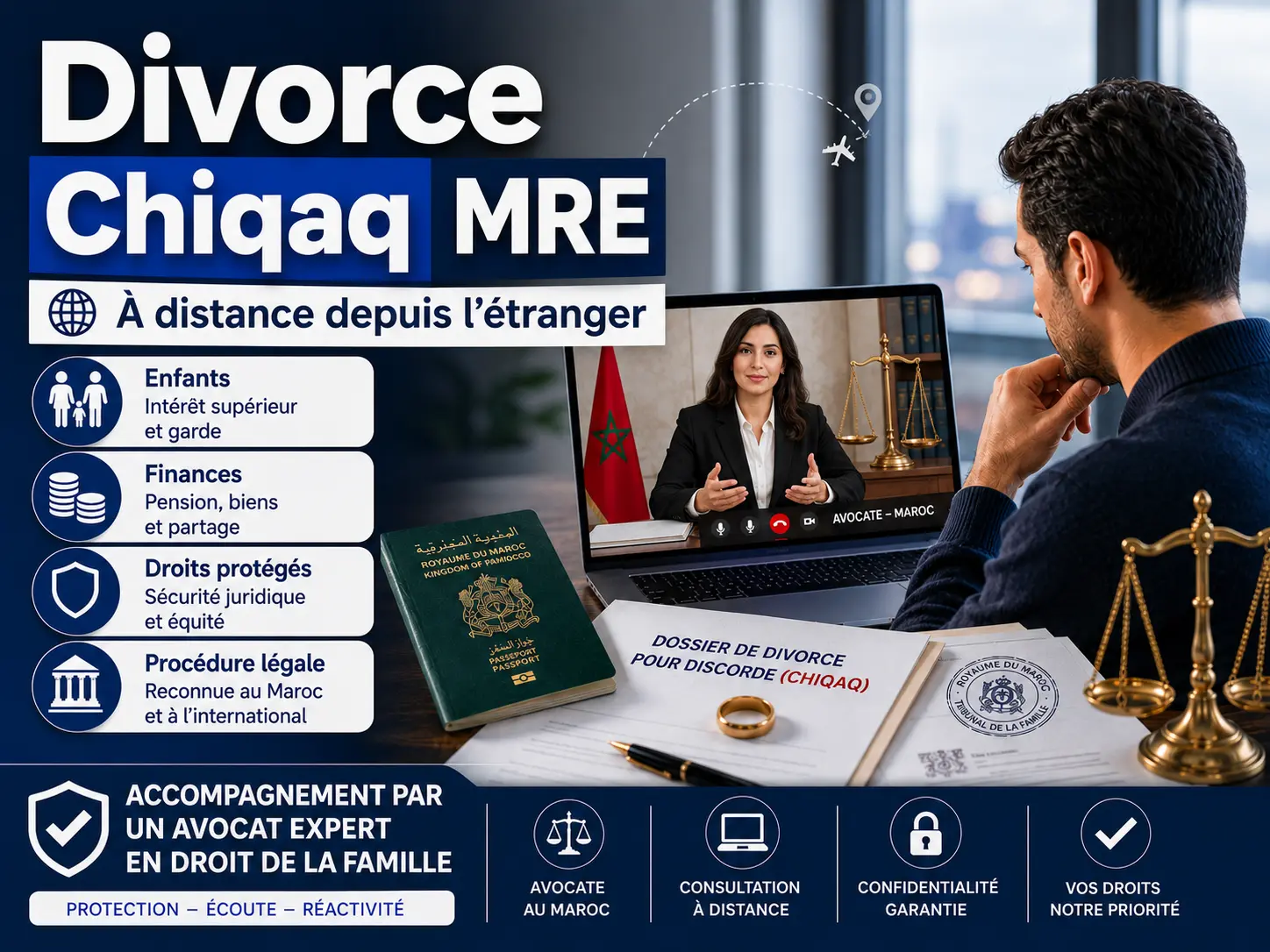


In Morocco, any dissolution of marriage is governed by the family judge according to the Moroccan Family Code (Moudawana), which involves mandatory conciliations, a judgment and transcription in the civil registry to produce its full effects.
Hiring a Moroccan divorce lawyer ensures the security of the procedural strategy, the preparation of the case file, financial and parental rights, the enforcement of judgments and, where applicable, the international recognition of the decisions.
Key takeaways
An initial exchange helps to identify the appropriate method of dissolution (Talaq, Tatliq/Chiqaq, mutual consent or Khul') and to anticipate its financial and parental effects.
The lawyer guarantees the regularity of the formalities (filing, summonses, conciliations, possible deposits), the solidity of the evidence and the articulation of the requests for a balanced and enforceable decision.
His intervention is crucial for quantifying idda, mout'a, nafaqa and accommodation of the child, organizing custody and visitation rights, and ensuring the transcription and execution of decisions rendered.
Talaq is not an isolated private act: it requires judicial authorization, establishment by two adouls and a judicially controlled decision, then a transcription governing the pecuniary and parental effects.
The court sets in advance the fees due (idda, mout'a, nafaqa, accommodation for the child) and may require a deposit before authorizing the act with the adouls, according to the procedures provided.
The Tatlik is a divorce pronounced by the court for legal reasons, including lack of maintenance, harm, absence or other foreseen causes, and encompasses the specific Chiqaq procedure when cohabitation becomes untenable.
In Chiqaq, the judge conducts attempts at conciliation and may resort to conciliators, then rules on the dissolution and its effects if the reconciliation fails, making a sovereign assessment of the discord.
Mutual consent is based on a comprehensive agreement between the spouses on the principle and effects of the divorce, subject to review for conformity by the judge and to the preservation of the children's interests before approval.
This route is often faster when the agreement covers custody, visitation rights, nafaqa, child accommodation and the settlement of property issues, subject to compatibility with family public policy.
Khul' is a dissolution initiated by the wife with financial compensation paid to the husband, distinct from mutual consent, and remains subject to the judge's approval.
The court verifies the conditions and sets the effects, paying particular attention to the interests of the children and the absence of any breach of family public order before validating the buyback agreement.
Each route involves specific evidentiary requirements and effects on pensions, custody and transcription; specialist advice helps avoid pitfalls.
The application is filed with the territorially competent family court, along with the marriage certificate, identity documents, and supporting documents relating to the income, expenses and needs of the children.
When the couple or the marriage certificate is linked to a foreign country, sworn translations and consular formalities may be required, particularly to authenticate the documents and specify the residence.
The judge personally summons the spouses to attempt reconciliation, and in the presence of children two spaced-out attempts may be imposed depending on the case, before opening the hearing on the merits.
In Chiqaq, conciliators may be appointed and a report may inform the court about the persistence of the discord and the advisability of pronouncing dissolution and its effects.
The court rules on the dissolution and sets the financial and parental rights, then the deed is drawn up where necessary by the adouls and transcribed in the civil registry for full enforceability.
The parties have remedies available under the applicable rules of procedure, and the judge may order enforcement measures to guarantee the rights of the child and the ex-wife.
The judge assesses the idda and the mout'a in particular according to the duration of the marriage, the financial situation of the spouse and the circumstances of the divorce, in application of the relevant articles of the Code (including art. 84).
The nafaqa covers the maintenance, clothing, schooling, care and accommodation of the child, according to needs and resources, with the possibility of adaptation if circumstances change.
The child's housing can be guaranteed through the allocation of the family home or a dedicated contribution, in order to ensure the stability necessary for their best interests.
The And now and visitation rights are organized according to the best interests of the child and are distinct from legal guardianship (Wilaya) over acts and property, which may fall under the father's authority or be reorganized by a reasoned decision.
At 15, the child can express their choice of guardian within the framework set by the Code, the judge remaining guardian of their interest and being able to adapt the custody and visitation arrangements.
Decisions relating to Hadana, visitation rights and nafaqa may be modified in the event of a significant change in circumstances affecting the interests of the child, upon reasoned request.
The default regime is separation of assets: each spouse retains ownership of their own property, except for a specific agreement for the management and liquidation of acquisitions of the marriage provided for in Article 49.
In the absence of an agreement, the judge relies on the rules of evidence to take into account contributions, including non-monetary contributions (household management, support for the family project), in order to fairly decide the claims.
A well-drafted agreement or a rigorous evidentiary file reduces the risk of costly litigation during liquidation, especially in the presence of real estate assets or family businesses.

Anticipating Article 49 through an agreement or, failing that, preparing proof of contributions preserves financial interests in the event of separation.
In situations of danger or acute tension, the judge may order measures designed to protect the wife and children and to guarantee family obligations, including appropriate protective measures.
When one of the parents obstructs the exercise of Hadana or visitation rights, the judge may establish strict terms and reinforced enforcement mechanisms to prevent risks to the child.
In the event of unilateral international travel, coordination with foreign authorities and exequatur procedures may become necessary for the return or enforcement of decisions.
The timeframes depend on the type of procedure (Talaq, Tatliq/Chiqaq, mutual consent, Khul'), the conciliation schedule and the volume of evidence to be examined, with possibilities for appeal according to the applicable rules.
The judgment must then be executed: payment of pensions, organization of custody and visits, possible penalty measures, and transcription for enforceability in the registers.
Enforcement proceedings may be initiated in the event of non-compliance, and further adjustments are possible if the family or financial situation changes significantly.
Fees vary depending on the complexity, duration, expertise and legal recourse, with practices on a flat rate or hourly basis depending on the firm, and a preliminary estimate is recommended from the opening of the case.
Court fees cover, in particular, filings, notifications, enforcements, and may be added to the fees set by the judge (idda, mout'a, nafaqa, child accommodation) according to legal criteria.
For modest cases, assistance or facilities may exist depending on the situation, and a targeted evidentiary strategy helps to control the costs of proceedings.
Marriages or divorces involving foreigners sometimes require consular filings, sworn translations and authentications to ensure validity and enforceability in Morocco.
The recognition of a foreign judgment in Morocco goes through the exequatur before the court of first instance, with control of jurisdiction, authenticity and conformity to Moroccan public order.
Conversely, to enforce a Moroccan judgment relating to children and pensions abroad, it is necessary to resort to the recognition procedures of the country concerned, often supported by applicable conventions.
Preference will be given to demonstrated experience in Tatliq/Chiqaq, mutual consent and Khul', mastery of financial and parental evidence, and regular practice of family law within the competent courts.
For mixed couples and Moroccans living abroad, opt for a firm experienced in the enforcement and cross-border execution of family decisions in order to avoid refusals of recognition or blockages of execution.
Specialized support helps to avoid procedural errors and to secure financial and parental rights from the outset of the case.
Talaq under judicial supervision, Tatliq (including Chiqaq), mutually agreed and Khul' with consideration, all under the control of the judge.
It is in principle due in the case of Talaq by the husband, and its amount depends on the duration of the marriage, the situation of the husband and the circumstances of the divorce, at the discretion of the judge.
The judge organizes the Hadana and visitation rights according to the best interests of the child, separately from the guardianship (Wilaya), with the possibility of adaptation if circumstances change.
The separation of assets applies by default (art. 49), with the possibility of an agreement for the management and liquidation of acquisitions; failing that, the contributions are assessed by the judge.
By an application for enforcement before the competent court, on authenticated documents and, if necessary, translated, with control of jurisdiction, authenticity and public order.
Marriage certificate, identity documents, proof of income and expenses, information relating to children, and where applicable sworn translations and consular documents.
The duration varies depending on the method (Talaq, Tatliq/Chiqaq, mutual consent, Khul'), the schedule of conciliations, the volume of evidence and possible expert opinions and appeals.
Enforcement procedures and possible penalties may be sought to enforce pensions, custody and visitation rights, under the supervision of the family court.