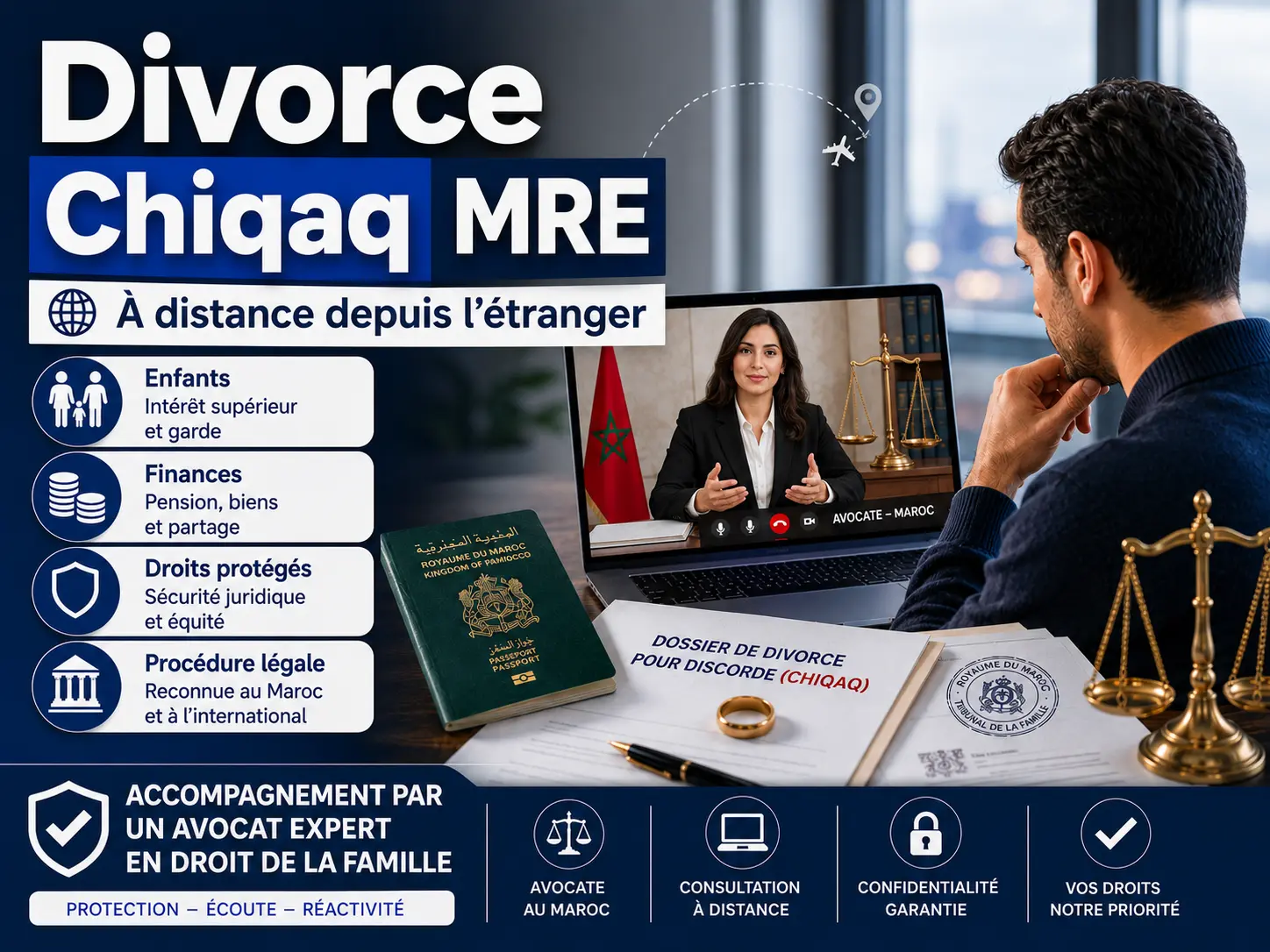


Divorce is a pivotal moment in life, often synonymous with emotional and administrative upheaval. In Morocco, the reform of Family Code (Moudawana) The 2004 law introduced major advances, notably facilitating the procedure for amicable divorce in MoroccoThis option, based on the mutual consent of the spouses, is today the preferred way for a quick, dignified and respectful separation, particularly suited to Moroccans Residing Abroad (MRE) and mixed couples.
Lawyer Amal Anouide, a lawyer at the Safi Bar with more than 13 years of experience and operating throughout the Kingdom (Casablanca, Marrakech, Rabat, etc.), guides you through the legal intricacies of this procedure to secure your future and that of your children.
Key points to remember:
An amicable divorce, or divorce by mutual consent, is governed by law.Article 114 of the Family Code. Contrairement au divorce due to discord (Chiqaq), which involves open conflict, amicable divorce is based on a prior agreement between the spouses.
According to Article 114:
"The two spouses may agree in principle to end their marital union, either unconditionally or with conditions, provided that these conditions are not incompatible with the provisions of this Code and do not prejudice the interests of the children."
This legal provision allows spouses to control the terms of their separation without letting the court arbitrarily decide their financial or parental fate.
To hire a amicable divorce in MoroccoThe cornerstone is the drafting of a divorce agreementThis document must be comprehensive and balanced.
The agreement must address all the consequences of the breakup. Here are the crucial points that Ms. Amal Anouide's firm is working to secure:
Attention : The judge may refuse to approve the agreement if he considers that it is detrimental to the interests of the children (for example, a derisory child support payment) or that it contravenes public policy.
The procedure is strictly regulated to guarantee the validity of consent.
The application is filed with the clerk's office of the family court section of the competent court (generally that of the marital home or the wife's residence, according to Article 79). It must be accompanied by the signed and legalized agreement.
This is a mandatory step stipulated by article 81. The court summons the spouses.
If conciliation fails and the judge validates the agreement (ensuring that the rights of the wife and children are protected), he issues a divorce authorization.
Armed with the court's authorization, the spouses must appear before two Adoul (notaires de droit musulman) habilités dans le ressort du tribunal pour dresser l’acte divorce.
The judge approves the notary's act. The divorce is then transcribed in the civil registry (in the margins of the birth certificates).
A complete application is essential to avoid rejection or delay. Here is a list of the documents generally required:
Table 1: List of documents to be provided for an amicable divorce
Document | Description | Observation |
Divorce petition | Written request signed by both spouses. | Written by the lawyer. |
Divorce agreement | Detailed agreement on the effects of the divorce. | Legalized signature required. |
Marriage certificate | The original of the notary's deed. | Or a recent certified copy. |
Identity documents | National identity card (for Moroccans) or Passport/Residence permit. | Certified copies. |
Birth certificates | For children born of marriage. | Dated less than 3 months ago. |
Certificate of non-pregnancy | For the wife. | Issued by a doctor (sometimes required). |
Proof of income | Payslips, tax notices. | To determine child support. |
Certificate of residence | Justifying the marital home. | Or an administrative certificate. |
Note: For Moroccans residing abroad (MREs), foreign documents sometimes need to be translated or apostilled according to international conventions.

One of the major advantages of an amicable divorce is its speed.
While a divorce due to discord (Chiqaq) can last up to 6 months (maximum period stipulated by Article 97), an amicable divorce is often finalized in a few weeks (between 2 and 4 weeks after filing, depending on the court's workload), provided that the file is perfect and that the spouses are present at the hearings.
Costs include:
The law firm of Amal Anouide has developed specific expertise for Moroccans living abroad and foreigners.
If you were married in Morocco or if one of the spouses is Moroccan, the Moroccan courts have jurisdiction (Article 2 of the Family Code).
A divorce granted in Morocco often needs to be recognized in your country of residence (France, Belgium, Canada, etc.) to take effect there. This is the procedure for...Exequatur.
L’article 128 du Code de la Famille précise que les jugements étrangers peuvent aussi être exécutés au Maroc sous certaines conditions.
Expert advice: A poorly drafted divorce agreement in Morocco can be blocked by European or North American judges if it violates international public policy (gender equality, children's rights). Attorney Anouide ensures the international compliance of your documents.
It's tempting to try to handle things yourself to save money, but the legal risks are high. A lawyer's role goes beyond simple representation: they provide advice and ensure fairness.
Table 2: Comparison of Divorce with and without a Lawyer
Criteria | With a Specialist Lawyer | Without a Lawyer |
Drafting the agreement | Precise legal clauses, anticipation of future disputes, protection of assets. | Risk of void or imprecise clauses or omission of crucial points (taxes, debts). |
Administrative management | The firm handles filings, registrations, and follow-up. You save time. | You have to manage the back-and-forth trips to the courthouse and the queues. |
Validation by the Judge | Very high acceptance rate from the first hearing. | Risk of referral or rejection if the interests of the children are poorly assessed. |
Serenity | You are supported and protected emotionally. | Increased stress in the face of the judicial system and the other spouse. |
Located in Safi and operating throughout the Kingdom, our firm offers:
The divorce amiable au Maroc est une procédure moderne qui permet de clore un chapitre de vie avec dignité. Cependant, sa simplicité apparente ne doit pas faire oublier la complexité de ses conséquences juridiques et financières. Une convention mal négociée peut avoir des répercussions sur des décennies.
Don't leave your future to chance. Enlist the help of a recognized expert to guide you through this transition.
Are you considering an amicable divorce or do you need legal advice on the Family Law Moroccan?
Contact the office of Amal Anouide today.
Ensure your peace of mind with a lawyer who defends your rights and those of your children.

Here are the answers to the most frequently asked questions at the office of Me Amal Anouide by our clients, especially those residing abroad.
Yes. In accordance with the conciliation procedure stipulated by the Family Code, the judge must personally ensure the free and informed consent of both spouses. However, their presence is generally required. only once During the approval hearing, Mr. Anouide prepares the entire file in advance to ensure your trip is optimized and brief.
Yes, a divorce by mutual consent granted in Morocco is recognized in most European countries (France, Belgium, Spain, etc.), provided that international public policy is respected. Once the judgment is obtained in Morocco, it will be necessary to proceed with its transcription or to a procedureexequatur in your country of residence so that it takes effect there. Our firm advises you on drafting the agreement to facilitate this international recognition.
Until the judge approves the agreement and pronounces the divorce, it is possible to modify it or withdraw from it. However, once the divorce is pronounced and the notarial act is drawn up, the judgment becomes irrevocable regarding the breakdown of the marital relationship. Clauses relating to custody or alimony may, however, be revised later by a new judgment in the event of a substantial change in circumstances (income, relocation, etc.).
In this case, it is no longer strictly a completely amicable divorce. If a disagreement persists on a specific point (such as alimony), the judge will have to decide, which can shift the proceedings towards a divorce based on discord (Chiqaq), longer and more expensive. Me Anouide's role is to negotiate upstream to find common ground and avoid this pitfall.
This is a common concern. According to Article 175 of the Family Code, the remarriage of the mother can This can lead to the loss of custody if the father requests it, except in certain specific cases (e.g., if the child is very young, has a disability, or if the new husband is a relative of the child). It's a complex issue that requires a case-by-case analysis by your lawyer.