
Marriage is a sacred institution in Morocco, governed by precise rules derived from the Family Code (Moudawana)When this union involves a foreign national and a Moroccan citizen, it is referred to as Mixed marriageThis type of union, a symbol of the meeting of two cultures, is governed by a rigorous legislative framework aimed at protecting the rights of the spouses and guaranteeing respect for Moroccan public order.
For Moroccans residing abroad (MREs) or foreigners wishing to marry in the Kingdom, the procedure can seem complex. Between certificates of capacity, police investigations, and questions relating to... Moroccan nationality, mixed marriageThe support of an experienced lawyer is often essential.
The firm of Master Amal Anouide, a lawyer at the Safi Bar and active throughout the Kingdom, guides you through the legal intricacies to realize your life project with complete serenity.
Key points to remember:
Mixed marriage in Morocco is not a mere administrative formality; it is a solemn legal act subject to the dual oversight of the Family Law and the law of foreigners.
Mixed marriages are primarily governed by Law No. 70-03, the Family Code. Article 4 defines marriage as a pact based on mutual consent. However, when one of the parties is not Moroccan, additional administrative procedures are required beyond the substantive conditions (consent, capacity, dowry).
Moroccan law, inspired by the precepts of Islam, sets strict conditions regarding the religion of the spouses (Article 39 of the Family Code):
The procedure of Mixed marriage est plus longue que celle d’un mariage entre deux Marocains en raison de l’enquête de police obligatoire et des documents spécifiques requis par les consulats étrangers.
Preparing the file is the first step. It must be done meticulously to avoid rejection by the Family Court.
Table 1: List of documents required for mixed marriage (Indicative)
Documents for the Moroccan spouse | Documents for the foreign spouse |
Full copy of the birth certificate | Full copy of the birth certificate |
Official certificate of engagement | Certificate of capacity to marry (issued by the Consulate/Embassy) |
Prenuptial medical certificate | Prenuptial medical certificate |
Copy of the National Identity Card (CIN) | Copy of passport (identity pages + date of entry into Morocco) |
ID photos | Criminal record (from country of origin and Morocco) |
— | Certificate of nationality |
— | Certificate of conversion to Islam (for the non-Muslim spouse) |
— | Proof of income/employment |
Once the file is complete, it is submitted to the clerk's office of the family court (Article 65 of the Family Code). The judge presiding over the marriage verifies that all the conditions are met.
In the context of a mixed marriage, the judge systematically orders a police investigation or the gendarmerie. This investigation aims to verify the sincerity of the intention to marry and to ensure that it is not a "marriage of convenience" intended solely for immigration purposes.
After authorization from the Judge, the two Adoul They formalize the marriage contract. It is at this point that the dowry (Sadaq) is mentioned, whether it is paid immediately or deferred (Article 26 et seq. of the Family Code).
One of the most frequently asked questions at the office of Me Amal Anouide concerns the acquisition of nationality. The link between Moroccan nationality, mixed marriage is often misunderstood, because the law makes a major distinction based on the sex of the foreign spouse.
According to theArticle 10 of the Moroccan Nationality Code (Dahir n° 1-58-250 as amended), a foreign woman who marries a Moroccan can acquire Moroccan nationality, but it is not automatic.
The conditions are as follows:
The acquisition takes effect on the date of filing the declaration, unless the Minister of Justice objects within one year.
Unlike the wife, the foreign man who marries a Moroccan woman does not benefit from a simplified procedure acquisition of nationality through marriage.
To become Moroccan, he must go through the procedure of ordinary naturalization (Article 11 of the Nationality Code), which notably requires:
Since the reform of the Nationality Code in 2007, there has been complete equality regarding parentage. Article 6 stipulates: "A child is Moroccan if they are born to a Moroccan father or a Moroccan mother."
Thus, whether the father or the mother is a foreigner, the child born of this union is Moroccan by origin by descent, whether he was born in Morocco or abroad.
Table 2: Impact of Mixed Marriage on Nationality and Residence
Situation | Acquired Rights | Duration Condition |
Foreign wife of a Moroccan man | Can acquire Moroccan nationality by declaration. | After 5 years of living together in Morocco. |
Foreign husband of a Moroccan woman | No acquisition through marriage. Must apply for naturalization. | Traditional naturalization (5 years of residence + strict conditions). |
Children (Moroccan Father or Mother) | Moroccan nationality by origin (automatic). | From birth. |
Residence Permit (Law 02-03) | Right to a registration card / residence permit. | Immediate (subject to administrative regularity). |
Although nationality is not always acquired, the right to residency is protected by Law No. 02-03 relating to the entry and residence of foreigners in Morocco.
Under Article 17 of Law 02-03, the registration card (residence permit) is issued, subject to the regularity of entry into the territory, to the foreign spouse of a Moroccan national.
This means that mixed marriage regularizes the administrative status of the foreign spouse and allows him/her to reside and work legally in Morocco.
For Moroccans residing abroad who marry under the laws of the host country, the marriage is valid in Morocco if it complies with the substantive conditions of the Family Code (notably no religious impediments) and if it is registered with the Moroccan Consulate within 3 months (Article 15 of the Family Code).
If the marriage has not been declared or if there are difficulties in recognition (Exequatur), the intervention of a lawyer is necessary to validate the union before the Moroccan courts in order to protect inheritance rights and filiation.
Mixed marriage procedures involve a complex interplay between family law, administrative law, and private international law. A simple error in the application or a failure to understand the deadlines can lead to the refusal of the marriage authorization or future complications regarding nationality.
Lawyer Amal AnouideWith over 13 years of experience, it offers cutting-edge expertise:
Located in Safi, the firm intervenes with speed and humanity to unite families across borders.
Mixed marriage in Morocco is a path towards integration and the building of a multicultural family. Although the Moroccan nationality, mixed marriage although subject to specific conditions, particularly for foreign spouses, the legislative framework offers solid rights regarding residence and parentage.
To ensure the success of your endeavors and secure your shared future, legal expertise is your greatest asset. Don't let administrative formalities overshadow this happy moment.
Are you planning a mixed-faith marriage? Contact Maître Amal Anouide's office today for a personalized consultation.
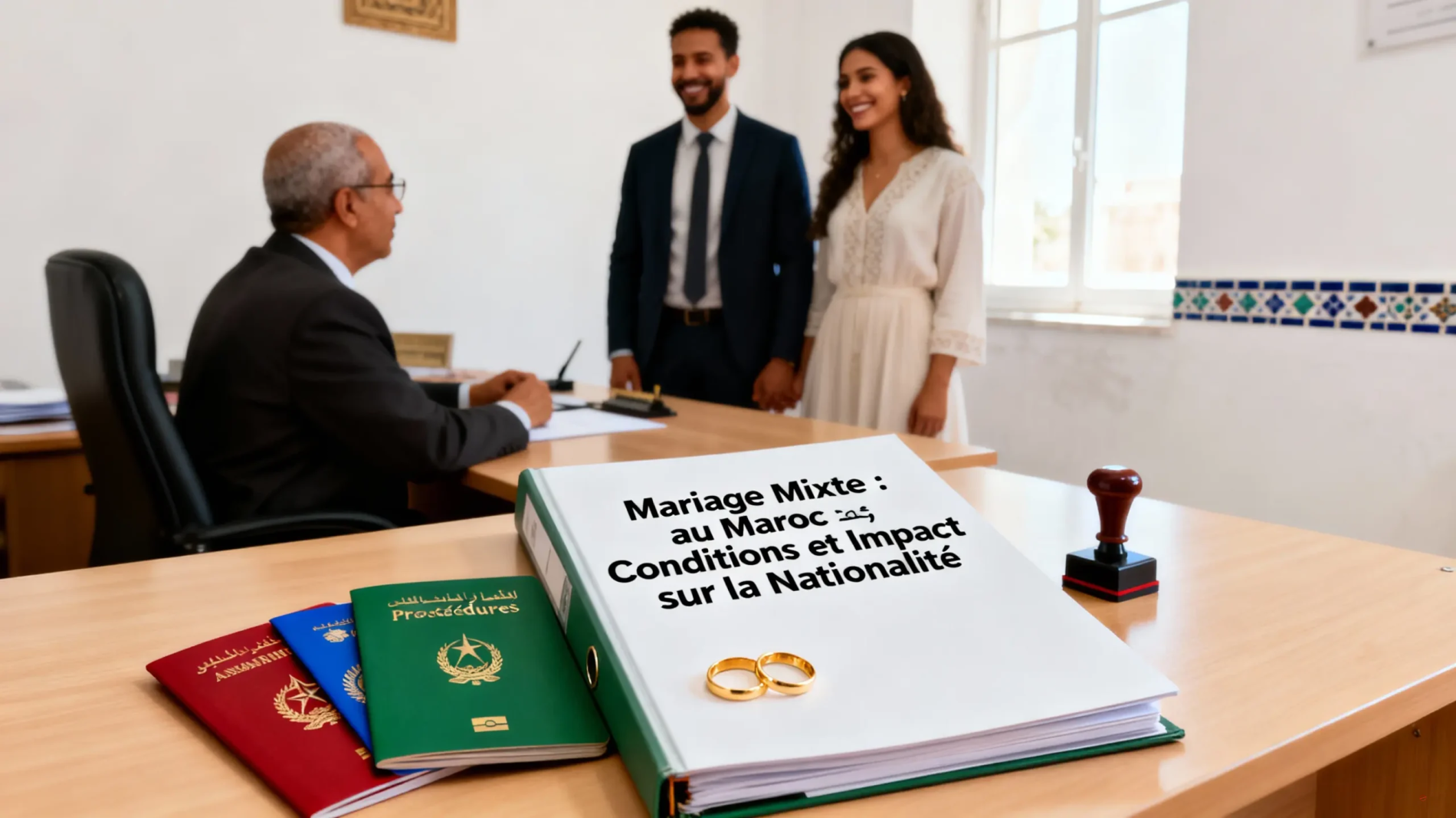
Mixed marriages raise many practical questions. Here are the answers to the most frequently asked questions at the law firm of Maître Amal Anouide.
Non. Marriage does not automatically confer Moroccan nationality.
Yes. According to Article 39 of the Family Code, the marriage of a Muslim woman to a non-Muslim man is forbidden. The prospective husband must therefore officially convert to Islam before an Adoul (notary) and obtain a certificate of conversion before submitting the marriage application.
On the contraryA Moroccan Muslim man can marry a non-Muslim woman (Christian or Jewish) without her needing to convert.
Unlike a marriage between two Moroccans, the procedure is longer due to the mandatory police or gendarmerie investigation. On average, it takes between 2 and 4 weeks between the submission of the complete file and the authorization of the Family Judge. This timeframe may vary depending on the court and the complexity of the case.
Absolutely. By default, the Moroccan legal regime is separation of property. However, Article 49 of the Family Code allows (and encourages) spouses to draw up a document attached to the marriage certificate to define the management of assets acquired during the marriage. This is a crucial step to protect each spouse's assets, especially in an international context.
To get married, the foreign spouse must have legal status upon entry into the country (valid entry stamp or visa). Once the marriage ceremony is complete, they can apply to regularize their administrative status and request a registration card (residence permit) as the spouse of a Moroccan national.
Article 17 of the Family Code authorizes marriage by proxy (mandate), but under very strict conditions (specific circumstances preventing presence, authentic mandate, etc.). In the context of a mixed marriage, where the police investigation often requires physical presence to verify the sincerity of the union, this procedure is complex and necessitates the prior approval of the Family Court Judge. Legal counsel is essential in this case.