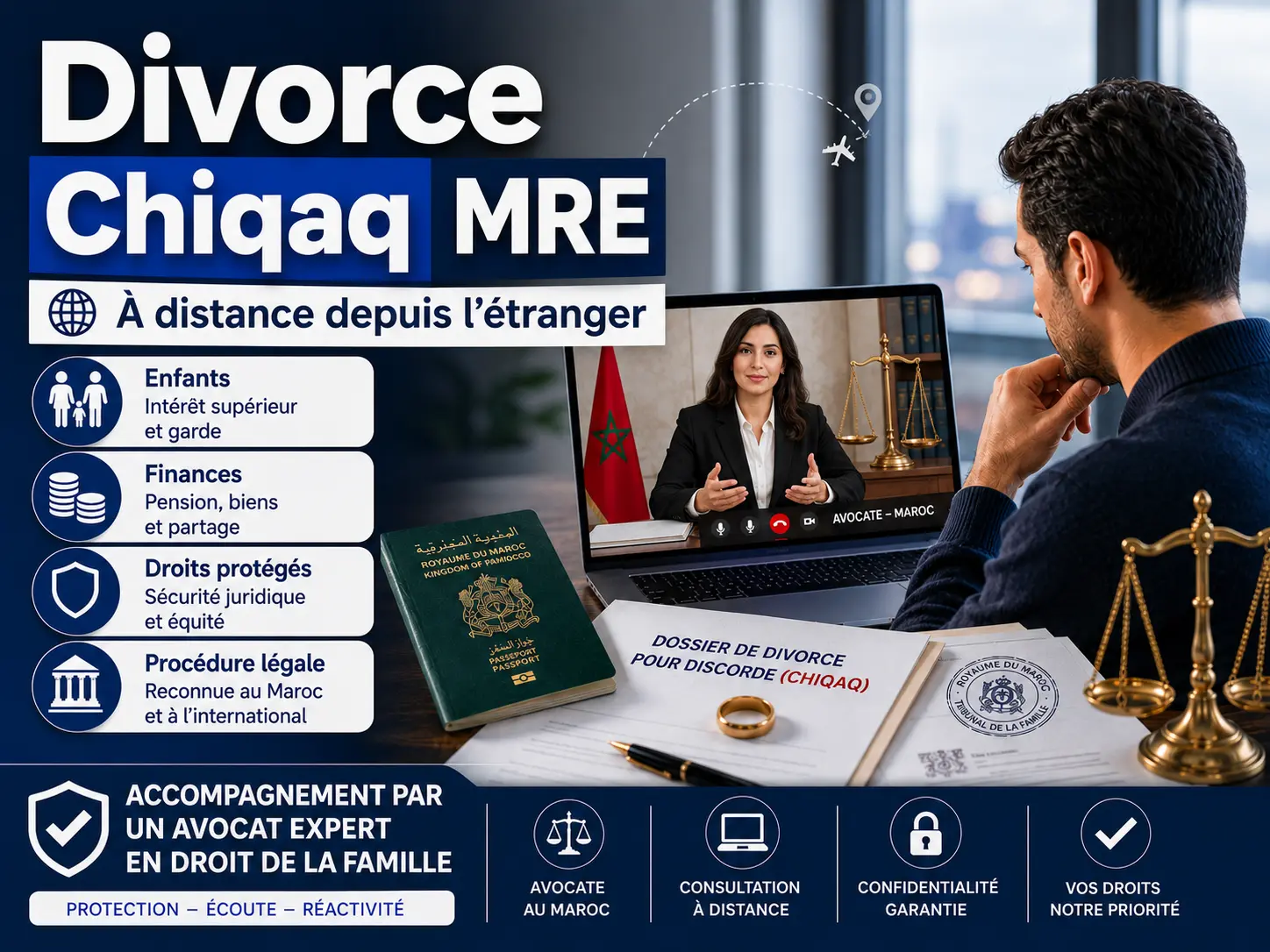
The divorce due to discord, or Tatlīq li-shiqaq, is a legal mechanism provided for by the Moroccan Moudawana (Family Code) which grants Both spouses have the right to request the dissolution of the marital bond.This type of divorce can be initiated even without explicit reasonas soon as it becomes It is impossible to continue the marital relationship.It represents a major innovation of the current Moudawana, not existing in the old Personal Status Code.
In this process, the judge plays a central rolenot only in the management of family disputes but also in the dissolution of the marital bond. It is crucial to emphasize that divorce, particularly when children are involved, is a serious matter, as parental separation is often difficult for children. Sources warn of the rapid increase in divorce rates in the courts, a trend "that does not bode well," and remind us that the Patience is the essential foundation of a marital relationship.The Tatlīq li-shiqaq is described as a "double-edged sword" that can be used for good or ill.
This article will detail the procedures for requesting this type of divorce, the crucial role of the judge throughout the process, and the various financial compensations (merit) to which spouses and children may be entitled, depending on the specific circumstances of each case.
I. Procedures for Initiating Divorce Proceedings Due to Discord
The divorce due to discordor Tatlīq li-shiqaq, is a right granted by Moroccan law to each spouseWhether it is the husband or the wife, to ask the court to grant a divorce from the other partner, and this, even without an explicit reasonThe person bringing this action is not required to justify the reasons for their request for dissolution of the marriage.
To initiate this procedure, it is necessary to submit a formal request:
- Application Submission (Introductory Article) :
- The application must be submitted to president of the court of first instance, section of the Family Law.
- The content of the request It must be precise and detailed. It must include the surnames and first names of both spouses, their date of birth, their national identity card number, and their addressesInformation about themarriage certificateInformation, including the court documentation section where it is registered, is also required. If children are present, the application must specify their their number, their age, their state of health and their school situationFinally, the application must clearly state theimpossibility of continuing the marital relationship et se conclure par une demande d’acceptation du président sur la forme et une demande de jugement de divorce due to discord.
- Documents to attach For the application to be complete, it must be accompanied by a certified copy of the marriage certificate, of a copy of national identity cardand children's birth certificates if the couple has any. If it is the husband who initiates the procedure, he must also provide evidence of his income (salary statement if he is employed) and his financial obligations (such as loans or financial support to his parents or sisters), as well as the identity documents of the children and their school certificates if they are concerned by the alimony.
- THE deposit fees of this file at the court registry amount to 160 dirhams.
- Registration of the request and summons :
- Once drafted, the application is registered with the court.
- Of the Summonses are then sent to both parties so that they can attend an initial conciliation session, the date of which is set in advance. This The first session is specifically dedicated to attempting reconciliation. between the spouses.
- Recommendation from a lawyer :
- Although the Code of the Family does not make the presence of a lawyer mandatory For this type of procedure, it is It is highly recommended to use his services.The main reason is the lawyer's in-depth knowledge of the rules and legal proceduresThis can prevent the parties from suffering harm or financial losses resulting from a lack of understanding of the procedure.
II. The Role of the Judge and the Conduct of Hearings
The divorce process for discord (Tatlīq li-shiqaq) gives the judge a leading role in managing family disputes and dissolving the marital bond. This role is manifested through several crucial stages:
- Attempts at reconciliation :
- The The first court session is systematically devoted to attempting conciliation. between the spouses.
- The court always favours reconciliation.
- If the couple has children, the procedure generally involves two conciliation sessions, with a delay ofat least 30 days between them, in order to maximize the chances of reconciliation.
- Determination of the responsible party (if applicable) :
- If conciliation efforts fail and the parties are firmly resolved to divorce, the court determines which party is responsible of the dissolution of the marital relationship. This includes examining who initiated the divorce proceedings, whether it was the husband or the wife.
- Factors influencing duration and judgment :
- The maximum time allowed to render a judgment dans le cadre d’un divorce pour discorde est de six months selon la Moudawana. Cependant, la durée réelle peut être plus courte, allant de deux à cinq mois.
- The The number of hearing sessions is not fixed.It can vary and the duration of the procedure can be prolonged by the absence of one of the parties At the hearings, the court always sought conciliation.
- The judge takes into account a multitude of criteria to assess and determine the financial compensation due in the event of a divorce. These criteria include the duration of marriage, THE income of both spouses, their social status (their social environment for growth), and the attendance and number of childrenDetermining which party was held responsible or which party requested the divorce is also a key factor influencing the allocation of financial rights.
III. Financial Compensation (Mustahaqat)
The Tatlīq li-shiqaq This involves the payment of various financial compensations, the amount and nature of which vary depending on which party initiated the divorce proceedings and the specific circumstances of the couple. The judge plays a crucial role in determining these amounts based on several criteria.
- Criteria for Determining Compensation The court assesses compensation taking into account:
- The duration of marriage.
- THE income of both spouses.
- Their social status (the social environment in which they grew up).
- The attendance and number of children.
- The determination of the party responsible for the breach of the marital relationship or of the one who requested the divorce.
- Compensation for the Wife (if the husband initiated the divorce proceedings due to discord) If the husband initiates the divorce proceedings For discord, the wife is entitled to the following compensation:
- The Mut'a (compensation for pleasure) This is financial compensation awarded to the wife for the harm suffered as a result of the divorce. The amount varies considerably (it can be 10,000, 20,000, 30,000 dirhams, or even more) and represents a significant portion of the expenses related to the divorce. The judge takes into account the length of the marriage, the income of both spouses, their social status, and the presence of children when determining this amount.
- THE remaining rights of the Sadaq (Dot) and the deferred Sadaq (مؤخر الصداق), if applicable.
- **Housing expenses during the Idda period (سكن العدة)**: The wife is entitled to compensation for her housing during the Idda period, which is generally three months. This amount covers the rent.
- L’indemnité de garde (Ajrat al-Hadana – اجة حضانة) If the couple has children, the wife, as the child's guardian, receives a monthly allowance for childcare. This amount is separate from child support payments.
- Compensation for the Wife (if the wife initiated the divorce proceedings due to discord) If it is the woman who files for divorce on the grounds of discord, she is not entitled to Mut'a, because she is considered to have chosen separation. She receives only:
- THE accommodation costs during the `Idda period.
- L’guard allowance (Ajrat al-Hadana), if children are present.
- THE remaining rights of the Sadaq and the deferred Sadaq, if applicable.
- Compensation for Children Children are entitled to several forms of compensation, regardless of which party initiated the divorce:
- The Alimentary Pension (Nafaqa – maintenance) It covers food, clothing, medical expenses, and school fees for the children. The court ensures that the children maintain, as far as possible, the same standard of living as before the divorce (for example, if they were enrolled in private education).
- THE Children's housing costs This is a separate obligation from child support. The father must either provide adequate housing for the children, or the court will set an amount for the rent of their residence.
- THE frais des fêtes (Tawsiyat al-Ayyad – توسعة الأعياد) An annual amount is granted for expenses related to religious holidays (such as Eid al-Adha and Eid al-Fitr).
- Specific Obligations and Rights of the Husband :
- Compensation Filing If the husband initiated the divorce, he must deposit all financial compensation (for the spouse and children) into the court fund (Court Treasury) at the registry within 30 days.
- Consequence of Non-Filing Failure to deposit these sums within the allotted time will result in the considering that the husband has withdrawn his request for divorceand the marital relationship is restored. The court will not issue a divorce decree until these amounts are deposited.
- Husband's Right to Compensation If the woman has filed for divorce on the grounds of discord without a valid reason that convinces the court of her harm, the The husband also has the right to claim compensation if he proves that he did not want the dissolution of the marriage and that he suffered financial losses (e.g., wedding expenses, gifts).
- Children's Visitation Rights The father has visitation rights for his children, the terms of which are generally set by the court (for example, Sundays from 9 a.m. to 6 p.m.). However, the children usually have to spend the night with the mother, who is the custodial parent.
- Adjustment of Alimony If the father's financial situation changes (for example, job loss), he has the right to ask the court for
IV. Post-Divorce Rights and Important Considerations
Once the divorce decision has been made or the process is well advanced, certain rights and obligations remain, and crucial aspects of the procedure deserve to be highlighted for the parties involved.
- Husband's Rights After Divorce :
- Children's Visitation Rights The father retains visitation rights with his children. The court usually sets the terms of these rights, for example, Sundays from 9 a.m. to 6 p.m. It is important to note that the children generally have to spend the night with their mother, who is the primary caregiver.
- Right to Adjustment of Alimony : If the father's financial situation changes significantly after the divorce (for example, in the event of job loss), he has the right to request the court to reduce the amount of child support (Nafaqa).
- Possibility of Claiming Compensation If the wife initiated the divorce proceedings on the grounds of irreconcilable differences, and the court determines that she lacked valid grounds proving she suffered harm, the husband also has the right to claim compensation. This compensation can cover financial losses he incurred, such as wedding expenses or gifts, if he can prove he did not desire the dissolution of the marriage and that he suffered losses.
- Crucial Consequences of the Process :
- Obligation to File Compensation If the husband initiated the divorce proceedings due to discord, he is required to deposit all financial compensation (for the wife and children) from the court fund (Court Treasury) within 30 days.
- Consequence of Non-Filing Failure to deposit these sums within the allotted time has a major consequence: the husband is considered to have withdrawn his divorce petition, and the marital relationship is then reinstated. The court will not issue a divorce decree until these amounts have been deposited.
- General Advice and Reflections :
- The “Double-Edged” Nature of Tatlīq li-shiqaq This procedure is described as a "double-edged sword" (if you are sickIt can be used positively to resolve untenable marital situations, but also negatively.
- The Importance of Hiring a Lawyer He is strongly Citizens are advised to seek assistance from a lawyer. in these proceedings. The lawyer possesses in-depth knowledge of the rules and procedures that can ensure each party benefits from their rights and avoids harm or losses due to a lack of knowledge of the laws.
- The Fundamental Role of Patience in Marriage Several sources emphasize that the foundation of marriage is patience (as-sabR). Couples are advised to show patience and mutual consideration, especially for the well-being of children.
- The Rise in Divorce Rates It is mentioned with concern that the frequency of divorces in court has reached a "lightning speed" (watirat sarukhiya) and that divorce statistics are not "a good omen" (laa tabushiru bi-al-khayr).
In conclusion, it's good that he... Tatlīq li-shiqaq offers a path to marital dissolution in case of discord; it is a process governed by strict rules that aim to protect the rights of all parties, especially those of children, and it is advisable to fully understand all the implications.
In conclusion, the Tatlīq li-shiqaq (divorce due to discord) est une voie légale essentielle offerte par le Family Code marocain permettant la dissolution du lien conjugal lorsque la poursuite de la relation est devenue impossible en raison de profonds désaccords. Ce droit est accessible à chacun des époux, même sans avoir à justifier de motifs spécifiques de discorde lors du dépôt initial de la demande.
The procedure is governed by a rigorous judicial process that begins with the submission of a detailed request to the court of the familyThe role of the judge is central, particularly through mandatory attempts at conciliationThese sessions are considered a fundamental step before any divorce decision, with particular attention paid to the well-being of the children. The maximum duration of the proceedings is six months, although the number of sessions is not fixed and may vary depending on the parties' attendance and the complexity of the case.
THE financial compensation (Mustahaqat) These payments constitute a cornerstone of this procedure, aimed at protecting the rights of the wife and children. Their amount is determined by the judge based on criteria such as the length of the marriage, the spouses' income, their social status, and the presence of children. It is crucial to note that The husband who initiates the divorce proceedings on the grounds of discord must deposit all financial compensation into the court fund within 30 days. Failure to fulfill this obligation is considered a withdrawal on her part, resulting in the reinstatement of the marital relationship. If the wife files the claim without a valid reason convincing the court of her harm, she is not entitled to Mut'a (mutual aid), but the husband may, under certain conditions, claim compensation for losses incurred. For children, clear rights are established regarding child support (Nafaqa), housing expenses, and holiday expenses.
In short, the Tatlīq li-shiqaq is described as a "double-edged sword" (sileh hadayn)offering a necessary solution, but one with profound implications. Given the complexity of these procedures and to guarantee the protection of their rights, Citizens are strongly advised to seek legal counsel..